
AI news ·
Zuckerberg moves desk into Meta AI lab and codes alongside new superintelligence team
Mark Zuckerberg has moved his desk into Meta's AI lab and is coding daily alongside new hires Alexandr Wang and Nat Friedman. The shift accompanies a reported $15B investment in Meta's Superintelligence Labs division.
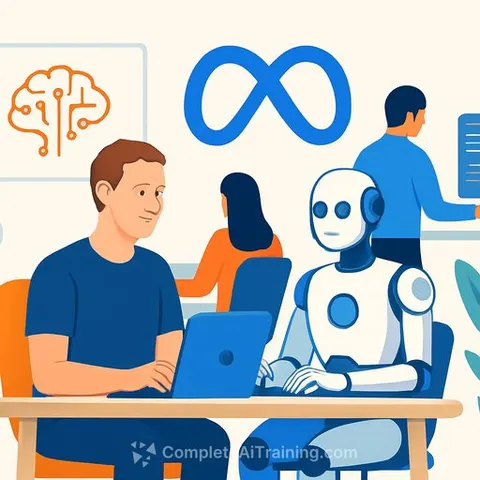
Zuckerberg Moves Into Meta AI Labs to Accelerate Development
Mark Zuckerberg has moved his desk into Meta's AI research space and is coding alongside the company's AI leadership. Meta President Dina Powell McCormick disclosed the move, saying Zuckerberg is "seated in the AI lab with Alex Wang and Nat Friedman, and he's coding all day long." The shift signals a direct operational change tied to Meta's reported $15 billion investment in a new Superintelligence Labs division.
What this means for product teams
Zuckerberg's hands-on presence compresses decision cycles between product leadership and research. Tighter feedback loops typically accelerate prototyping, speed model releases, and push research outputs into products faster than typical organizational structures allow.
The leadership hires reinforce this direction. Alexandr Wang, formerly at Scale AI, and Nat Friedman, ex-GitHub CEO, are positioned to drive engineering and product execution. Their backgrounds point toward emphasis on data pipelines, developer tooling, and production deployment workflows.
The $15 billion allocation to Superintelligence Labs covers compute infrastructure, dataset curation, and talent acquisition. Larger budgets permit bigger training runs and shorter experimentation cycles.
Competitive pressure and hiring implications
Meta is now competing directly with OpenAI and Google on large language models and consumer-facing AI products. Founder-level technical involvement is a credible escalation, not a symbolic gesture. Meta's existing infrastructure investments in AI chips and research stacks make rapid acceleration feasible.
For product development teams, this creates immediate hiring pressure. Senior ML engineers, systems engineers, and tooling specialists will face intensified competition. Meta will likely prioritize candidates who can move fast in production environments.
What to watch
Monitor Meta for rapid announcements on model specifications, developer APIs, and product releases built on research models. Watch hiring patterns in systems, tooling, and safety teams. Public benchmarking results and open-source releases will reveal technical priorities and engineering direction.
Release timelines are the clearest signal. If Zuckerberg's coding presence translates to practice, expect faster model launches and tighter product integration cycles than Meta's historical pace.
For context on how large language models work and what drives product strategy in this space, see Generative AI and LLM and AI for Product Development.