AI agent for aerospace engineers
Aircraft Structural Load Case Check Agent
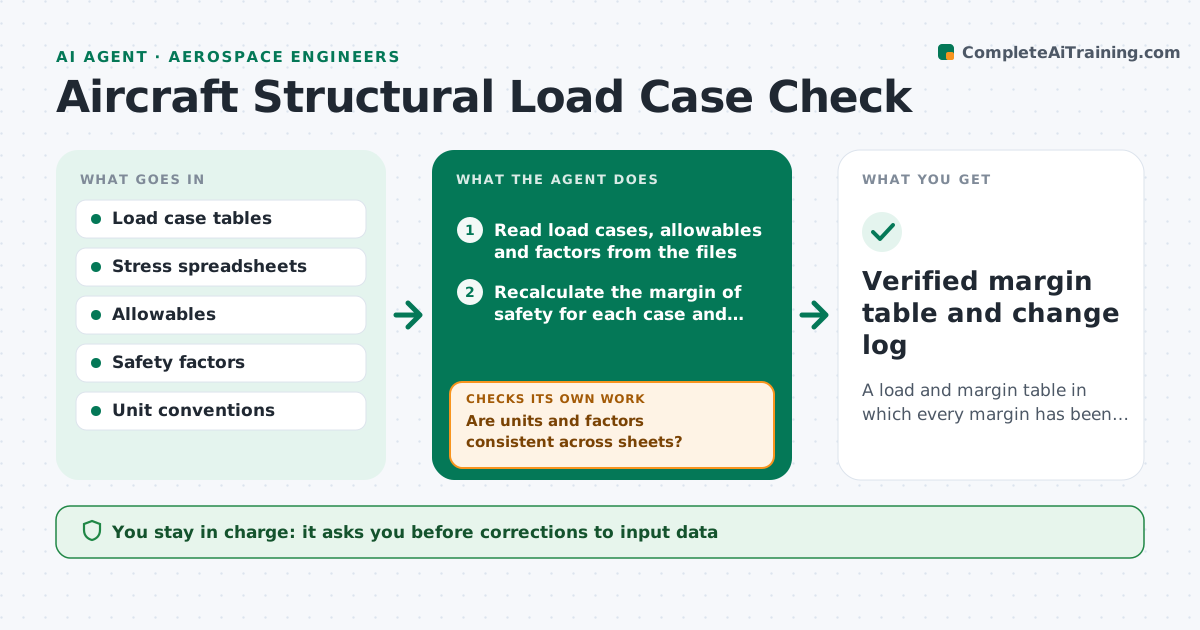
A load and margin table in which every margin has been independently recomputed and every low margin explained.
What it does
Load tables and stress spreadsheets get updated by hand every time a new load case arrives, and a single wrong cell can hide a negative margin. This agent reads the load tables and stress spreadsheets, recalculates the margin of safety for each load case and component with the stated formulas, and compares its results to the numbers in the sheets. It flags any margin below your minimum and any cell that differs from its recalculation. For each flag it traces the cause back to the inputs such as allowable, load factor or geometry, and suggests the fix. After the engineer corrects inputs, it reruns. The engineer approves the updated report. Edge case: units mixed between metric and imperial sheets are caught before any margin is computed.
How it works
Follow the arrows from top to bottom. The orange dashed arrow is the loop: when a check fails, the agent goes back and tries again.
Read the steps as a list
- Load table or stress sheet updated
- Read load cases, allowables and factors from the files
- Are units and factors consistent across sheets?If not: list inconsistent cells and convert, or ask the engineer which convention applies. Back to step 2.
- Recalculate the margin of safety for each case and component
- Compare recalculated values to the sheet values
- Do all margins match the sheet and exceed the minimum?If not: trace each mismatch or low margin to its input and propose the fix. Back to step 4.
- Engineer reviews fixes and corrects the inputsThe agent waits here for your OK.
- Rerun with the corrected inputs
- Draft the updated margin summary for the report
- Engineer approves the updated reportThe agent waits here for your OK.
- Verified margin table and change log
How it decides
It recomputes margin of safety as allowable divided by applied load times factor, minus one. A margin below the minimum or a mismatch with the sheet is flagged.
- Margin below the set minimum: flag as critical and list the driving load
- Sheet value differs from recomputation by more than 0.01: flag as a mismatch
- Allowable older than the latest material data: ask which applies
- Load factor not stated: stop and ask, never assume
Make it yours
Every agent is a starting point. You choose these settings for your own situation.
- Minimum margin of safety (default 0.00)
- Tolerance for sheet mismatch
- Unit convention
- Sheet layouts to read
- Report template
What keeps you in control
It always asks you first
- Corrections to input data
- The updated report
Hard limits
- Never overwrite an engineer's input data
- Never assume a load factor
It stops when
- Done: all margins verified and report approved
- Stop: missing allowables or factors
Set it up
We guide you through the set-up, step by step
Members get the full set-up guide for this agent. No technical skills needed: you copy, paste and upload.
- One set of instructions to paste into your AI, with the clicks for ChatGPT, Claude, Microsoft 365 Copilot, Gemini and Grok
- The agent then walks you through connecting your own data, one source at a time
- A downloadable copy with the flow chart, the rules and the full guide