AI tool
KerasFormers
KerasFormers is a library for running Hugging Face model architectures in Keras 3, supporting over 60 vision, speech, large language, and vision-language models. It provides weight conversion and parity checks so users can work across TensorFlow, ...

About KerasFormers
KerasFormers is a Keras 3 collection of pretrained transformer models that launched this week. It provides model implementations, checkpoint conversion, and APIs to run Hugging Face pretrained models across JAX, PyTorch, and TensorFlow backends. The library currently covers 60+ vision, speech, LLM, and VLM architectures.
Review

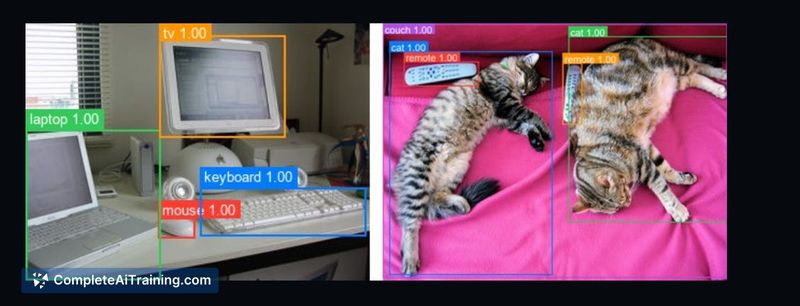
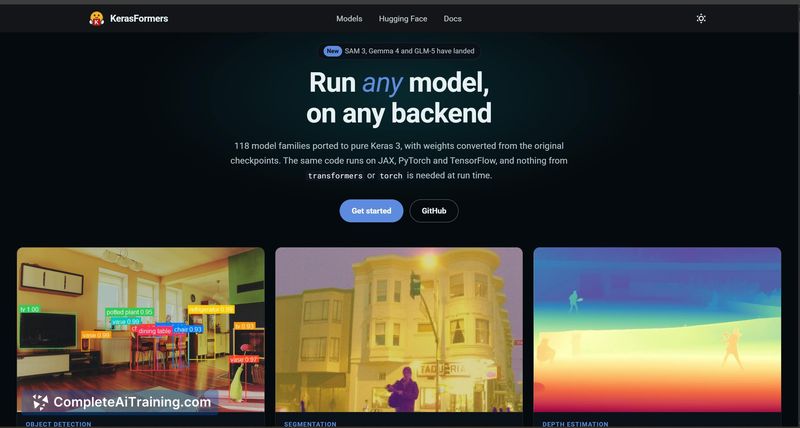
KerasFormers addresses a specific gap: bringing Hugging Face's model ecosystem into Keras 3 without requiring backend-specific code rewrites. The project's maker started it after repeatedly hitting the need to adapt modern models for Keras 3 workflows. The library is open source and free to use.
Key Features
- Backend-agnostic implementations that run on JAX, TensorFlow, and PyTorch through Keras 3.
- Hugging Face to Keras weight conversion with parity validation built into the conversion pipeline.
- Support for 60+ architectures spanning vision, speech, LLM, and VLM model categories.
- Native channels_first support via keras.config, which maintains bit-exact numerical parity with channels_last across all 13 SegFormer variants.
- Pure Keras 3 implementations rather than wrappers around existing PyTorch code.
Pricing and Value
The tool is listed as Free on its launch page. There is no paid tier or subscription model mentioned in the available documentation. Since the project is open source and hosted on GitHub, users can access the full library without cost, though the exact licensing terms are not detailed in the reference content.
Pros
- Runs the same model code across three backends without requiring framework-specific rewrites.
- Converts Hugging Face weights directly, which saves significant time compared to manual checkpoint translation.
- Includes parity validation to catch numerical discrepancies between the original and converted models.
- Supports a broad range of modern architectures, from vision transformers to multimodal models.
- The channels_first support works with bit-exact parity, which matters for users with specific hardware constraints.
Cons
- The project is still evolving, so the available model coverage may change as new architectures are added or existing ones are revised.
- Documentation is limited beyond the launch page and maker's comments; users may need to rely on GitHub source code for detailed implementation guidance.
- It's not well suited for teams that primarily work with native PyTorch or Hugging Face Transformers pipelines, since KerasFormers is specifically built for the Keras 3 workflow.
Conclusion
KerasFormers fits the needs of Keras 3 users who want access to modern Hugging Face architectures without leaving the Keras ecosystem. The free, open-source nature and multi-backend support make it a practical option for experimentation and research projects. Teams with existing PyTorch or Hugging Face pipelines would find limited reason to switch, but Keras-centric teams will find the conversion tooling and parity checks useful.
Jobs KerasFormers suits
We checked KerasFormers against 500+ jobs; these get the most out of it.