About Marmot
Marmot is an open-source data catalog built for teams that want searchable, contextualized data without heavy infrastructure. It catalogs assets, adds relevant context, and makes data discoverable for both people and AI tools.
Review
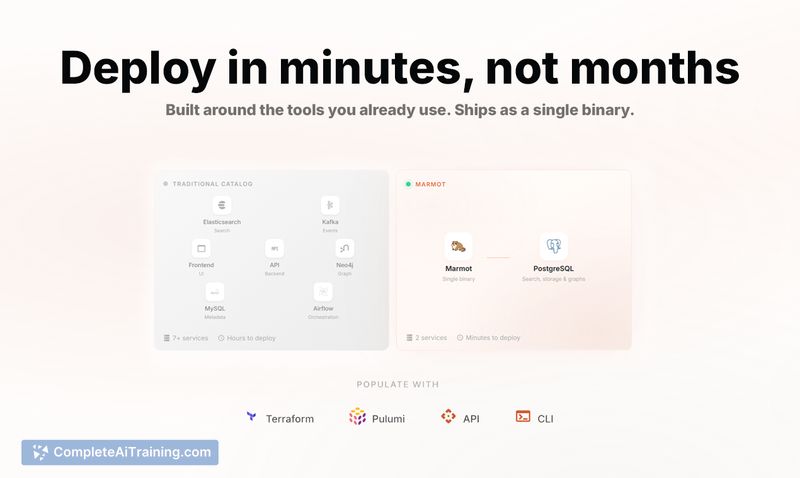
Marmot focuses on simplicity and practical integration: a single binary plus a Postgres database that can be deployed quickly. It combines a growing set of connectors, full lineage tracking, and a built-in MCP server to give language models accurate context about available data.
Key Features
- Lightweight deployment model: single binary and Postgres, with a Docker Compose quick-start option and a live demo site.
- Plugin ecosystem (25+ and expanding), including dbt, Kafka, S3, Trino, Iceberg and PostgreSQL connectors.
- Full data lineage across assets to trace origin and transformations.
- Built-in MCP server to provide LLMs with contextual data and reduce incorrect answers from AI agents.
- 100% free and open-source, with source code available on GitHub.
Pricing and Value
Marmot is free and open-source, so there is no licensing cost to run the software yourself. A hosted tier with usage limits is planned to help teams evaluate the product without self-hosting. The main value lies in reducing infrastructure requirements compared with catalogs that need Elasticsearch, Kafka and a graph database, making it a lower-cost option for teams that want a searchable catalog and AI-facing context delivery.
Pros
- Open-source and free, enabling inspection and customization of the codebase.
- Minimal infrastructure footprint-single binary plus Postgres simplifies operations.
- Good connector coverage out of the box and an expanding plugin set.
- Lineage tracking and MCP support make it useful for AI workflows that need trustworthy context.
- Quick-start options and a public demo let teams evaluate without a major time investment.
Cons
- As a recent launch, some advanced enterprise features (for example, mature governance UI or fine-grained access controls) may be limited or still in development.
- Self-hosting still requires basic operational knowledge, even if the stack is smaller than many alternatives.
- Connector coverage is growing; niche systems may require custom integration work.
Overall, Marmot is a strong fit for small to medium engineering and data teams that want an open, low-overhead catalog that integrates with AI tooling. It works well for teams that prefer self-hosting today and for those looking to provide LLMs with reliable, queryable context. Try the demo or the Docker Compose quick-start to see if it matches your workflow and connector needs.
Open 'Marmot' Website
Your membership also unlocks: