About Paritok
Paritok is a non-destructive compression gateway that sits between a coding agent and the API. It reduces the tokens sent per turn by compressing tool schemas, file reads, tool output, and stale conversation history. The tool is open source and launched with support for Claude Code, Codex, Cursor, and any OpenAI or Anthropic compatible endpoint.
Review
Paritok addresses a specific cost problem in long coding agent sessions: the API is stateless, so every turn resends the full context, including tool definitions and outputs the model may never use again. The developers report that a 4B model trained on 45K real agent trajectories handles the compression, while a separate CPU-based filter strips tool schemas without any model involvement. The gateway tags each compressed segment with a reference ID so the agent can retrieve the original bytes on demand.
Key Features
- Tool schema filtering that runs on CPU and requires no model inference, reducing a 29K token tool block to roughly 8K per turn.
- A code-native 4B model that compresses file reads and tool output to about a quarter of their original size.
- Stale history summarization that activates once the context budget fills, preventing sessions from overflowing into lossy compaction.
- A recall mechanism via
read_originalthat lets the agent pull back exact original bytes for any compressed segment, with no quality loss on that segment. - Local or hosted GPU execution; compression runs on your own hardware or on their hosted server.
Pricing and Value
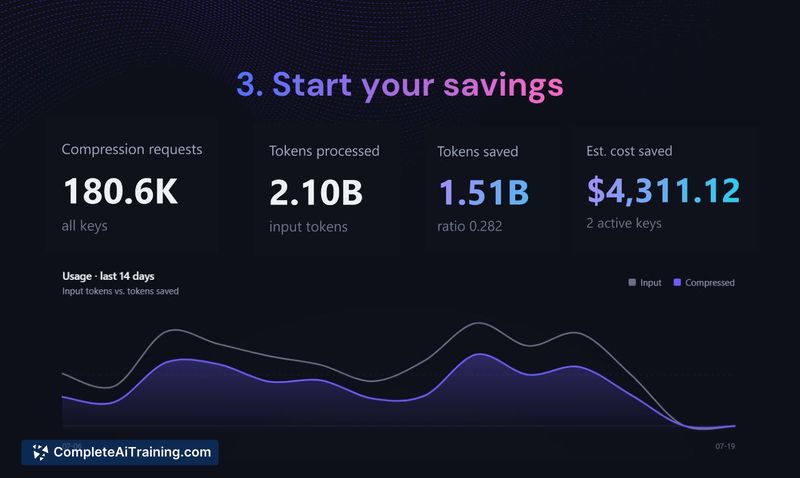
Paritok is listed as free and open source. The tool's own launch data from a two-week hosted-GPU period reports 62,486 compressions that cut 447M input tokens across third-party users, at roughly 85% average raw token reduction with recall enabled by default. The developers note that raw token savings overstate actual dollar savings because Anthropic prices cached tool blocks at a discount; they estimate cache-aware savings at roughly 60-70% end-to-end. The tool also reports ~3× more turns fitting in the same context window.
Pros
- Compression is non-destructive; the agent can always retrieve original bytes via reference tags, so quality loss is recoverable per segment.
- Latency is bounded; a typical compression pass takes about 13 seconds on a consumer GPU (RTX 4060 via Ollama) or roughly 3 seconds on the hosted server for a 2800-token input producing 700 output tokens.
- Works with existing agent setups including Claude Code, Codex, and Cursor without changing the agent's workflow.
- Tool schema filtering alone reduces a 29K token block to 8K on turn 1, before the 4B model's compression takes over as sessions saturate.
Cons
- Compression adds latency on turns with large tool outputs; it only runs when there is substantial content to compress, so short turns see no benefit.
- Raw token reduction figures overstate actual cost savings; the developers themselves cite cache-aware savings at 60-70%, not the headline 85%.
- Not well suited for short, single-turn sessions where the fixed cost of compression outweighs the token savings, or for users who need deterministic, uncompressed context at all times.
Paritok fits teams running long coding agent sessions on large codebases where context saturation is the bottleneck. The recall mechanism makes it viable for production use, and the open-source licensing means you can inspect and self-host the gateway. For users whose sessions rarely exceed a few turns, the compression overhead likely isn't worth the setup.
Open 'Paritok' Website
Your membership also unlocks: