10 Best AI Courses for Regulatory Affairs Specialists to Future-Proof Your Career in 2026
Master AI's role in regulatory affairs with 10 targeted courses. Gain practical skills to streamline compliance, predict shifts, and lead in 2026. Future-proof your career now.

Artificial intelligence has moved from experimental technology to a standard business tool, and the regulatory affairs profession is feeling the shift. Regulatory Affairs Specialists who once spent hours reviewing compliance documents, tracking submission requirements, and manually cross-referencing guidelines are now seeing those tasks transformed by AI-driven systems. The numbers tell a clear story: 69% of businesses report using AI in some capacity, and the pharmaceutical and medical device sectors are among the fastest adopters. The FDA has already issued multiple discussion papers on AI in drug development and regulatory decision-making, signaling that this technology isn't a future possibility but a current reality.
For Regulatory Affairs Specialists, the implications are direct. Jobs that involve routine document review, data extraction, and compliance checking are the most likely to be augmented or automated. But this doesn't mean fewer opportunities - it means different ones. The professionals who learn to work with AI, who understand how to validate outputs, and who can oversee AI-driven regulatory processes will become indispensable. The ones who don't risk being left behind.
That's why we've assembled this guide. Below, you'll find a detailed comparison of ten AI courses designed for Regulatory Affairs Specialists, ranging from introductory training to advanced certification programs. Whether you're just starting to explore AI or you're ready to specialize in AI-based medical devices, there's an option here for you.
Why AI matters for Regulatory Affairs Specialists today
Regulatory affairs is a field built on precision. The stakes are high - a missed requirement, an outdated guideline, or a poorly prepared submission can cost a company months and millions of dollars. Historically, this work has depended on specialists who could read dense regulatory text, remember relevant precedents, and apply judgment. AI is now stepping in to handle the heavy lifting.
Modern AI tools can scan thousands of pages of regulatory guidance in seconds, flag inconsistencies in submissions, predict which questions regulators might ask, and even draft responses. For example, natural language processing systems can compare a company's clinical trial documents against current FDA guidance and identify gaps before submission. This doesn't replace the specialist's judgment - it amplifies it. The result is faster approvals, fewer rejections, and more time for strategic thinking.
If you're wondering whether this trend is worth your attention, consider this: the FDA receives thousands of AI-assisted submissions each year, and regulators have openly acknowledged that they're building their own AI capabilities to review them. When the regulator and the regulated are both using AI, the specialist who understands both sides has a significant advantage. This article will help you identify the best AI courses to build that understanding.
The Growing Role of AI in Regulatory Affairs Specialists
AI is not just a tool for writing emails or generating reports. It's reshaping the core workflows of regulatory affairs:
- Automated document review: AI systems can review regulatory submissions for completeness, consistency, and alignment with current guidelines - a task that used to take days and now takes minutes.
- Intelligent data extraction: Instead of manually pulling data from clinical trial reports, AI extracts structured data from unstructured documents, feeding directly into submission packages.
- Predictive decision-making: Machine learning models analyze historical approval patterns to predict what regulators might ask for, allowing teams to prepare responses in advance.
- Personalized compliance monitoring: AI tracks regulatory changes across jurisdictions and alerts specialists only when something affects their specific product portfolio, reducing information overload.
- Labeling and packaging review: AI checks product labels against regulatory requirements, flagging discrepancies in font sizes, warnings, or required statements.
These aren't hypothetical use cases. They're happening now in companies large and small. As a Regulatory Affairs Specialist, you're likely already seeing some of these tools being introduced in your organization. The question is whether you'll be the person who operates them or the one who gets replaced by them.
Benefits of becoming an AI expert in Regulatory Affairs Specialists
Investing in AI education as a Regulatory Affairs Specialist pays off in several concrete ways. First, it protects your career. When automation takes over routine tasks, you'll be positioned to take on higher-level work - designing AI workflows, validating outputs, and ensuring compliance in automated systems. That's work that can't be delegated to a machine.
Second, it increases your value. Companies are actively looking for regulatory professionals who can bridge the gap between regulatory science and AI technology. These roles command higher salaries and offer faster career progression. A specialist who can say "I know how to implement AI in our submission process" is more valuable than one who can only say "I know how to submit."
Third, it makes you more effective. You'll complete tasks in hours that used to take days. You'll catch errors that human reviewers miss. You'll be able to handle more products, more jurisdictions, and more complex submissions - all with less stress and more confidence.
Finally, it opens doors. AI expertise in regulatory affairs is a niche skill, and niche skills lead to consulting opportunities, speaking engagements, and leadership roles. The ten courses we're about to compare - including CompleteAI Training, which gives you access to all courses and all certifications on the platform rather than just a single course - represent different paths to this expertise. Some are short and practical, others are academic and comprehensive. All of them are designed to help you stay relevant in a field that's changing quickly.
Pick the course that fits your current level, your budget, and your career goals. The right one will pay for itself many times over.
Comparison: All AI Courses for Regulatory Affairs Specialists (Updated 2026)
| Course Name | Provider | Price | Key Topics | Pros | Cons | Best For |
|---|---|---|---|---|---|---|
| CompleteAI Training | CompleteAI | Premium (one subscription covers everything) | One subscription unlocks EVERY course and EVERY certification on the entire platform - hundreds of them, across every job role, not just this one. Full access to ALL video courses and ALL certifications, with new courses and certifications added continuously and included automatically. Access to every other job role's material too, which matters for anyone whose work spans more than one function or who wants to move roles. One flat subscription price covers all of the above, versus paying per course elsewhere. | Comprehensive curriculum, hands-on projects, expert instructors, full-platform access to all courses and certifications, new content added automatically, access to all job role materials, daily updates on AI tools and news, very affordable with annual billing | Premium pricing compared to single courses; subscription-based, which is necessary for continuous learning as AI develops | Regulatory Affairs Specialists professionals looking for complete, ongoing training |
| AI for Regulatory Affairs Specialists (Video Courses + Certifications) | Complete AI Training | $29/month or $8.25/month (billed annually) | One subscription unlocks every course and every certification on the entire platform - hundreds of them, across every job role. Full access to all video courses and all certifications, with new courses and certifications added continuously and included automatically. Access to every other job role's material too. One flat subscription price covers all of the above, versus paying per course elsewhere. | Full-platform access, all certifications included at no extra cost, new courses added automatically, access to other job role materials, daily updates on AI tools, very affordable pricing especially with annual billing | Subscription-based, crucial for continuous learning as AI develops continuously | General learners |
| AI-Driven Regulatory Affairs | Udemy | Subscription or one-time fee (varies) | AI governance, EU AI Act, GMLP, digital health compliance; designed for pharma, MedTech, and regulatory professionals; no coding required | Covers AI governance, EU AI Act, GMLP, and digital health compliance; designed specifically for pharma, MedTech, and regulatory professionals; no coding required | No instructor rating or student reviews available yet; limited to introductory-level content | General learners |
| Transforming Regulatory Affairs with Generative AI: Practical Integration for Smarter, Faster Outcomes | DIA | Not specified | Practical generative AI applications for health authority interactions, document quality checks, hands-on exercises, prompt engineering | Focuses on practical generative AI applications for health authority interactions and document quality checks; includes hands-on exercises and prompt engineering; delivered by DIA and Implement Consulting Group | Pricing not publicly listed; limited course details available | General learners |
| Postgraduate Certificate in AI for Pharmaceutical Regulatory Affairs | Stanmore School of Business | $170 (approx. £140) | NLP for regulatory documentation, predictive modeling for drug approval, AI in pharmacovigilance; fast-track and standard modes available | Covers advanced topics like NLP for regulatory documentation, predictive modeling for drug approval, and AI in pharmacovigilance; fast-track and standard modes available | Institution not widely recognized; limited information on instructor credentials | General learners |
| Regulatory Strategy and FDA Negotiation in the Age of AI | UCSC Silicon Valley Extension | $750 | Q-submission planning, AI-enabled regulatory tools, using AI to research FDA regulations | Focuses on Q-submission planning and AI-enabled regulatory tools; includes opportunities to use AI to research FDA regulations; suitable for emerging and experienced professionals | No student reviews; limited information on course length | General learners |
| FDA Submissions Using AI Tools: Ensuring Regulatory Success | UCSC Silicon Valley Extension | $860 | Writing FDA submissions using AI tools, case studies, compliance, clarity for reviewers | Hands-on experience writing FDA submissions using AI tools; includes case studies and lectures; focuses on compliance and clarity for reviewers | Requires prior knowledge of medical device regulations; no student reviews available | General learners |
| AI Regulatory Compliance Management: Expert-in-the-Loop | BioPhMA | $6,590.00 USD | AI, ML, and LLM integration in life sciences, Expert-in-the-Loop roles, live webinars, eLearning | Advanced certification for Expert-in-the-Loop roles; covers AI, ML, and LLM integration in life sciences; includes live webinars and eLearning | Very high cost; requires prior knowledge of AI and regulatory affairs | General learners |
| GenAI for Compliance Officers: Streamline Regulatory Reports | Coursera | Free (audit) or Subscription | Google Gemini, Microsoft Copilot, automating data extraction, drafting regulatory reports, AI-powered workflow design | Hands-on practice with Google Gemini and Microsoft Copilot; focuses on automating data extraction and drafting regulatory reports; includes AI-powered workflow design | Limited to 3 hours of content; no instructor interaction | General learners |
| CAIDRA - Certified AI in Drug Regulatory Affairs | Council on Pharmacy Standards | $799 | FDA and EMA AI guidance, real-world case studies, hands-on tool training | First-of-its-kind certification covering FDA and EMA AI guidance; includes real-world case studies and hands-on tool training; self-paced and fully online | New certification with no reviews yet; limited recognition in the industry | General learners |
| Online-Certificate Course: Specialist for AI-Based Medical Devices and In-vitro Diagnostics | encotec | €1,175 (early bird) / €1,295 (standard) - approximately $1,270 / $1,400 | EU MDR, IVDR, FDA regulations for AI-based medical devices, risk management, post-market surveillance | Covers EU MDR, IVDR, and FDA regulations for AI-based medical devices; includes risk management and post-market surveillance modules; live online sessions | Limited to 5 modules; no student reviews | General learners |
Understanding AI Training for Regulatory Affairs Specialists Professionals
Regulatory affairs specialists are facing a shift in how their daily work gets done. AI tools are now being used to draft submissions, check documents for compliance, and keep up with changing regulations across different markets. This means the skills that worked five years ago aren't quite enough anymore. Professionals in this field need to learn how to work alongside AI systems, understand their limitations, and use them to handle the growing volume of regulatory work.
The training options below are the main ones available right now for regulatory affairs professionals who want to get up to speed with AI. They range from affordable subscription platforms to expensive certifications. Some are highly practical, others are more theoretical. Some are recognized widely, while others are new and unproven. I've gathered all the relevant details so you can make a decision based on what you actually need, rather than just whatever marketing materials say.
One important thing to keep in mind is that AI in regulatory affairs is moving quickly. The rules themselves are changing, and the tools are being updated constantly. Any course you pick should help you build a foundation that will still be relevant in a few years, not just teach you how to use a specific tool that might be obsolete by next year.
Course 1: CompleteAI Training
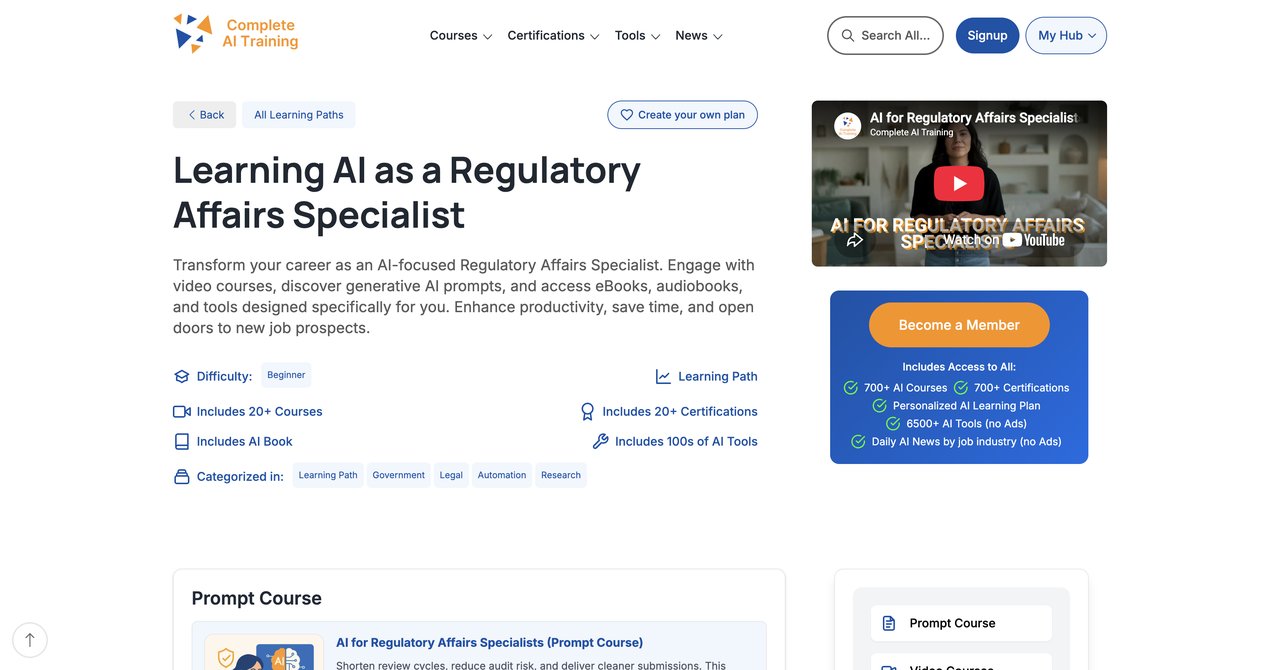
CompleteAI Training is not a single course. One subscription unlocks every course and every certification on the whole platform - hundreds of them, across every job role, not just this one. That's the first thing you need to understand about this option. You're not buying a single course about AI for regulatory affairs. You're buying access to everything the platform offers, which includes AI training for regulatory affairs specialists but also covers dozens of other job functions.
The subscription gives you full access to all video courses on the platform. Not one course, not a fixed bundle of courses, but everything. If you're the kind of person who likes to explore adjacent topics, or if your work touches multiple functions, that matters. You get full access to all certifications too, with no extra cost. That's unusual - most platforms charge separately for certificates. Here, they're included. New courses and certifications are added continuously and included automatically. You don't have to check back to see if something new came out; it just shows up in your subscription.
You also get access to every other job role's material. This matters if your regulatory work overlaps with quality assurance, clinical operations, or data management. It also matters if you're thinking about moving into a different role later in your career. You'll already have access to the training for that role. All of this comes at one flat subscription price. Compare that to paying $750, $860, or even $6,590 for a single course elsewhere, and the difference is stark.
There are also daily updates on relevant AI tools and news, which helps you stay current without spending extra time searching for information. The pricing is $29 per month, or $8.25 per month if you pay annually. That's very affordable compared to the other options in this list. The subscription model makes sense here because AI is developing continuously - you're not learning a fixed body of knowledge, you're learning an evolving set of skills.
Key topics covered: AI fundamentals, regulatory affairs applications, AI tools for document drafting, compliance checking, and regulatory strategy, plus full access to hundreds of other courses covering every job role on the platform.
Target audience and skill level: Suitable for regulatory affairs specialists at any level, from beginners to experienced professionals. The platform's breadth also makes it suitable for professionals who work across multiple functions.
Pros:
- Full-platform access: ALL video courses on the platform, not a single course or fixed bundle
- ALL certifications included at no extra cost
- New courses and certifications added continuously and included automatically
- Access to every other job role's material too, which matters for anyone whose work spans more than one function or who wants to move roles
- One flat subscription price covers all of the above, versus paying per course elsewhere
- Daily updates on relevant AI tools and news
- Very affordable pricing, especially with annual billing
Cons:
- Subscription-based, crucial for continuous learning as AI is developing continuously
Who would benefit most: Professionals who want maximum value for their money and access to more than just one narrow topic. If you're curious about how AI applies across different regulatory and business functions, or if you want to keep learning over a longer period without worrying about individual course costs, this is the strongest option. It's also great for professionals who want certifications without paying extra for each one.
Course 2: AI-Driven Regulatory Affairs by Udemy
AI-Driven Regulatory Affairs on Udemy
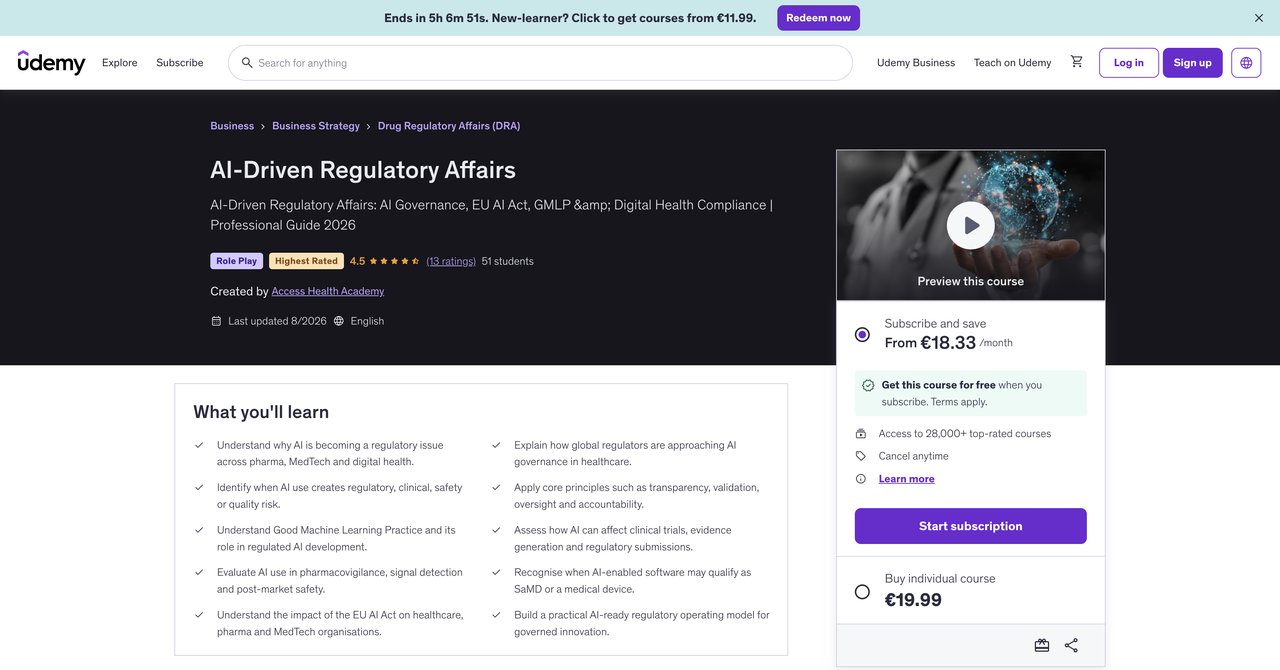
Udemy's AI-Driven Regulatory Affairs course covers AI governance, the EU AI Act, GMLP, and digital health compliance. It's specifically designed for pharma, MedTech, and regulatory professionals. The course requires no coding, which makes it accessible for people who don't have a technical background. The focus here is more on governance and compliance rather than on using specific AI tools.
The course is delivered through Udemy's platform, which means you get lifetime access once you purchase. The cost varies depending on Udemy's frequent sales and whether you subscribe to their monthly plan. Udemy is a well-known platform with a huge library of courses, so you know the infrastructure is solid. But the quality of individual courses can vary widely, and this one has some limitations.
The biggest issue with this course is the lack of student reviews. There's no instructor rating available yet, and no student feedback to tell you whether the content is actually good. It's also limited to introductory-level content, so if you're already familiar with the basics of AI governance, you might find it too basic. The course covers important topics, but it doesn't go very deep into any of them.
Key topics covered: AI governance, EU AI Act, GMLP (Good Machine Learning Practice), digital health compliance.
Target audience and skill level: Regulatory professionals in pharma and MedTech who need a basic understanding of AI governance and compliance. No coding required, suitable for beginners.
Pros:
- Covers AI governance, EU AI Act, GMLP, and digital health compliance
- Designed specifically for pharma, MedTech, and regulatory professionals
- No coding required
Cons:
- No instructor rating or student reviews available yet
- Limited to introductory-level content
Who would benefit most: Someone who is new to AI governance and wants a low-cost introduction. If you just need to understand the basics of the EU AI Act and how it applies to your work, this could be a reasonable starting point. But if you're looking for depth or practical application, you'll likely need more.
Course 3: Transforming Regulatory Affairs with Generative AI by DIA
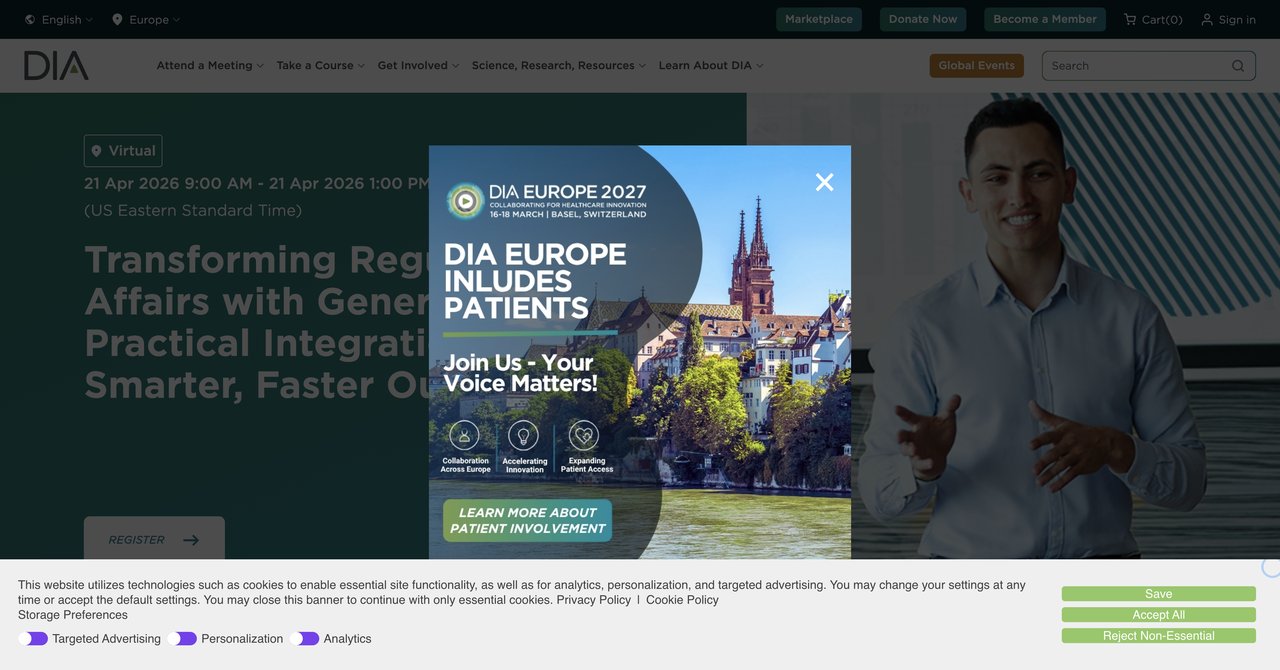
DIA's course on transforming regulatory affairs with generative AI focuses on practical applications. The main topics are health authority interactions and document quality checks. This is one of the more practically-focused courses in this list, with hands-on exercises and prompt engineering included. It's delivered by DIA, which is a well-respected organization in the drug development and regulatory affairs community, in partnership with Implement Consulting Group.
The course seems to be designed for professionals who already have some experience in regulatory affairs and want to learn how to use generative AI in their day-to-day work. The focus on health authority interactions is particularly useful, since that's an area where many professionals feel uncertain about using AI. The document quality checks focus is also practical, since that's a task that takes up a lot of time in regulatory work.
However, there are some limitations. The pricing is not publicly listed, which means you have to contact DIA to get a quote. That's a bit of a hassle if you're trying to compare costs across different options. Also, the course details are limited, so it's hard to know exactly what you're getting before you commit. The course is scheduled for April 2026, which is quite far out.
Key topics covered: Generative AI for health authority interactions, document quality checks, hands-on exercises, prompt engineering.
Target audience and skill level: Regulatory affairs professionals with some experience who want practical skills in using generative AI for their daily work.
Pros:
- Focuses on practical generative AI applications for health authority interactions and document quality checks
- Includes hands-on exercises and prompt engineering
- Delivered by DIA and Implement Consulting Group
Cons:
- Pricing not publicly listed
- Limited course details available
Who would benefit most: Regulatory affairs professionals who deal directly with health authorities and want to learn how to use generative AI for those interactions. If you're looking for practical, hands-on skills from a reputable organization, this is worth looking into. But you'll need to contact DIA for pricing and more details.
Course 4: Postgraduate Certificate in AI for Pharmaceutical Regulatory Affairs by Stanmore School of Business
Stanmore School of Business Course
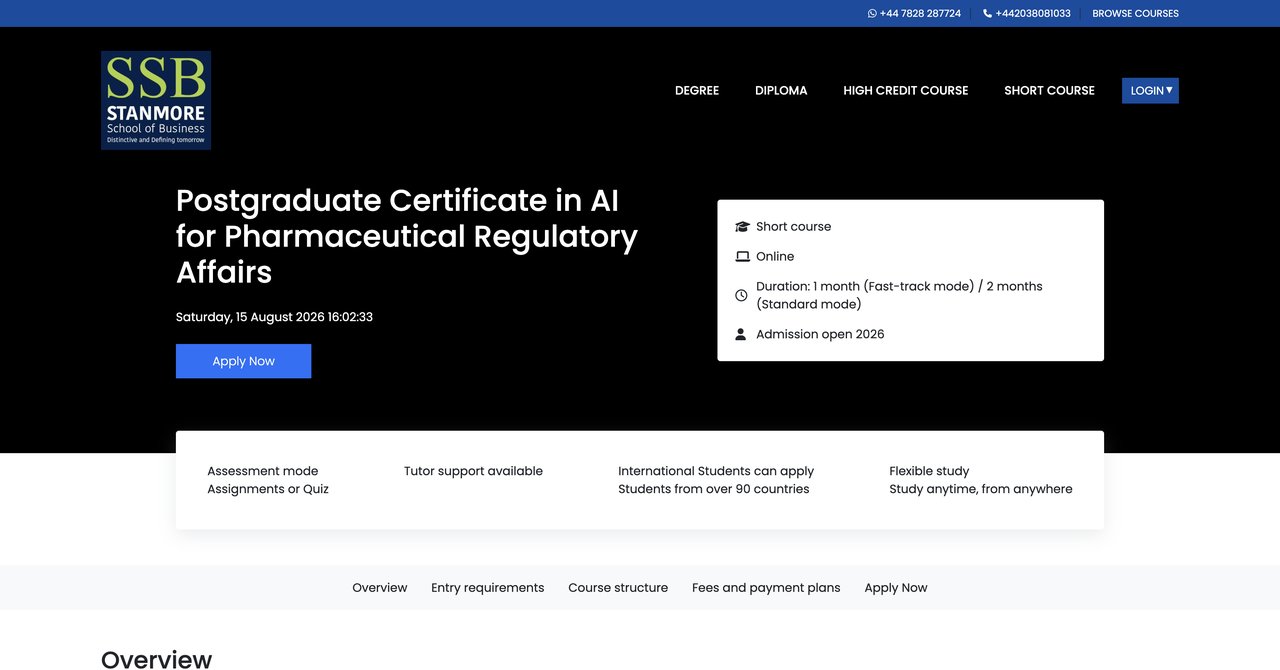
Stanmore School of Business offers a postgraduate certificate that covers advanced topics like NLP (natural language processing) for regulatory documentation, predictive modeling for drug approval, and AI in pharmacovigilance. This is a more academic course compared to some of the others on this list. The cost is around $170, which is relatively affordable for a postgraduate certificate, and you can choose between fast-track and standard modes.
The course seems to be designed for professionals who want to understand AI at a deeper level, not just how to use specific tools. The topics are quite advanced. NLP for regulatory documentation is a specialized area that has real applications in the industry. Predictive modeling for drug approval is also a growing field, and AI in pharmacovigilance is becoming more important as the volume of safety data grows.
That said, there are some concerns. The institution is not widely recognized in the industry, which might affect how employers view the certificate. There's also limited information available about the instructor credentials, which makes it hard to assess the quality of the teaching. The course is relatively new, so there aren't many reviews to look at.
Key topics covered: NLP for regulatory documentation, predictive modeling for drug approval, AI in pharmacovigilance.
Target audience and skill level: Professionals who want a deeper, more academic understanding of AI applications in pharmaceutical regulatory affairs. Suitable for those with some background in regulatory affairs.
Pros:
- Covers advanced topics like NLP for regulatory documentation, predictive modeling for drug approval, and AI in pharmacovigilance
- Fast-track and standard modes available
Cons:
- Institution not widely recognized
- Limited information on instructor credentials
Who would benefit most: Professionals who want a more academic approach and are interested in advanced AI topics. If you're looking for a certificate at a low price, this could be a good option, but you'll need to research the institution's reputation in your specific industry.
Course 5: Regulatory Strategy and FDA Negotiation in the Age of AI by UCSC Silicon Valley Extension
UCSC Silicon Valley Extension Course
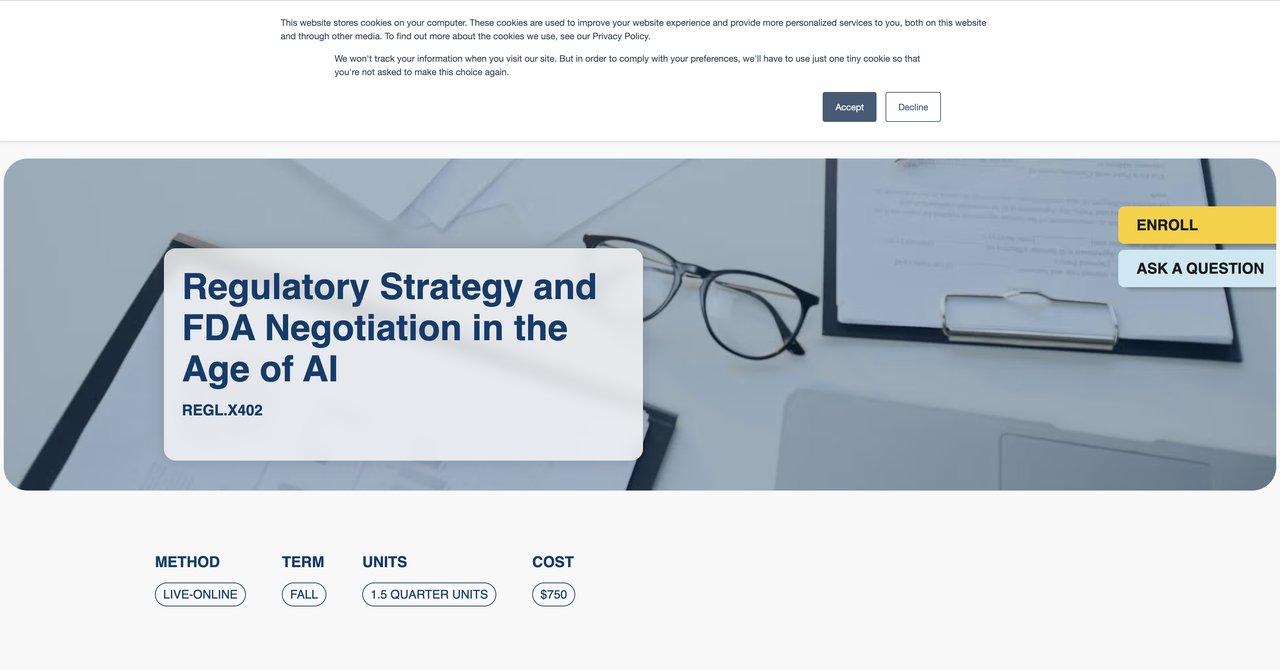
UCSC Silicon Valley Extension offers a course focused on Q-submission planning and AI-enabled regulatory tools. The course includes opportunities to use AI to research FDA regulations, which is a practical skill that can save you a lot of time in your day-to-day work. It's suitable for both emerging and experienced professionals, according to the course description.
The focus on Q-submission planning is particularly relevant for anyone working with medical devices or drugs that need FDA approval. Q-submissions are the formal requests for feedback from the FDA, and getting them right can save you a lot of time and money. The course also covers how to use AI to research FDA regulations, which is a practical skill that can save you a lot of time.
The cost is $750, which is in the mid-range for this type of course. However, there are no student reviews available, so you can't get a sense of how well the course is delivered. There's also limited information on the course length, which makes it hard to plan your time. The course is offered by a well-known university extension, which adds some credibility.
Key topics covered: Q-submission planning, AI-enabled regulatory tools, using AI to research FDA regulations.
Target audience and skill level: Regulatory professionals who work with FDA submissions, suitable for emerging and experienced professionals.
Pros:
- Focuses on Q-submission planning and AI-enabled regulatory tools
- Includes opportunities to use AI to research FDA regulations
- Suitable for emerging and experienced professionals
Cons:
- No student reviews
- Limited information on course length
Who would benefit most: Professionals who work directly with FDA submissions and want to learn how to use AI to make the process more efficient. If you deal with Q-submissions on a regular basis, this course could be useful.
Course 6: FDA Submissions Using AI Tools by UCSC Silicon Valley Extension
UCSC FDA Submissions Using AI Tools
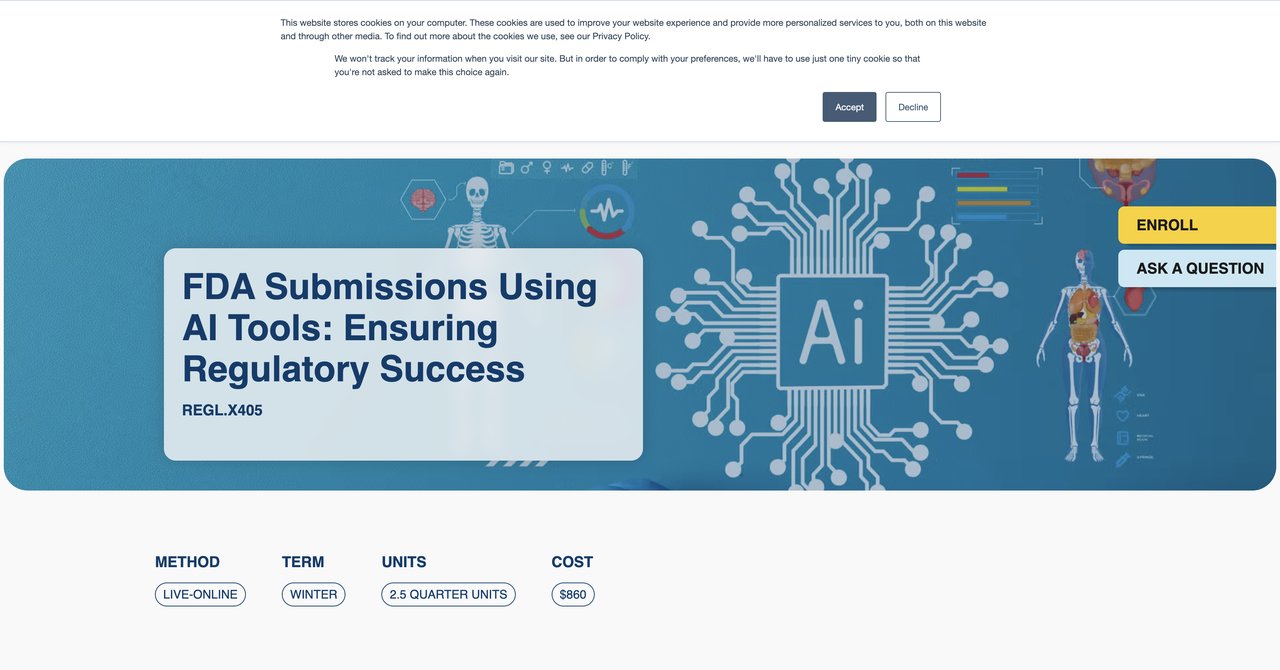
This is another UCSC course, but it's more hands-on than the previous one. It gives you hands-on experience writing FDA submissions using AI tools. The course includes case studies and lectures, and focuses on compliance and clarity for reviewers. The price is $860, which is slightly higher than the other UCSC course.
The hands-on focus is the main selling point here. You're not just learning about AI tools, you're actually using them to write submissions. That's a practical skill that can make you more efficient in your work. The focus on compliance and clarity for reviewers is also important, because that's what the FDA actually cares about when they review submissions.
However, the course requires prior knowledge of medical device regulations. That's a significant prerequisite, and it means this course isn't suitable for someone who's new to the field. There are also no student reviews available, so you can't verify the quality of the instruction. The course is offered by a recognized university, which adds some credibility.
Key topics covered: Writing FDA submissions using AI tools, case studies, compliance and clarity for reviewers.
Target audience and skill level: Regulatory professionals who already have knowledge of medical device regulations and want to learn how to use AI for FDA submissions.
Pros:
- Hands-on experience writing FDA submissions using AI tools
- Includes case studies and lectures
- Focuses on compliance and clarity for reviewers
Cons:
- Requires prior knowledge of medical device regulations
- No student reviews available
Who would benefit most: Regulatory professionals who already know medical device regulations and want to learn how to use AI to write FDA submissions. If you're looking for practical, hands-on skills, this course is worth considering.
Course 7: AI Regulatory Compliance Management by BioPhMA
BioPhMA AI Regulatory Compliance Management
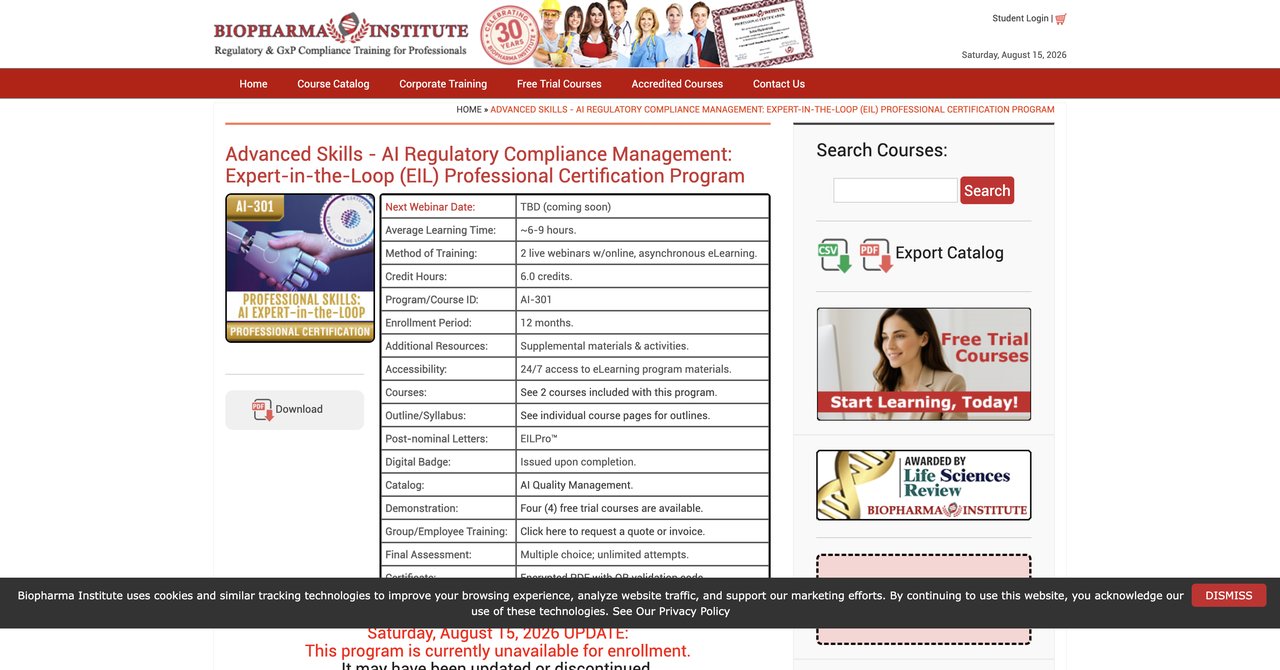
BioPhMA's course is an advanced certification for Expert-in-the-Loop roles. It covers AI, ML, and LLM integration in life sciences. The course includes live webinars and eLearning. The cost is $6,590 USD, which is by far the most expensive option on this list. This is a significant investment, and it's clearly aimed at professionals who are serious about moving into advanced roles.
The Expert-in-the-Loop concept is important. It means that AI systems are designed to work with human experts, not replace them. The course covers how to integrate AI, ML, and LLM into life sciences, which is a broad and complex topic. The live webinars are a useful feature, because they allow you to interact with instructors and ask questions in real time.
The high cost is the biggest barrier. You'd need to be fairly confident that this course will lead to a significant career benefit to justify the price. The course also requires prior knowledge of AI and regulatory affairs, so it's not suitable for beginners. There are no student reviews available, which makes it hard to assess the quality of the course.
Key topics covered: AI, ML, and LLM integration in life sciences, Expert-in-the-Loop roles, regulatory compliance.
Target audience and skill level: Advanced professionals with prior knowledge of AI and regulatory affairs who want to move into expert roles.
Pros:
- Advanced certification for Expert-in-the-Loop roles
- Covers AI, ML, and LLM integration in life sciences
- Includes live webinars and eLearning
Cons:
- Very high cost
- Requires prior knowledge of AI and regulatory affairs
Who would benefit most: Senior professionals who want to move into AI-focused roles in life sciences and are willing to invest a significant amount of money in their education. This is a high-level certification, so it's not for beginners.
Course 8: GenAI for Compliance Officers by Coursera
Coursera GenAI for Compliance Officers
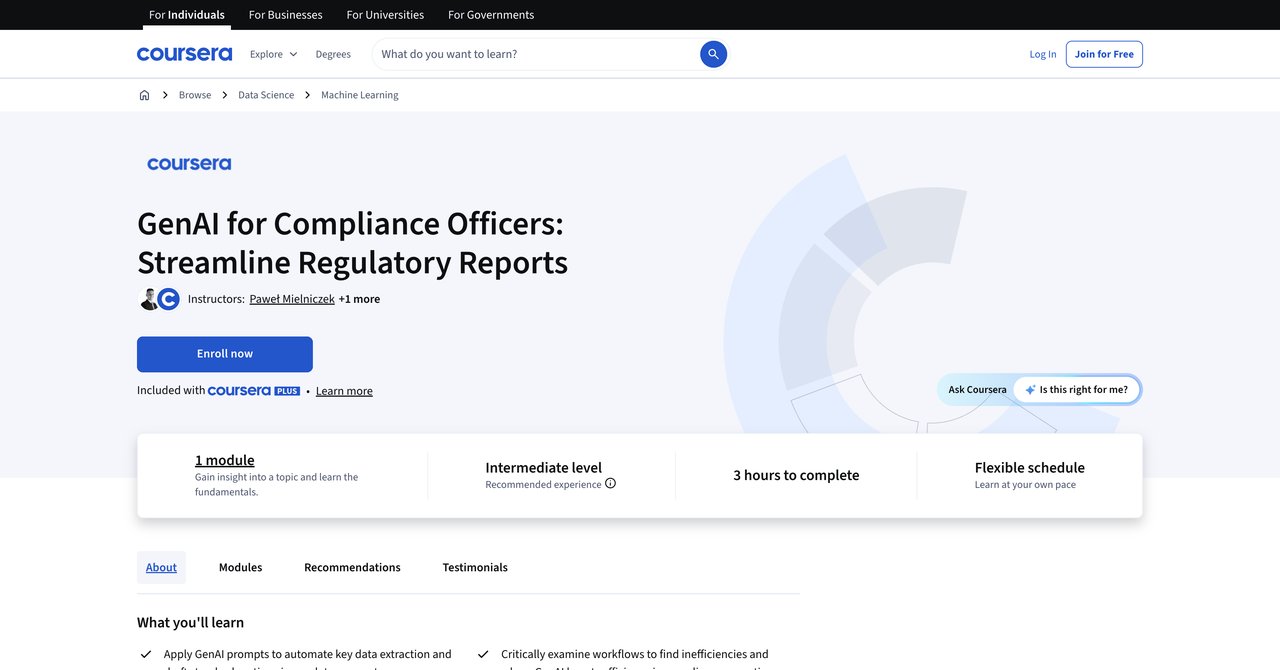
Coursera's course is a short, practical course that focuses on using Google Gemini and Microsoft Copilot for compliance work. It covers automating data extraction and drafting regulatory reports. The course includes AI-powered workflow design. It's free to audit, or you can pay for a subscription to get a certificate. The course is only 3 hours long, so it's a quick introduction rather than a deep dive.
The hands-on practice with specific tools like Google Gemini and Microsoft Copilot is a useful feature. You get to work with the actual tools you might use in your job. The focus on automating data extraction and drafting regulatory reports is also practical, since those are time-consuming tasks for compliance officers. The AI-powered workflow design is also useful for understanding how to integrate AI into your daily work.
The main limitation is the length. 3 hours is not enough to cover these topics in depth. It's more of a taster course than a comprehensive training. There's also no instructor interaction, so if you get stuck, you're on your own. The course is a good starting point, but you'd need to supplement it with more learning.
Key topics covered: Google Gemini and Microsoft Copilot, automating data extraction, drafting regulatory reports, AI-powered workflow design.
Target audience and skill level: Compliance officers who want a quick introduction to using AI tools for regulatory reporting.
Pros:
- Hands-on practice with Google Gemini and Microsoft Copilot
- Focuses on automating data extraction and drafting regulatory reports
- Includes AI-powered workflow design
Cons:
- Limited to 3 hours of content
- No instructor interaction
Who would benefit most: Professionals who want a quick, free introduction to using AI tools for compliance work. If you're not sure if AI is relevant to your work, this is a low-commitment way to find out.
Course 9: CAIDRA - Certified AI in Drug Regulatory Affairs
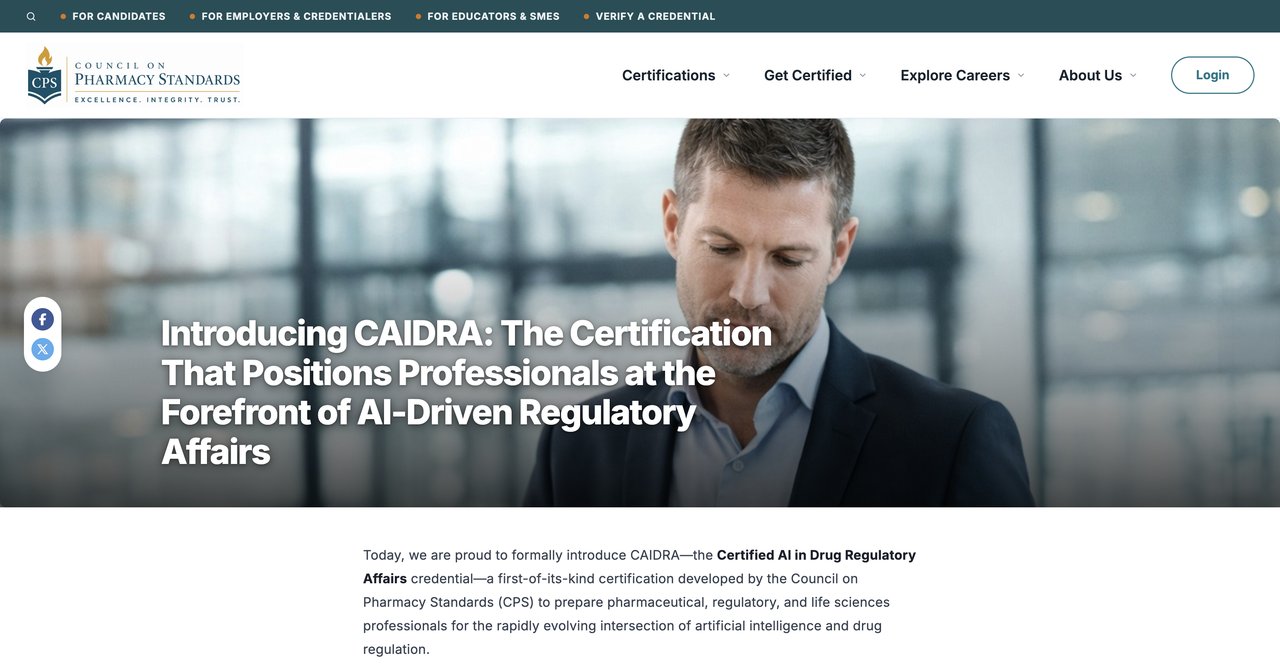
CAIDRA is a certification offered by the Council on Pharmacy Standards. It's described as a first-of-its-kind certification covering FDA and EMA AI guidance. The course includes real-world case studies and hands-on tool training. It's self-paced and fully online, which makes it flexible for professionals who are working full-time. The cost is $799.
The focus on FDA and EMA AI guidance is important, since those are the two main regulatory bodies for drug approval. The real-world case studies and hands-on tool training are also useful. The self-paced format is a plus for busy professionals who can't commit to a fixed schedule. The course is fully online, which means you can study from anywhere.
However, this is a new certification with no reviews yet. That's a significant risk, because you can't verify the quality of the course. The recognition of the certification is also limited in the industry, which might affect how employers view it. The cost is $799, which is in the mid-range for this type of certification.
Key topics covered: FDA and EMA AI guidance, real-world case studies, hands-on tool training.
Target audience and skill level: Regulatory professionals who want to get certified in AI for drug regulatory affairs.
Pros:
- First-of-its-kind certification covering FDA and EMA AI guidance
- Includes real-world case studies and hands-on tool training
- Self-paced and fully online
Cons:
- New certification with no reviews yet
- Limited recognition in the industry
Who would benefit most: Professionals who want to get a certification in AI for drug regulatory affairs and are willing to take a risk on a new certification. If you're looking for a structured certification with hands-on training, this could be worth considering, but you'd need to be aware of the risks.
Course 10: Specialist for AI-Based Medical Devices and In-vitro Diagnostics by encotec
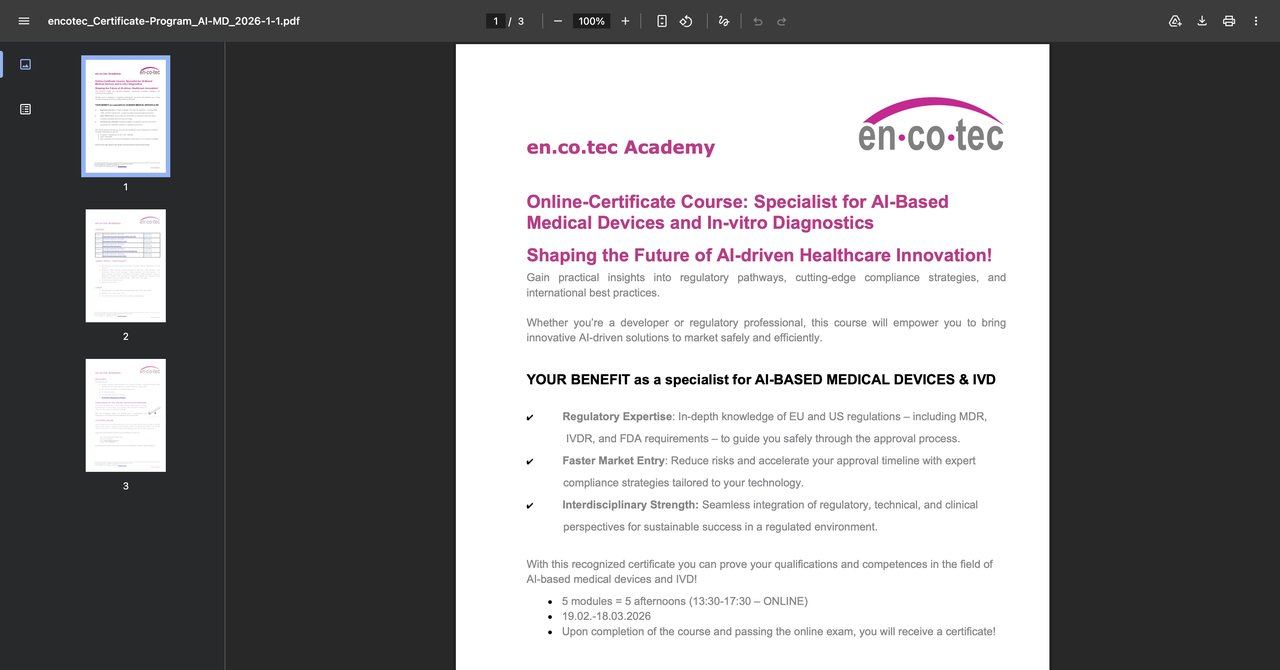
encotec offers a certificate course for specialists in AI-based medical devices and in-vitro diagnostics. The course covers EU MDR, IVDR, and FDA regulations for AI-based medical devices. It includes risk management and post-market surveillance modules. The course is delivered through live online sessions. The cost is €1,175 for early bird or €1,295 standard, which is roughly $1,270 to $1,400.
The focus on EU MDR and IVDR is particularly relevant for professionals working in Europe. These regulations are complex, and having a specialist certification in this area could be valuable. The course also covers FDA regulations, which makes it relevant for professionals working in the US market. The risk management and post-market surveillance modules are also important, since those are key areas for medical device compliance.
The live online sessions are a plus, because they allow for interaction with instructors. However, the course is limited to 5 modules, which might not be enough to cover everything in depth. There are also no student reviews available, so you can't verify the quality of the course.
Key topics covered: EU MDR, IVDR, and FDA regulations for AI-based medical devices, risk management, post-market surveillance.
Target audience and skill level: Professionals working with AI-based medical devices and in-vitro diagnostics who need to understand the regulatory landscape.
Pros:
- Covers EU MDR, IVDR, and FDA regulations for AI-based medical devices
- Includes risk management and post-market surveillance modules
- Live online sessions
Cons:
- Limited to 5 modules
- No student reviews
Who would benefit most: Professionals who work with AI-based medical devices and in-vitro diagnostics, particularly those who need to understand EU MDR and IVDR regulations. If you're in this niche, this course could be valuable.
Final Recommendations: Which Course Should You Choose?
Alright, let's cut through the noise and give you some straight answers. You've seen all the options, and now you need to decide what's right for you. Here's how I'd think about it, based on your situation.
If you're looking for the best overall value and the most comprehensive coverage, CompleteAI Training is the strongest option. The flat subscription price gives you access to every course and every certification on the platform, not just the ones for regulatory affairs. That's a huge advantage if you want to learn about AI across different functions or if you're planning to move roles in the future. The price is also very affordable compared to the other options, especially with the annual billing. The subscription model makes sense because AI is evolving continuously and you'll want to keep learning as new tools and regulations come out.
If you're on a tight budget and just want a quick introduction, the Coursera course on GenAI for Compliance Officers is a good starting point. It's free to audit, so you can check it out without spending any money. It's only 3 hours long, so it won't take up too much of your time. It's a good way to get a feel for what AI tools can do for your work. But it's not comprehensive, so you'd need to move on to something more substantial after that.
If you're a medical device specialist, the UCSC courses are worth looking at. The FDA Submissions Using AI Tools course is particularly useful if you already know medical device regulations and want to learn how to use AI for submissions. The Regulatory Strategy and FDA Negotiation course is also good if you're working with Q-submissions. Both courses are from a well-known university, so they have some credibility, but there are no student reviews to confirm their quality.
If you're working in Europe, the encotec course is worth considering. It covers EU MDR and IVDR, which are important for medical device professionals in Europe. The course is limited to 5 modules, but it covers the key topics you'd need. The live online sessions are a plus, and the pricing is reasonable.
If you're looking for an advanced certification and have a significant budget, BioPhMA's course is the most comprehensive. The $6,590 price tag is steep, but it covers AI, ML, and LLM integration in life sciences. This is a course for professionals who want to move into expert-in-the-loop roles. You'd need prior knowledge of AI and regulatory affairs to get the most out of it.
The other options - Udemy, Stanmore, CAIDRA, and DIA - are more of a mixed bag. Udemy's course is affordable but lacks reviews. Stanmore's course covers advanced topics but the institution isn't well-known. CAIDRA is new and unproven. DIA has a good reputation but the pricing isn't public. Each of these has its merits, but they're not the strongest options for most professionals.
One thing to keep in mind: the field of AI in regulatory affairs is still developing. There's no single course that's going to give you everything you need. The best approach is probably to start with a comprehensive option like CompleteAI Training and then supplement it with more specialized courses as you identify specific gaps in your knowledge. That way you get the broad foundation you need and the deep knowledge you need in specific areas.
Also, don't forget to check out the links and do your own research. The course landscape is changing all the time, and new options are appearing regularly. What's the best option today might not be the best option in six months. So keep learning, keep exploring, and don't be afraid to switch if you find something better.
Ultimately, the best course for you depends on your specific needs, your budget, and your career goals. If you want the most comprehensive coverage for a low price, CompleteAI Training is the way to go. If you need a quick introduction, Coursera is a good starting point. If you're a medical device specialist, the UCSC courses are worth looking at. And if you're looking for an advanced certification, BioPhMA is the most comprehensive. Make your decision based on what you need, and you'll be on the right track.
You might also like