AI app for it and development · no coding needed
Vector search library and data stewardship console
Reduce the number of rented vector services while keeping one searchable, governed store of embeddings and metadata.
Made for: Product and platform teams embedding semantic search, recommendations and retrieval into their own applications
What it does for you
The problem
Vector search is spread across several rented services, so embeddings, indexes, filters, ranking and access rules live in different places and cannot be searched or governed as one library.
What it gives you
Searchable vector library with filters, ranking and access rules
What you give it
Permitted documentsimagesaudioevent dataembedding model choicefilterranking rulesaccess policies
Build your own version of SemaDB, Pinecone Serverless and more
One app with what these 10 AI tools do, yours to keep and change: SemaDB, Pinecone Serverless, Zilliz Cloud, Asimov, Zilliz Cloud Serverless, Firebase Vector Search, Marqo, Actian VectorAI DB, Meilisearch AI, SuperDuperDB.
Everything these tools do, in one app
- Vector similarity search Finds items that are similar to a query using vector embeddings.Found in SemaDB, Pinecone Serverless, Zilliz Cloud and 6 more
- Fully managed service Runs the database for you so you don't have to manage servers or infrastructure.Found in SemaDB, Pinecone Serverless, Zilliz Cloud and 3 more
- Automatic scaling Adjusts resources automatically as your data and query load grow.Found in SemaDB, Pinecone Serverless, Zilliz Cloud and 3 more
- No manual tuning Avoids the need to configure schemas, pod sizes, or search algorithms.Found in SemaDB, Asimov
- Automatic backups Backs up your data automatically to protect against loss.Found in SemaDB, Pinecone Serverless
- Automatic sharding Distributes data across multiple nodes automatically for performance.Found in SemaDB
- RESTful API Lets you interact with the service using standard HTTP requests.Found in SemaDB, Asimov, Zilliz Cloud Serverless and 3 more
- Interactive playground Provides a web-based tool to test API requests and see examples.Found in SemaDB, Asimov
- Multi-language examples Offers example requests in many programming languages to help you get started.Found in SemaDB
- Free tier Allows you to start using the service without upfront cost.Found in SemaDB, Asimov, Actian VectorAI DB and 2 more
- Usage-based pricing Charges based on the amount of data processed and queries executed.Found in Pinecone Serverless, Zilliz Cloud, Zilliz Cloud Serverless and 1 more
- Automatic indexing Indexes data automatically to speed up search and streamline development.Found in Pinecone Serverless, SuperDuperDB
- Integration with AI frameworks Works with popular machine learning and data processing tools.Found in Pinecone Serverless, Zilliz Cloud, Zilliz Cloud Serverless and 1 more
- Support for multiple data types Handles vectors from images, text, audio, and other unstructured data.Found in Zilliz Cloud, Marqo
- Security and compliance Provides encryption, access control, and compliance certifications for enterprise use.Found in Zilliz Cloud, Zilliz Cloud Serverless, Actian VectorAI DB
- Hosted re-ranking Uses hosted models to re-rank search results for better relevance.Found in Asimov
- Custom filtering Lets you filter search results using custom parameters.Found in Asimov, Meilisearch AI
- Usage tracking Tracks usage and events to help you monitor and debug.Found in Asimov
- 24/7 support Provides round-the-clock support for production workloads.Found in Asimov
- Firebase integration Integrates with Firebase services like Firestore and Authentication.Found in Firebase Vector Search
- Real-time synchronization Keeps data updated in real time across devices and platforms.Found in Firebase Vector Search, SuperDuperDB
- Portable deployment Runs on edge devices, on-prem servers, and cloud with the same API.Found in Actian VectorAI DB
- Edge and offline operation Supports local, low-bandwidth, or disconnected use cases.Found in Actian VectorAI DB
- SDKs and integrations Provides SDKs and compatibility with tools like LangChain and LlamaIndex.Found in Actian VectorAI DB
- Container and orchestration support Distributed as a Docker container and compatible with Kubernetes, Helm, and Terraform.Found in Actian VectorAI DB
- Open-source and self-hosted Allows you to host the search engine on your own infrastructure with no licensing fees.Found in Meilisearch AI
- AI-powered ranking Uses machine learning to rank search results for better relevance.Found in Meilisearch AI
- Natural language query Lets you query the database using plain English.Found in SuperDuperDB
- Customizable dashboards Provides dashboards and reporting tools for data visualization.Found in SuperDuperDB
How it works, step by step
- Ingest vectors from text, images, audio and other unstructured data
- Run vector similarity search against a query embedding
- Apply custom filters to search results
- Re-rank results with hosted models
- Index data automatically as it arrives
- Keep data synchronized in real time across devices and platforms
- Expose a RESTful API and multi-language examples
- Provide an interactive playground for test requests
- Connect AI frameworks and SDKs such as LangChain and LlamaIndex
- Support natural language queries over the library
- Show customizable dashboards and usage tracking
- Enforce encryption, access control and compliance rules
- Run the same API on cloud, on-prem and edge devices
- Back up and shard data automatically
- Compare the reviewed result with the recorded baseline and value assumptions
- Capture corrections and named-owner approval before consequential use
- Export a versioned searchable vector library with source references and unresolved questions
Jobs this app suits
Our AI checked this app against 500 jobs; these get the most out of it. Each job links to its learning path.
Build it yourself with your AI system
Build this app yourself, no coding needed
Start with a quick version you can try in a few minutes. Like it? Then build the full app by copying and pasting our step-by-step instructions: everything is prepared for you.
Sign in to see how to build it yourself
Build a quick version to try, or get the full app pack for Vector search library and data stewardship console with the step-by-step building instructions. You don't need any technical skills: you copy, paste and answer a few questions. Both are included in the membership.
4 Have it built for you days to a few weeks
Rather not do it yourself, or want it fully tailored to your data, your way of working and your brand? Nexibeo builds Vector search library and data stewardship console with you.
What's in the app pack
Included in the Complete AI Training membership.
- The building instructions your AI follows, step by step
- The questions your AI will ask you about your business before it starts
- A clickable demo you can open in your browser, to see how it should work
- A detailed blueprint of the screens, the information it keeps and the checks it runs
Become a member to get the app packAlready a member? Sign in
The files, for the technically curious
- START-HERE.mdHow to build it with your own AI (read first)3 KB
- README.mdOverview and links6 KB
- questions.mdQuestions to answer before you build2 KB
- prompt-cloudflare.mdThe full build prompt, hosted on Cloudflare24 KB
- prompt-vps.mdThe same build on your own server (Docker)24 KB
- spec.jsonData model, API, AI pipeline, acceptance criteria11 KB
- demo/index.htmlThe working demo on sample data197 KB
Questions
Do I need to know how to code?
No. You copy and paste the prompts on this page into ChatGPT or Claude, and the AI does the building. When it asks you something, you answer in your own words.
What does it cost?
The quick version, the app pack and the step-by-step instructions are for members: you pay the membership price, not a price per app (see the plans). Building the full app uses your own ChatGPT or Claude subscription. Putting it online is often cheap or no cost at the start, and your AI tells you before anything costs money.
How long does it take?
The quick version: about two minutes. The real app: an afternoon for a first version you can use, longer if you want every feature.
Can I change it to fit my business?
Yes. Tell your AI what to change in plain words, like “add a column for the price” or “use our logo and colours”. Or have Nexibeo build and customise it for you.
More detailsHow the AI works, safeguards and what to build first
Reduce the number of rented vector services while keeping one searchable, governed store of embeddings and metadata. For product and platform teams embedding semantic search, recommendations and retrieval into their own applications, convert permitted documents, images, audio and event data into a searchable vector library with filters, ranking and access rules. The benefit is a testable hypothesis, measured through accepted search results per query and retrieval errors after release; do not assume that AI output alone produces business value.
Confirm the buyer's problem and scope, collect permitted documents, images, audio and event data, then follow this sequence: 1. Ingest vectors from text, images, audio and other unstructured data. 2. Run vector similarity search against a query embedding. 3. Apply custom filters to search results. 4. Re-rank results with hosted models. Resolve uncertain cases with qualified reviewers, approve the searchable vector library with filters, ranking and access rules, and measure accepted search results per query and retrieval errors after release against a documented baseline.
How the AI works
Use AI to interpret permitted inputs, suggest structured mappings and generate candidate outputs for the stated task modules. Use deterministic code for arithmetic, schema validation, hard constraints and reproducible tests. Review source-linked explanations and uncertainty before accepting results. One fixed embedding model and index configuration; final relevance and access checks remain with the owning team. A model suggestion is never a verified fact, professional decision or authorization to act.
Safeguards
Preserve source attribution, embedding provenance, access permissions and usage rights. The owning team approves substantive changes and publication scope. One fixed embedding model and index configuration; final relevance and access checks remain with the owning team. Keep all consequential actions under authorized human control and do not fabricate missing inputs, permissions, professional judgments or market evidence.
What to build first
Pilot scope: One fixed embedding model and index configuration; final relevance and access checks remain with the owning team. Implement one approved input format, a bounded representative case set and the first two task modules: ingest vectors from text, images, audio and other unstructured data; run vector similarity search against a query embedding. Support the third module with operator review: apply custom filters to search results. Include source references, corrections, basic organization access, approval states, export and value measurement. Use managed operator assistance for unresolved exceptions. The cost estimate covers this narrow prototype, not unrestricted multi-tenant scale, complex production integrations, specialist certification or physical operations.
What it can connect to
Customer-owned documents, authorized media and permitted event data. Cloud asset storage, AI framework and SDK connections, and application destinations. Start with file exchange and validate destination specifications before promising direct publishing. Start with authorized file exchange. Validate current provider access, usage rights and schema behavior before promising a connector.
The screens in detail
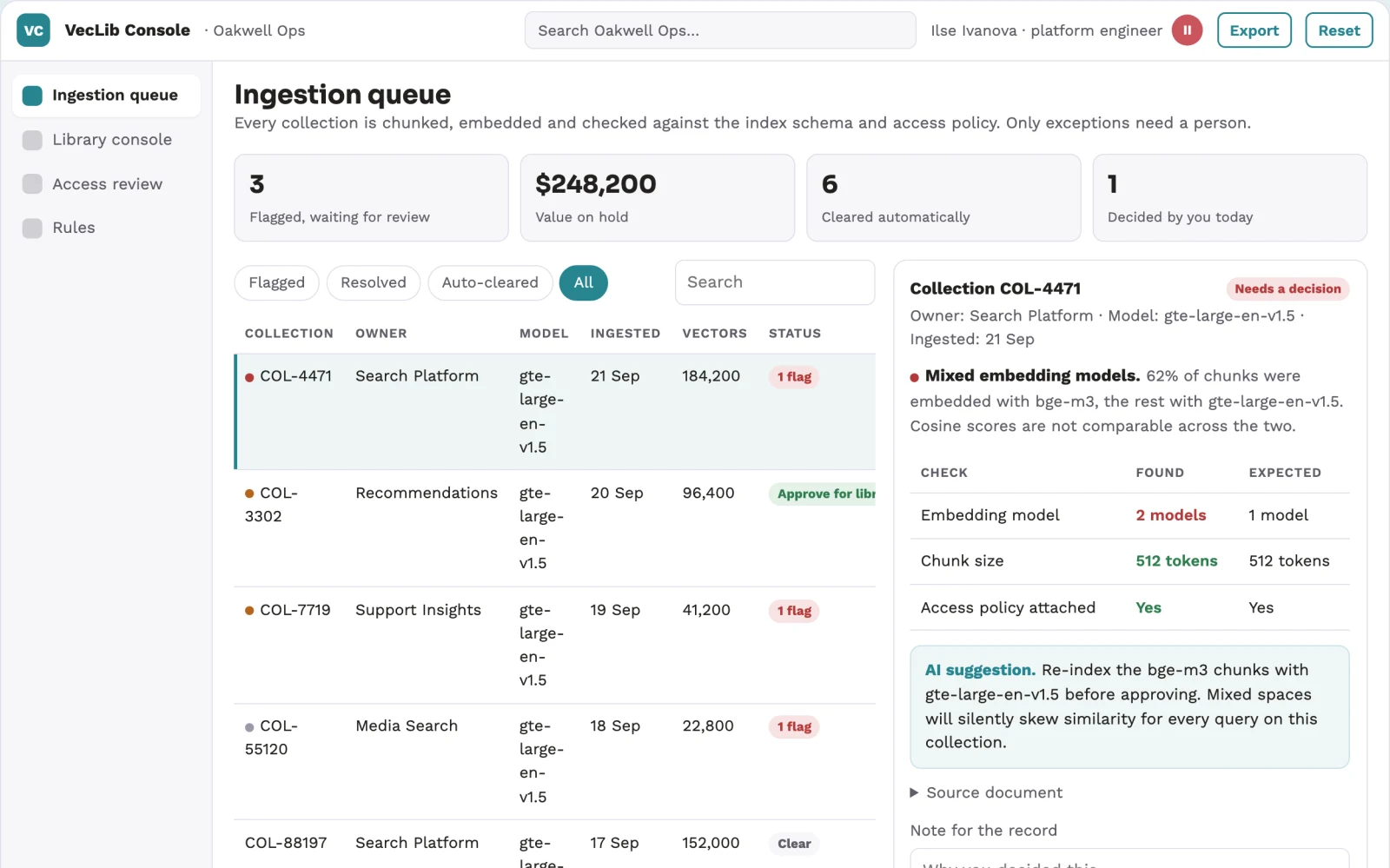
Primary screens: Data source and ingestion, Searchable library console, Access and usage review. Use a thumbnail gallery for collections, a large central search and result canvas, and a right-hand panel for filters, ranking and comments. Let users compare result sets side by side. Display draft, indexed and approved states. Provide a client preview link with comments anchored to the relevant record. Make the task-specific outcome a searchable vector library with filters, ranking and access rules visible beside its evidence, review state and value baseline.