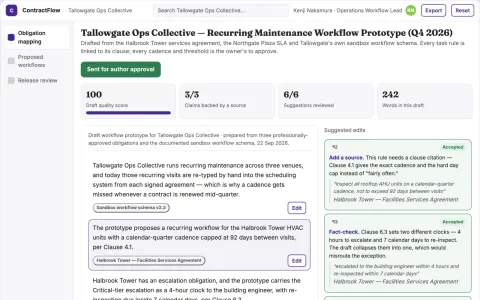
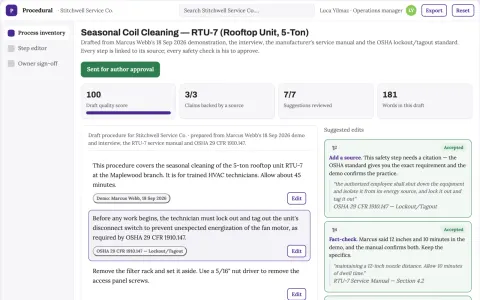
AI app for operations · no coding needed
Document data extraction and validation workspace
Reduce manual document handling while keeping a named reviewer accountable for every extracted record.
Made for: Operations teams processing high volumes of invoices, forms and scanned documents
What it does for you
The problem
Key data is trapped in mixed-format documents and manual entry causes errors, delays and rework.
What it gives you
Reviewer-approved extracted records linked to source pages
What you give it
Supplied PDFsimagesscansstructured files
Build your own version of docTI Custom Document Processing, SenseTask and more
One app with what these 4 AI tools do, yours to keep and change: docTI Custom Document Processing, SenseTask, Invofox 2.0, SmolDocling.
Everything these tools do, in one app
- Document data extraction Automatically pulls key information from documents.Found in docTI Custom Document Processing, SenseTask, Invofox 2.0 and 1 more
- Document classification Categorizes documents by type.Found in docTI Custom Document Processing, SenseTask, Invofox 2.0
- Multiple format support Handles various document formats like PDFs, images, and scanned files.Found in docTI Custom Document Processing, SenseTask, SmolDocling
- Customizable field extraction Lets users specify which fields to extract from documents.Found in SenseTask
- Workflow automation Automates document-related workflows and approvals.Found in SenseTask
- System integration Connects with existing business systems like ERP and CRM.Found in docTI Custom Document Processing, SenseTask
- Data validation Checks extracted data for errors and applies validation rules.Found in docTI Custom Document Processing, Invofox 2.0
- Scalable processing Handles varying document volumes efficiently.Found in docTI Custom Document Processing
- Continuous learning Improves accuracy over time through AI refinement.Found in SenseTask
- Accuracy experimentation Provides a workflow to test and measure extraction accuracy before deployment.Found in Invofox 2.0
- Cross-field validation Validates relationships between fields, such as totals matching.Found in Invofox 2.0
- Webhook support Enables integration hooks for handling failed validations and human-in-the-loop workflows.Found in Invofox 2.0
- High-variance input handling Processes messy, real-world documents effectively.Found in Invofox 2.0
- Layout recognition Identifies page layout elements like paragraphs, headings, and lists.Found in SmolDocling
- Table extraction Extracts tables with their structure and content.Found in SmolDocling
- Code block detection Detects and formats code blocks, preserving indentation.Found in SmolDocling
- Equation and figure handling Handles equations and figures, linking captions appropriately.Found in SmolDocling
How it works, step by step
- Extract key fields from supplied documents
- Classify documents by type
- Accept PDFs, images, scans and structured files
- Let users define which fields to extract
- Automate document workflows and approvals
- Connect to ERP, CRM and storage systems
- Apply validation rules to extracted data
- Process varying document volumes
- Refine extraction accuracy from reviewer corrections
- Run accuracy experiments before deployment
- Validate relationships between fields, such as totals matching
- Send webhooks for failed validations and human-in-the-loop steps
- Handle messy real-world documents
- Recognize layout elements such as paragraphs, headings and lists
- Extract tables with structure and content
- Detect code blocks and preserve indentation
- Link equations and figures to their captions
- Compare the reviewed result with the recorded baseline and value assumptions
- Capture corrections and named-owner approval before consequential use
- Export a versioned reviewer-approved extracted records linked to source pages with source references and unresolved questions
Jobs this app suits
Our AI checked this app against 500 jobs; these get the most out of it. Each job links to its learning path.
Build it yourself with your AI system
Build this app yourself, no coding needed
Start with a quick version you can try in a few minutes. Like it? Then build the full app by copying and pasting our step-by-step instructions: everything is prepared for you.
Sign in to see how to build it yourself
Build a quick version to try, or get the full app pack for Document data extraction and validation workspace with the step-by-step building instructions. You don't need any technical skills: you copy, paste and answer a few questions. Both are included in the membership.
4 Have it built for you days to a few weeks
Rather not do it yourself, or want it fully tailored to your data, your way of working and your brand? Nexibeo builds Document data extraction and validation workspace with you.
What's in the app pack
Included in the Complete AI Training membership.
- The building instructions your AI follows, step by step
- The questions your AI will ask you about your business before it starts
- A clickable demo you can open in your browser, to see how it should work
- A detailed blueprint of the screens, the information it keeps and the checks it runs
Become a member to get the app packAlready a member? Sign in
The files, for the technically curious
- START-HERE.mdHow to build it with your own AI (read first)3 KB
- README.mdOverview and links4 KB
- questions.mdQuestions to answer before you build3 KB
- prompt-cloudflare.mdThe full build prompt, hosted on Cloudflare26 KB
- prompt-vps.mdThe same build on your own server (Docker)26 KB
- spec.jsonData model, API, AI pipeline, acceptance criteria14 KB
- demo/index.htmlThe working demo on sample data199 KB
Questions
Do I need to know how to code?
No. You copy and paste the prompts on this page into ChatGPT or Claude, and the AI does the building. When it asks you something, you answer in your own words.
What does it cost?
The quick version, the app pack and the step-by-step instructions are for members: you pay the membership price, not a price per app (see the plans). Building the full app uses your own ChatGPT or Claude subscription. Putting it online is often cheap or no cost at the start, and your AI tells you before anything costs money.
How long does it take?
The quick version: about two minutes. The real app: an afternoon for a first version you can use, longer if you want every feature.
Can I change it to fit my business?
Yes. Tell your AI what to change in plain words, like “add a column for the price” or “use our logo and colours”. Or have Nexibeo build and customise it for you.
More detailsHow the AI works, safeguards and what to build first
Reduce manual document handling while keeping a named reviewer accountable for every extracted record. For operations teams processing high volumes of invoices, forms and scanned documents, convert supplied PDFs, images, scans and structured files into reviewer-approved extracted records linked to their source pages. The benefit is a testable hypothesis, measured through accepted records per operator hour and corrections after downstream posting; do not assume that AI output alone produces business value.
Confirm the buyer's problem and scope, collect supplied PDFs, images, scans and structured files, then follow this sequence: 1. Extract key fields from supplied documents. 2. Classify documents by type. 3. Apply validation rules to extracted data. 4. Validate relationships between fields, such as totals matching. Resolve uncertain cases with qualified reviewers, approve reviewer-approved extracted records linked to source pages, and measure accepted records per operator hour and corrections after downstream posting against a documented baseline.
How the AI works
Use AI to interpret permitted inputs, suggest structured mappings and generate candidate outputs for the stated task modules. Use deterministic code for arithmetic, schema validation, hard constraints and reproducible tests. Review source-linked explanations and uncertainty before accepting results. Final posting, payment and compliance decisions remain human. A model suggestion is never a verified fact, professional decision or authorization to act.
Safeguards
Preserve source attribution, field accuracy and usage permissions. Named reviewers approve extracted records and downstream posting scope. One document family and one approved export destination; final posting and compliance checks remain human. Keep all consequential actions under authorized human control and do not fabricate missing inputs, permissions, professional judgments or market evidence.
What to build first
Pilot scope: One document family and one approved export destination; final posting and compliance checks remain human. Implement one approved input format, a bounded representative case set and the first two task modules: extract key fields from supplied documents; classify documents by type. Support the remaining modules with operator review: apply validation rules to extracted data; validate relationships between fields, such as totals matching. Include source references, corrections, basic organization access, approval states, export and value measurement. Use managed operator assistance for unresolved exceptions. The cost estimate covers this narrow prototype, not unrestricted multi-tenant scale, complex production integrations, specialist certification or physical operations.
What it can connect to
Buyer-owned document repositories, ERP and CRM systems, cloud storage and webhook endpoints. Start with file exchange and validate destination specifications before promising direct posting. Start with authorized file exchange. Validate current provider access, usage rights and schema behavior before promising a connector.
The screens in detail
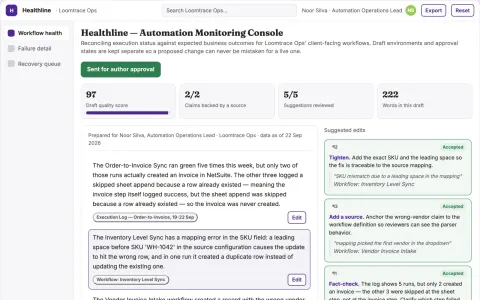
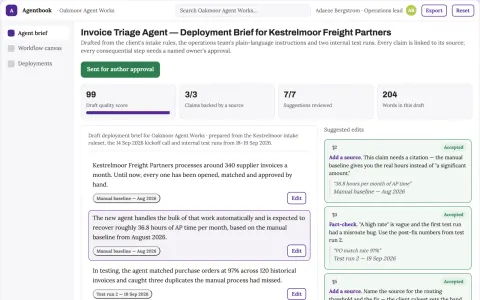
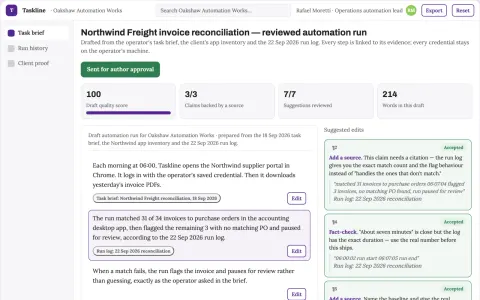
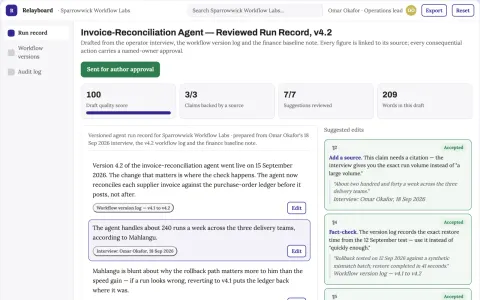
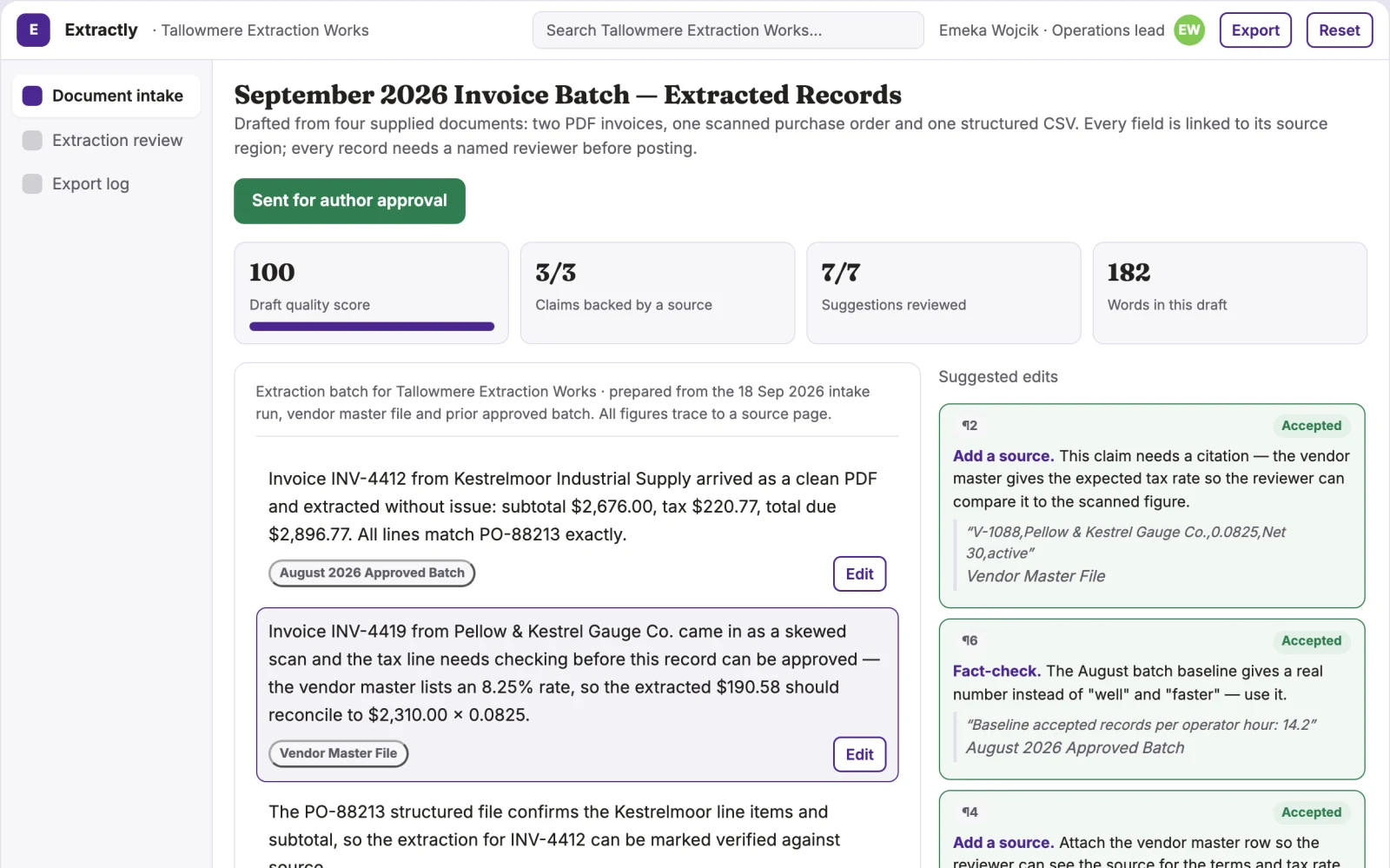
Primary screens: Document intake and classification, Extraction review and validation, Export and system handoff. Use a queue view for incoming documents, a large central viewer showing the source page beside extracted fields, and a right-hand panel for validation rules, confidence and comments. Let users compare extracted values against source regions. Display draft, changes requested and approved states. Provide a webhook and export log view for failed validations and human-in-the-loop steps. Make the task-specific outcome reviewer-approved extracted records linked to source pages visible beside its evidence, review state and value baseline.