Self-Improving AI Agents: From Scaling Laws to Agentic Systems (Video Course)
Ask an AI model a hard problem once, it might fail. Ten thousand tries? It might succeed. The knowledge was there all along. Stanford CS329A shows how inference-time scaling and self-improvement loops turn that hidden capability into systems you can build.
Related Certification: Certification in Building Self-Improving AI Agent Systems

Also includes Access to All:
What You Will Learn
- Explain scaling laws, emergent capabilities, and scaling limits
- Summarize the post-training pipeline: fine-tuning, instruction tuning, RLHF
- Apply inference-time scaling and verifier-based sampling strategies
- Design agentic workflows with planning, tool use, and orchestration
- Implement self-improvement loops using synthetic data and verifiable rewards
- Evaluate verifier bottlenecks, reliability trade-offs, and governance implications
Study Guide
# Stanford CS329A: Self-Improving AI Agents , Part 1: Course Overview and Technical Foundations ## Introduction: Why This Course Matters Right Now Here's something that might surprise you. The AI models you're using today,the ones writing code, answering questions, generating reports,are not the same models that existed even a year ago. Not because the architectures changed dramatically. Not because someone discovered some completely new breakthrough. But because we figured out something fundamental about how these systems actually work. They know more than they show. Ask a large language model a difficult math problem once, and it might fail. Ask it ten thousand times, and it might solve it. The knowledge was there all along,locked inside the weights, waiting for the right conditions to emerge. This single insight has reshaped the entire field of artificial intelligence, and it's the foundation for everything we're going to explore in this course. CS329A at Stanford is about the convergence of several powerful ideas: scaling laws that made large language models possible, inference-time computation that extracts hidden capabilities, and the self-improvement loops that allow AI systems to generate their own training data and get better at what they do. This isn't theoretical speculation. These are working systems deployed in production right now, transforming how software gets written, how research gets conducted, and how customer support operates. If you're a developer, a researcher, a product manager, or a technology leader, understanding these concepts isn't optional anymore. The shift from single-turn chatbots to goal-oriented agents that can plan, execute, and verify their own work represents one of the most significant advances in applied AI. And the people who understand how these systems work,really understand them, not just how to prompt them,are the ones who'll be building what comes next. Let's start from the beginning and build up to the frontier. --- ## Section 1: The Scaling Laws That Started Everything ### What Scaling Laws Actually Tell Us Before we get into agents and self-improvement, we need to understand how we got here. And that story starts with a remarkably simple empirical observation. Language models improve when you make them bigger. Not just a little bit,predictably, consistently, along a curve that you can plot and extrapolate. This relationship is formalized in what we call scaling laws, and they operate along three primary axes: **Compute**: The total computational budget used for training. More compute reliably decreases the test loss,the measure of how well the model predicts unseen data. **Dataset size**: The amount of training data. Larger datasets consistently produce better models, assuming everything else stays constant. **Parameter count**: The number of weights in the neural network. More parameters,more layers, more width,improves the final performance. These three factors work together. If you scale all three proportionally, you get predictable, reliable improvements. This was first systematically documented with GPT-3, and it held true through PaLM, through GPT-4, through Gemini. It became the roadmap for the entire industry. Here's a concrete example of how this played out. When OpenAI released GPT-3 with 175 billion parameters, it was a monumental leap from GPT-2's 1.5 billion. But even that seemed modest compared to what came after. PaLM hit 540 billion parameters. GPT-4 is estimated to be in the trillions. Each step along this trajectory produced models that were not just incrementally better, but qualitatively different in what they could do. ### The Emergent Capabilities Nobody Predicted Here's where things get interesting. Scaling laws predicted that models would get better at predicting the next token. What they didn't predict was that entirely new capabilities would emerge at certain scales,abilities that simply didn't exist in smaller models. **Few-shot learning** is a perfect example. Give a sufficiently large model a prompt with a few examples of a task, and it can infer the pattern and apply it to new inputs. No weight updates. No fine-tuning. Just the examples in the context window. Consider this: you want a model to translate English to French. You provide "cheese → fromage," "cat → chat," "dog → chien." Then you ask it to translate "house." A sufficiently large model will produce "maison" without ever having been explicitly trained on translation. **Zero-shot learning** takes this even further. The model performs a task given only a natural-language instruction, with no examples at all. "Translate English to French: cheese → ?" The model produces the correct answer because it has internalized enough about language structure to follow the instruction. These capabilities don't appear gradually. They emerge abruptly at certain scale thresholds. Research on models like LaMDA and GPT showed that smaller models,say, 8 billion parameters,show no benefit from chain-of-thought prompting. But at 62 billion parameters and above, the same prompting technique produces dramatic improvements on reasoning tasks. This is what we mean by emergent behavior. It wasn't predicted by scaling laws. It wasn't explicitly trained. It emerged from scale itself. ### The Limits of Pure Scaling Now, a crucial caveat. By around 2024, the pure pre-training scaling approach began showing signs of saturation. Doubling the compute wasn't producing the same returns it once did. The frontier labs were running into practical limits,data availability, training costs, energy consumption. This saturation forced the field to look elsewhere for capability gains. And that search led to a fundamental reframing of where intelligence lives in these systems. --- ## Section 2: The Post-Training Pipeline ### From Raw Model to Useful Assistant Here's something that might not be obvious if you've only interacted with ChatGPT or Claude. The model you're chatting with is not the model that comes out of pre-training. There's an entire pipeline of additional training that transforms a statistically capable but unsteered base model into something that actually follows instructions and behaves helpfully. Let's walk through each stage. **Stage 1: Pre-Training** The model is trained on internet-scale text corpora to predict the next token. It reads books, websites, code repositories, academic papers,hundreds of billions of tokens. What emerges is a statistical understanding of language and the world. The model knows facts. It knows grammar. It knows patterns of reasoning. But it doesn't know how to follow instructions. It doesn't know what's helpful or harmful. It's a raw statistical engine, not an assistant. **Stage 2: High-Quality Fine-Tuning** The first refinement involves continuing next-token prediction, but on much higher-quality data. Frontier labs reportedly spend tens or hundreds of millions of dollars licensing premium content,books, professional essays, curated corpora. This improves the model's writing quality, factual coherence, and stylistic sophistication. Think of it this way: pre-training gives the model a broad education from whatever's available on the internet. Fine-tuning is like sending it to a prestigious writing program where it studies under the best examples available. **Stage 3: Instruction Tuning** Now we teach the model to follow directives. Training data takes the form of instruction-response pairs: *"Please answer the following question: What is the boiling point of nitrogen?" → "-196°C (-321°F)"* Modern instruction-tuning datasets combine several sources: - Human-generated demonstrations created by contractors - Template-based role-play data covering common interaction patterns - Synthetic data generated by more capable models The quality and diversity of this dataset has an outsized impact on the final model's helpfulness and generalizability. Increasingly, instruction tuning includes chain-of-thought demonstrations that teach the model to reason step-by-step when appropriate. **Stage 4: RLHF,Reinforcement Learning from Human Feedback** This is where alignment happens. The process works like this: First, collect preferences. Human raters compare multiple model-generated responses to the same prompt and indicate which ones are better. These comparisons capture dimensions like correctness, helpfulness, specificity, and harmlessness. Second, train a reward model. This preference data trains a separate model to predict human judgments of output quality. The reward model learns to score any response based on how likely a human would be to prefer it. Third, optimize the policy. The language model,now acting as a policy,is fine-tuned to maximize the reward model's scores for its generations. This is done through reinforcement learning, typically using algorithms like PPO. The reward model can weight different dimensions of quality. A product aimed at general consumers might emphasize harmlessness. A coding assistant might emphasize correctness and specificity. These weights are tunable based on deployment goals. Here's a concrete example. Suppose you're building a customer support chatbot. The reward model might be trained to prefer responses that are: - Factually correct (the customer's account balance is accurate) - Helpful (the response actually solves the customer's problem) - Concise (doesn't waste the customer's time with irrelevant information) - Safe (doesn't reveal sensitive information or make promises the company can't keep) The RLHF process optimizes the model to produce responses that score highly across these dimensions. **Important caveat**: This pipeline produced ChatGPT, which reached one million users in five days,faster than any prior software product in history. But alignment remains an unsolved problem. RLHF improves behavior; it doesn't perfect it. Models can still be adversarial, can still hallucinate, can still produce harmful outputs in edge cases. --- ## Section 3: Inference-Time Scaling,The New Frontier ### The "Large Language Monkeys" Paradigm About a year and a half ago, a research direction emerged that fundamentally changed how we think about model capability. It's called inference-time scaling, and the core insight is deceptively simple. What if, instead of asking a model to solve a problem once, we asked it thousands of times,and then selected the best answer? The "Large Language Monkeys" project explored exactly this. Named after the infinite monkey theorem,the idea that a monkey randomly hitting keys for infinite time will eventually type Shakespeare,the researchers tested whether repeated sampling could unlock latent knowledge in fixed models. The workflow is straightforward: 1. Generate N parallel samples for a given input problem 2. Apply a verifier to filter outputs,unit tests for code, known answers for math 3. Return only the verified correct solutions ### What They Found The results were striking, and they've reshaped how we think about model evaluation. **Smaller models can outperform frontier models with enough samples.** A 7-billion-parameter model sampled ten thousand times outperformed GPT-4o at pass@1 on several math and coding benchmarks. Think about what that means. A model that's orders of magnitude smaller than the frontier, given enough attempts, can produce better results than a much larger model making a single attempt. **Coverage scales logarithmically.** The fraction of problems solved by at least one sample increases logarithmically with sample count. Each additional sample contributes less than the previous one, but the cumulative effect is substantial. **Models know more than they show.** For some problems, only three or four solutions out of ten thousand were correct. The model had the knowledge all along,it just couldn't reliably access it in a single generation. **Temperature matters.** The temperature parameter controls sample diversity. Higher temperatures produce more varied outputs, but beyond a threshold,typically around 1.2,quality degrades. You need diversity to explore different solution paths, but too much diversity produces nonsense. Here's a practical example. Imagine you're using a coding model to generate a function that sorts an array. You ask it once, and it produces a buggy implementation. But if you ask it a hundred times, you'll get a range of solutions. Some will be buggy. Some will be correct. With a unit test as a verifier, you can automatically identify the correct ones. The model didn't get smarter. You just gave it more chances to access what it already knew. ### The Verifier Bottleneck Now, the critical constraint. This approach works beautifully when you have objective verifiers. Math problems have known answers. Code has unit tests. Structured tasks have rule-based checks. But what about domains without clear verification? Creative writing. Strategic planning. Open-ended analysis. How do you know which of a hundred generated responses is actually good? This is the generator-verifier gap. Models can generate plausible outputs far more easily than they can identify which outputs are correct. It's easy to produce a convincing but wrong legal analysis. It's much harder to verify whether that analysis is actually sound. Researchers are attacking this problem from multiple angles: - Training specialized verifier models that evaluate output correctness - Combining multiple verifiers for ensemble checks - Using LLM-as-judge approaches where one model evaluates another's output - Developing process reward models that evaluate intermediate steps rather than just final answers The verifier bottleneck is one of the most important open problems in the field. It limits self-improvement, it limits inference scaling, and it limits agentic systems. If we could solve verification, a huge range of applications would suddenly become feasible. --- ## Section 4: Reasoning Models and the Thinking Paradigm ### From Sampling to Trained Reasoning Repeated sampling demonstrates what models could do with enough attempts. But reasoning models,like OpenAI's o1, DeepSeek-R1, and Gemini Thinking,represent the next evolution: models explicitly trained to reason internally before answering. These models don't just produce an answer. They produce a chain of thought. They analyze the problem. They decompose it. They evaluate their own progress. They catch their own errors and backtrack. They explore alternative approaches when one path fails. Here's what distinguishes reasoning models from standard LLMs: **Problem analysis**: The model begins by parsing the problem and identifying key constraints. What is actually being asked? What information is relevant? What approach makes sense? **Task decomposition**: Complex problems are broken into addressable subtasks. Instead of trying to solve everything at once, the model identifies manageable pieces. **Self-evaluation**: The model tests its intermediate outputs. It runs code. It checks arithmetic. It evaluates whether its current approach is actually working. **Self-correction**: When the model detects an error in its reasoning, it acknowledges it and adjusts. You'll see traces like "Wait, that's not right,let me reconsider." **Backtracking**: When a path fails, the model abandons it and tries alternatives. It doesn't get stuck in a single approach. ### The Scaling Law for Thinking OpenAI's o1 publication demonstrated something remarkable: test-time compute scales log-linearly with pass@1 accuracy on the AIME benchmark,a challenging math competition dataset. The same scaling relationship previously observed for training compute now held for inference compute alone, without changing any model parameters. This is huge. It means capability is partially a function of compute budget, not just model size. If you have more compute available at inference time, you can get better results from the same model. You can choose how much to think before answering. ### Where Reasoning Models Excel,and Where They Don't Reasoning models are not universally better. They're selectively better. They excel at: - Mathematics and calculation - Programming - Data analysis - Logic and planning They're not necessarily better at: - Personal writing - Text editing - Style-sensitive tasks - Open-ended creative work The reasoning advantage comes from learned thinking skills,analysis, decomposition, verification,that generalize beyond specific training tasks. But those skills aren't always relevant. If you're writing a heartfelt email or editing a blog post, extended deliberation might not help. It might even hurt, making the output overly analytical and stiff. Here's a useful way to think about it. Reasoning models are like people who think before they speak. That's valuable for complex problems. But for casual conversation, it makes them seem unnatural and overly deliberate. ### The Self-Improvement Loop Now we get to the heart of this course. The combination of test-time scaling and fine-tuning creates a powerful self-improvement cycle: 1. **Generate**: Models produce diverse reasoning traces and solutions for problems,often math or coding problems with known answers 2. **Filter**: Verifiers or reward models select high-quality responses 3. **Train**: The selected synthetic data becomes training material for fine-tuning 4. **Improve**: The fine-tuned model produces better generations, restarting the cycle Each iteration makes the model better at reasoning, which enables better synthetic data generation, which enables further improvement. Here's a concrete example. Suppose you have a model that's decent at math but not great. You give it a set of math problems. It generates thousands of solution attempts. You filter for correct answers using known solutions. You fine-tune the model on those correct solutions. The fine-tuned model is now better at math. You give it harder problems. It generates better solutions. You fine-tune again. Each cycle produces a more capable model. This loop,leveraging inference-time computation to generate training data that improves the model itself,is the essence of self-improving AI. It's particularly effective because test-time sampling generates data targeted to the model's own difficulty level, potentially filling gaps in human-curated training data. One fascinating finding: models tend to prefer their own generated traces over those from other models, even when the other model is stronger. This self-preference has implications for how we train multi-agent systems and how we curate synthetic data. --- ## Section 5: From Chatbots to Agents ### What Makes an Agent an Agent Traditional LLMs, even advanced reasoning models, operate as single-turn question-answer systems. You give them a prompt. They produce a response. Conversation over. Agents change this fundamental interaction model. An LLM agent is given a goal, plans steps, takes actions,often using external tools,receives feedback from the environment, and iterates until the goal is achieved or determined unachievable. The transition from LLM to agent introduces several new requirements: **Goal-oriented planning**: The system must break down high-level objectives into actionable steps. It can't just respond to a prompt; it needs to figure out what to do and in what order. **Tool use**: Agents call external functions,web search, code interpreters, file systems, APIs. They don't just generate text; they interact with the world. **Environmental feedback**: Agents observe the results of their actions and adjust accordingly. Code produces output or errors. Searches return results. The agent uses this feedback to guide its next steps. **Memory**: Agents track progress across multiple steps and interactions. They need to remember what they've already tried, what worked, and what didn't. **Stopping criteria**: Agents need to know when a task is complete. They also need to know when to give up,when the goal is genuinely unachievable. ### Real-World Agent Applications Let's look at where agents are actually working today. **Coding Agents** This is the most mature application. Give an agent an instruction like "implement a test for this function," and it will: 1. Navigate and search the repository to understand the codebase 2. Read relevant files to understand the function's behavior 3. Write test code 4. Execute the tests in a terminal 5. Interpret the outputs,passing or failing tests, error messages 6. Adjust the test or the code based on results 7. Iterate until tests pass or the agent determines the task is complete The agent-navigation loop is characteristic: interpret instruction, search repository, view files, edit code, execute commands, observe outputs, decide whether further edits are needed. **Deep Research** Users can request comprehensive research reports,"where should I rent if I'm taking a class at Stanford?",and the agent: 1. Identifies relevant web sources 2. Constructs an outline for the report 3. Summarizes each reference 4. Synthesizes findings into a complete report with pros and cons This is a dramatic improvement over searching the web manually and compiling information yourself. **AI Scientists** Agentic systems are starting to assist with research: - Brainstorming novel ideas beyond conventional wisdom - Generating and iterating on experiment designs - Writing and improving paper manuscripts The "AI Scientist" paradigm is still early, but it's moving quickly. ### Why Did Agent Reliability Improve So Dramatically? Here's a puzzle. The architectural pattern of coding agents,an LLM interacting with a terminal and tools,didn't change much over the past year. Yet reliability improved dramatically. What happened? Three factors drove the improvement: **More powerful base models**: Better reasoning capabilities in the underlying models translated directly to better agent behavior. The models could understand codebases better, plan more effectively, and recover from errors more gracefully. **Reinforcement learning with verifiable rewards**: During training, models were optimized against objective signals,did the code pass the tests? Did the solution match the known answer? This produced models that were genuinely better at tasks with clear success criteria. **Self-improvement loops**: Better models generate more reliable unit tests. More reliable tests enable better RL-based refinement. The loop accelerates progress. The lesson here is important: reliability comes from the loop, not the architecture. The same agentic pattern that was unreliable a year ago is now production-ready because the underlying models got better,and they got better through self-improvement. --- ## Section 6: Agentic Workflow Patterns ### The Building Blocks Most production agentic systems are constructed from a set of recurring components. Understanding these components is essential for designing your own systems. **LLM Calls**: The fundamental unit. Generate outputs or decisions,code, summaries, analysis, planning. **Verifiers**: Confirm correctness objectively. Unit tests, known-answer checks, rule-based validation. These provide unambiguous feedback. **Critics and Judges**: Evaluate quality subjectively. LLM-as-judge approaches for coherence, relevance, style. These are softer than verifiers but still valuable. **Tool Calls**: Interface with external systems. Web search, file I/O, API calls, calculators, code executors. **Orchestration**: Sequence and structure the workflow. Control flow, recursion, parallel execution. ### Core Workflow Patterns Let's walk through the patterns that show up again and again in production systems. **Prompt Chaining** Decompose a task into subtasks executed sequentially, each building on the previous output. This mirrors how reasoning models decompose complex problems. Each step's output becomes the next step's input. Example: For a research report, first generate an outline, then generate each section based on the outline, then synthesize sections into a final report. **Routing** Direct tasks to appropriate handlers based on complexity or type. Simple queries go to lightweight LLM calls. Complex tasks trigger more elaborate reasoning pipelines. Example: A customer support system routes simple questions about account balances to a fast, cheap model. Complex technical issues get routed to a more powerful model with access to documentation and troubleshooting tools. **Parallelization** Execute multiple LLM calls simultaneously to save time and increase coverage. - *Sectioning*: Divide independent subtasks among parallel workers, then aggregate results. For researching a topic, you might have different workers researching different subtopics simultaneously. - *Voting*: Run the same task multiple times and select the best output via evaluation. This is inference-time scaling in workflow form. **Orchestrator-Workers** A central LLM,the "manager",plans the work, then delegates specific tasks to worker LLMs. The orchestrator coordinates the workers, collects their outputs, and synthesizes results. This pattern appears in coding agents that first formulate a plan, then execute step-by-step, delegating specific tasks to specialized workers. **Evaluator-Optimizer** One model generates a solution. Another model judges it. The judge's feedback loops back to the generator for refinement until the solution meets quality thresholds. Example: A writing assistant generates a draft. An evaluator model reviews it for clarity, accuracy, and style. The evaluator provides feedback. The generator revises. The loop continues until the evaluator is satisfied. ### The Current State and Its Limits Despite rapid progress, most production agentic systems still use static, human-designed workflows rather than fully open-ended agent loops. The typical pattern is a hand-constructed graph of steps with LLM calls at each node, with feedback mechanisms to review and correct outputs. This is a crucial distinction. We're not at the point where agents can autonomously figure out any task. We're at the point where we can design workflows that reliably accomplish specific tasks. The move from static workflows to open-ended loops is one of the central research challenges in the field. --- ## Section 7: Applications Across Domains ### Software Engineering Coding agents have become the most visible and successful application of agentic AI. **Automated test generation**: Agents write and run tests against their own code. This is a perfect use case because unit tests provide unambiguous verification,the agent knows immediately whether its output is correct. **Code migration and version upgrades**: Repetitive, well-defined tasks are ideal for delegation. An agent can systematically migrate code from one framework to another, handling the repetitive parts while a human reviews the edge cases. **Large-scale refactoring**: Agents can systematically restructure codebases, renaming variables, reorganizing modules, updating dependencies. **Data engineering**: Extract, clean, and migrate data pipelines. These tasks often have clear success criteria, making them well-suited for agentic automation. The key enabler is the objective verifier. Unit tests provide unambiguous feedback that drives the agent's iteration loop. Without that feedback, the agent would be flying blind. ### Customer Support Agentic AI is transforming customer service through multiple entry points: **Live transcription**: Creating accurate records of customer interactions, enabling better follow-up and quality analysis. **Knowledge assistants**: Helping support agents retrieve relevant information from knowledge bases in real time. Instead of searching through documentation, the support agent can ask an AI assistant for the relevant policy or troubleshooting steps. **Smart replies**: Generating contextually appropriate chat responses that support agents can review and send. **Call summaries**: Condensing interactions for quality improvement and follow-up. Instead of manually documenting each call, agents produce summaries automatically. The progression is toward end-to-end resolution, where agents handle entire customer interactions without human intervention. That's still early, but the building blocks are in place. ### Research and Knowledge Work Deep research agents automate literature reviews and synthesis tasks that previously required hours of manual work. Instead of searching through dozens of papers manually, an agent can: - Identify relevant sources - Extract key findings - Synthesize information into a coherent report - Provide citations and references The AI Scientist paradigm extends this to: - **Idea generation**: LLMs can suggest research directions outside conventional thinking - **Experiment iteration**: Automating repetitive experimental workflows - **Manuscript preparation**: Drafting and refining paper text Emerging systems can even generate hypotheses, design experiments, run simulations, and write up results. The quality isn't at human expert level yet, but it's improving rapidly. --- ## Section 8: The Role of Verifiers in Self-Improvement ### Why Verifiers Are the Critical Bottleneck Throughout this course, we keep coming back to verifiers. They're central to inference scaling. They're central to RLHF. They're central to agentic systems. And they're central to the self-improvement loop. Without a mechanism to determine which generated outputs are correct, the entire approach collapses. Models would accumulate errors rather than filter them out. Let's be precise about the different types of verification: **Objective verifiers**: Available in verifiable domains. Unit tests for code. Known answers for math problems. Rule-based checks for structured tasks. These provide unambiguous signals. **LLM-as-judge**: For subjective domains,creative writing, reasoning quality, response helpfulness,a second LLM evaluates outputs against defined criteria. This is softer than objective verification but increasingly useful. **Human verification**: The bottleneck for many applications. Scaling human evaluation is expensive and slow. It doesn't scale the way automated verification does. ### The Generator-Verifier Gap Here's the fundamental challenge: it's often easier to generate plausible outputs than to verify them. A model can produce a convincing but incorrect legal analysis. It can generate code that looks correct but has subtle bugs. It can write a persuasive but factually wrong essay. The generation is easy. The verification is hard. This gap,between what models can generate and what they can reliably identify as correct,is one of the primary bottlenecks in making AI systems more capable and trustworthy. Research continues on improving verification through: - Combining multiple verifiers for ensemble checks - Training specialized reward models that are more accurate than generic LLM judges - Developing better LLM-as-judge protocols with clear criteria and structured evaluation - Process reward models that evaluate intermediate steps rather than just final answers ### RLVR,Reinforcement Learning with Verifiable Rewards A breakthrough in training modern reasoning models involves using verifiable rewards as the RL signal during fine-tuning. Instead of relying on human feedback to train a reward model, you use the objective signal directly. Did the code pass the tests? Did the math answer match the known solution? Did the structured output satisfy the rules? When the reward is unambiguous, optimization can proceed automatically without human labels. This enables the self-improvement loops we discussed earlier, where models generate their own training data from verifiable problem sets. This is a profound shift. Instead of needing humans to evaluate model outputs, you can use the structure of the task itself as the evaluation signal. And that's what makes self-improvement possible at scale. --- ## Section 9: Course Structure and What You'll Build ### The Assessment Structure This course is designed to give you both theoretical grounding and practical skills. The assessment structure reflects that: **Three homework assignments** worth 50% of the grade. These cover the core technical topics,scaling laws, post-training pipelines, inference-time scaling, agentic workflows, verifier design. They're hands-on, requiring you to implement and experiment with the concepts from lectures. **A course project** worth 50% of the grade. This is a research-oriented team project with 2-4 students. You'll go through the full research lifecycle: 1. **Project proposal**: Due early in the quarter. You identify a hypothesis or question,not just a demo. What do you want to investigate? What do you expect to find? 2. **Midterm progress presentation**: You present your work in progress. What have you tried? What have you learned? What are the challenges? 3. **Final report**: A comprehensive write-up of your findings. 4. **Poster presentation session**: You present your work to industry representatives. This is a real opportunity for feedback and networking. Acceptable project types include: - New evaluation datasets or benchmarks - Reliability analysis of existing agentic systems - Benchmark improvement with novel methods,"hill climbing" on existing benchmarks - Extending or challenging papers covered in the course Here's something worth noting: prior student projects from this course have resulted in conference publications. The project isn't just an academic exercise. It's a genuine opportunity to contribute to the field. ### Practical Advice for Success **Start project ideation immediately**. The proposal comes due early. Don't wait to think about what you want to work on. Identify a hypothesis or question early, and plan experiments so that the midterm presentation can showcase real progress. **Read the papers accompanying each lecture**. The reading list constitutes the current research frontier. Deeper intuition will directly improve your project quality and outcomes. **Use the course structure as a forcing function**. The milestones,proposal, midterm, final, poster,are designed to keep you moving. Take advantage of them. ### Course Policies - **Prerequisites**: Ensure you're comfortable with the stated prerequisites. The course moves quickly, and you'll need the foundational knowledge. - **Office hours and communication**: Office hours and Q&A are conducted through course platforms. Public question posting is encouraged,if you have a question, others likely do too. - **Late policy**: A stated allowance of late days exists, but no exceptions are made beyond that due to class size. - **Auditing**: Not permitted. Lectures will be made available through public channels. --- ## Key Insights and Takeaways Let's step back and synthesize what we've covered. **Scaling is not merely about size,it produces qualitatively new capabilities.** Emergent behaviors, including reasoning and few-shot learning, appear at scale and cannot be predicted from smaller models. These behaviors drive the frontier's roadmap. **Inference-time compute is a legitimate axis of scaling.** Given a verifier, asking a fixed model to solve a problem many times yields log-linear improvement. Capability is partially a function of compute budget, not just model size. **Verifiers are the critical bottleneck.** The gap between what models can generate and what they can reliably identify as correct fundamentally limits self-improvement. Progress on verifiers,process reward models, LLM judges, combined verifiers,is essential. **The self-improvement loop is the defining mechanism of modern AI progress.** Test-time scaling generates synthetic training data. Synthetic data improves the model. Improvements enable better generation. This loop is the essence of self-improving AI. **Reasoning models earn their use,but selectively.** Extended deliberation substantially improves performance on math, code, and analysis, but is unnecessary,and potentially harmful,for straightforward tasks. Models are being trained to decide when to think hard. **Current agents are orchestrated workflows, not fully autonomous systems.** The transition to open-ended goal-directed action is gradual. Reliable feedback loops and verifiable intermediate states are prerequisites for autonomy. **Reliability comes from the loop, not the architecture.** Coding agent reliability gains are attributed to better models and RL, not fundamental architectural change. --- ## Implications for Different Audiences ### For Researchers The inference-time scaling paradigm opens a new design space. Architecture is no longer fixed at deployment. You can treat inference compute as an algorithmic hyperparameter. Verifier training,both outcome-based and process-based,is an urgent research direction. The generator-verifier gap is a binding constraint on self-improvement. The self-improvement loop invites investigation of data-quality questions: - When does synthetic data plateau? - What is the risk of model collapse through self-consumption? - How does the loop interact with distribution shift? These are open questions that could define research careers. ### For Practitioners Organizations with well-defined, verifiable tasks,code migration, unit-test generation, data pipelines,can deploy agentic systems today with meaningful productivity gains. Reliability expectations should be calibrated. Current agents are best suited for repetitive tasks with clear success criteria. They're not ready for open-ended, high-stakes decisions. When using reasoning models, choose the lowest-cost model that achieves accuracy requirements. Extended reasoning is expensive and not always beneficial. The cost and latency tradeoff of inference-time sampling can be managed. Parallel sampling keeps latency low but increases total compute. The optimal strategy varies by application. ### For Policymakers The self-improvement loop raises governance questions. Models that improve their own training data may progress faster than external evaluations can track. Continuous capability assessment, rather than static benchmark evaluation, becomes necessary. Inference-time scaling means that capability is partially a function of access to compute, not only model weights. This is relevant for export control and equitable-access debates. --- ## The Road Ahead The field has moved through three distinct phases: 1. **"Larger models are better"** , the scaling law era 2. **"Thinking harder is better"** , the inference-time scaling era 3. **"Improving one's own training data is possible"** , the self-improvement loop era Each step has expanded the space of what's achievable with a fixed architecture and opened new research frontiers around verifiers, synthetic data quality, and autonomous multi-step goal pursuit. The tools to build, evaluate, and improve agentic systems are now available. Their full potential,and their risks,are only beginning to be understood. Here's what I want you to take away from this overview. The field is moving fast, but the fundamentals are learnable. The scaling laws, the training pipelines, the inference-time scaling, the agentic workflow patterns, the self-improvement loops,these are all concepts you can understand deeply and apply practically. The students who succeed in this course,and the practitioners who succeed in this field,are the ones who don't just use AI systems but understand how they work. They understand where capabilities come from. They understand the bottlenecks. They understand what's possible and what's not. That's what this course is designed to give you. The theoretical grounding to understand what's happening. The practical skills to build systems. And the research perspective to push the field forward. The rest of the course will build on this foundation. We'll dive deep into each of these topics,scaling laws, post-training, inference-time compute, reasoning models, agentic workflows, verifier design, self-improvement loops. You'll implement these concepts. You'll experiment with them. You'll push against their limits. And by the end, you'll be equipped to contribute to a field that's reshaping what's possible with artificial intelligence. Let's get to work.Frequently Asked Questions
Purpose of this FAQ:
This FAQ collects the most common questions about Stanford CS329A: Self-Improving AI Agents | Part 1 | Course Overview, and turns them into clear, practical answers. It is written for business professionals, product leaders, and technical learners who want to make sense of self-improving AI agents without getting lost in jargon. You will see how scaling laws, reasoning models, and agentic workflows connect, what the course actually covers, and how these ideas show up in real products and businesses.
Course basics and structure
What is "Stanford CS329A Self-Improving AI Agents | Part 1 | Course Overview" actually about?
Core focus:
Part 1 of CS329A sets the mental model for self-improving AI agents. It explains how we got from simple language models that just predict the next word to systems that can plan, use tools, verify their own work, and improve over time. You learn the big picture before getting lost in details.
Key themes:
The course walks through scaling laws (how model size, data, and compute drove progress), the modern LLM training pipeline (pre-training, fine-tuning, instruction tuning, RLHF), and the shift from single-shot answers to reasoning models and agentic workflows. It also covers verification, reward models, and why test-time compute is becoming as important as training compute.
Why it matters:
For business people, Part 1 gives you a strategic map: what these systems can do, where they reliably help (coding, research, support), and where the hype is ahead of the tech (open-ended autonomy, subjective reasoning).
Who is this course best suited for?
Intended audience:
The material speaks to three groups: technically inclined students, ML engineers who want a deeper view of agents, and business leaders who make product or investment decisions around AI. You do not need to be a researcher, but you should be comfortable with basic programming and high-level machine learning concepts.
For business professionals:
If you lead product, operations, or strategy, Part 1 gives you the vocabulary and mental models to talk productively with technical teams. You'll be able to ask better questions, spot unrealistic promises, and design projects that actually ship.
For builders:
If you already work with LLM APIs, the course helps you move from "prompting a chatbot" to architecting agents: planning loops, verifiers, and multi-step workflows that plug into real systems like codebases, CRMs, or research tools.
How does CS329A relate to CS 224A and CS 329H mentioned in the overview?
Course lineage:
The landing page text you saw grew out of earlier Stanford courses on AI agents (CS 224A / CS 329H). CS329A continues that thread but puts stronger emphasis on self-improvement: how models use their own outputs, verifiers, and reinforcement learning to get better.
Practical meaning for you:
Expect a blend of research ideas and applied systems thinking. Earlier courses laid the foundations of agents; CS329A leans harder into reasoning models, test-time scaling, and real agent workflows for coding, research, and operations.
If you never saw the earlier courses:
You're not missing required context. Part 1 reintroduces the core ideas in a way that is accessible if you understand what an LLM is and have basic familiarity with machine learning ideas like training, loss, and parameters.
What topics are covered in Part 1: Course Overview?
Main content blocks:
The overview covers: the scaling story (model size, data, compute), emergent reasoning abilities (few-shot, chain-of-thought), the modern LLM training pipeline, inference scaling (test-time compute), and the move from language models to agents with planning, tool use, and verification.
From theory to systems:
You'll see how these ideas show up in agentic workflows: planning loops, tool calls (search, code execution, APIs), self-correction, and memory. The course also highlights the "verifier problem" and why reliable checking is now the main bottleneck for self-improvement.
Logistics included:
Part 1 also touches on course format, assignments, and the final project, emphasizing hands-on work with LLMs, reasoning models, and simple agents.
What are the prerequisites for this course?
Technical foundations:
The official overview expects prior exposure to machine learning, deep learning, and programming. That usually means you understand concepts like training a model, loss functions, overfitting, and can write code in Python.
For non-ML business people:
You can still benefit from Part 1 if you're comfortable with high-level explanations and are okay skipping detailed math. Focus on the conceptual parts: scaling laws, training pipeline, agents, verifiers, and applications. You may not implement every algorithm, but you will understand what your technical team is talking about.
Mindset prerequisite:
More than anything, you need curiosity about how these systems actually work so you can move past buzzwords and see trade-offs clearly: capability vs. reliability, speed vs. cost, automation vs. human oversight.
How is the course structured in terms of assignments and projects?
Course structure from the overview:
The landing page describes three homework assignments plus a final project. Homework focuses on: LLM fundamentals, reasoning and chain-of-thought, and building simple agentic workflows.
Final project:
The project is open-ended: you choose a problem where agents or self-improving workflows matter. That can be coding assistance, deep research, customer support, or an experimental system that uses verifiers and self-improvement loops. The course encourages projects that are publishable or at least realistically deployable.
Work style:
Expect a mix of lectures on foundations, paper discussions, and hands-on experiments with models and agents. The grading split in the overview is roughly half homework, half project, which reflects how important practical implementation is in this space.
What are the key takeaways from Part 1 according to the course overview?
Big ideas distilled:
The overview repeats the key takeaways several times for a reason. First, scaling laws in data, compute, and parameters drove the first big leap in capabilities, but the new frontier is test-time compute and agentic workflows. Second, post-training (instruction tuning, RLHF) is what turned raw LLMs into helpful assistants.
Reasoning and agents:
Reasoning models and agents extend this further: they plan, decompose tasks, use tools, and iterate using verifiers or reward models. Verification is called out as the bottleneck,without trustworthy signals of "this is correct," self-improvement stalls or drifts.
For business use:
You should walk away knowing: where scaling still helps, why reasoning models matter more for code and math than for casual chat, and how agentic systems turn a model into a worker that can complete multi-step tasks with measurable outcomes.
Scaling laws and emergent capabilities
Certification
About the Certification
Become certified in Self-Improving AI Agents. You'll prove you can build agentic systems that scale inference-time compute and self-correct on their own,turning model knowledge into reliable solutions for hard problems.
Official Certification
Upon successful completion of the "Certification in Building Self-Improving AI Agent Systems", you will receive a verifiable digital certificate. This certificate demonstrates your expertise in the subject matter covered in this course.
Benefits of Certification
- Enhance your professional credibility and stand out in the job market.
- Validate your skills and knowledge in cutting-edge AI technologies.
- Unlock new career opportunities in the rapidly growing AI field.
- Share your achievement on your resume, LinkedIn, and other professional platforms.
How to complete your certification successfully?
To earn your certification, you’ll need to complete all video lessons, study the guide carefully, and review the FAQ. After that, you’ll be prepared to pass the certification requirements.
Other AI Video Courses
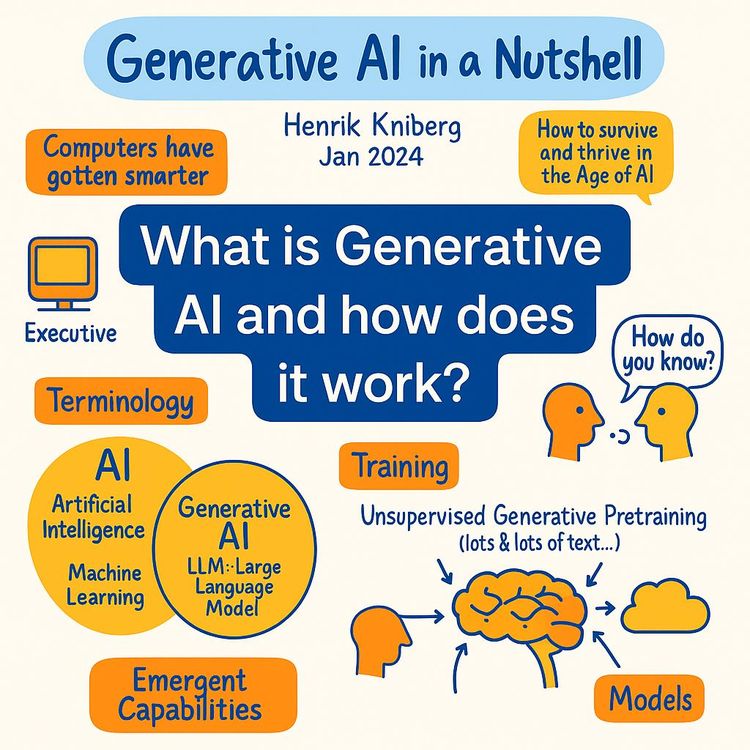
Video Course: What is Generative AI and how does it work?

Video Course: How to Use ChatGPT from Beginner to Professional

Video Course: How to Use Google Gemini for Google Workspace to Boost Productivity

Video Course: How to Use Claude 3.7 AI - Tips for Beginners!

Video Course: ChatGPT for Data Analytics: Full Course - from Beginners to Professional

Video Course: Generating Images and photos With ChatGPT?

Video Course: Generating Images & Photo's with MidJourney

Video Course: Generating Design's with Microsoft Designer and AI

Video Course: Generating Design's with Canva.com and AI
Join 20,000+ Professionals, Using AI to transform their Careers
Join professionals who didn’t just adapt, they thrived. You can too, with AI training designed for your job.