MCP server · Developer tools
Deed MCP server
by deed-lang
Lets your AI check, test and review Deed code with the real compiler instead of guessing.

Deed is a programming language built so that a function's signature states everything the function is allowed to do. This MCP server lets a coding assistant ask the Deed compiler real questions about a program, and lets it review a change for newly added authority. It is handy if you use an AI to write or edit Deed code and want the compiler, not the AI, to be the judge.
What is an MCP server? The 30-second version
On its own, your AI can only chat. An MCP server is a small helper program that gives your AI a new skill or a connection to something outside the chat. This one connects your AI to the Deed compiler, so the AI can hand it a program and get back real answers about types, contracts and effects. It runs on your own machine and speaks to your AI over a standard connection.
What this MCP server does
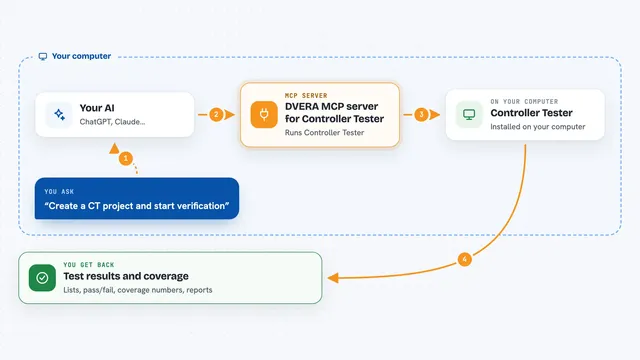
You paste or describe some Deed code and ask your AI to check it. Your AI passes the code as text to this helper, which runs the Deed compiler on it. The compiler checks types, contracts and effects, and the answer comes back as text. Your AI then explains that answer to you in the chat. The helper holds no authority of its own: a program that tries to reach a file is refused before it runs.
 Click to zoom
What you can do with it
- Check a Deed module and see whether it compiles
- Run the tests that come with a Deed program
- Ask what a function promises in its contract
- See which effects and capabilities a function uses
- Review a before and after version of a module for newly added authority
- Compare two versions and flag promises that got weaker
Try asking your AI
- “Check this Deed module and tell me what is wrong with it”
- “Run the tests in this Deed file and summarise the results”
- “What does this function's contract promise, and what effects does it use?”
- “Compare these two versions of my module and tell me if the new one gained any authority”
What it gives back to you
You get text back: compiler diagnostics, test results, contract and effect details, or a review receipt. A review receipt lists newly declared authority and any promises that dropped to a weaker tier. Your AI reads that text and explains it to you in plain words in the chat. Nothing is changed on your machine by the check itself.
Before you start
What you need
- The Deed toolchain installed on your computer (one line install from the project page)
- An AI app that can connect to MCP servers, such as the Claude desktop app
- A Deed program or module to work with
Good to know
It runs the Deed compiler on code you give it, so treat anything you paste as something you are willing to share with your AI app.
Install it with your AI
Add Deed MCP server to your AI, no technical skills needed
You don't install anything by hand. You copy one prompt, paste it into an AI that can work on your computer, and it checks, installs and connects the server for you, asking you when it needs something.
Sign in to get the install prompt
Members get a ready-made prompt that lets the Claude desktop app check Deed MCP server, install it and connect it for them, step by step. You don't need any technical skills: you copy, paste and answer a few questions. Your connected AI can also find and install any of the 4,361 MCP servers here for you.
Who it's for
Developers and reviewers who use an AI to write or edit Deed code and want the compiler to verify it.