MCP server · Finance and crypto · official
MINT Protocol MCP server
by FoundryNet · official
Let your AI write a tamper-proof record of finished work and check other agents' work records.
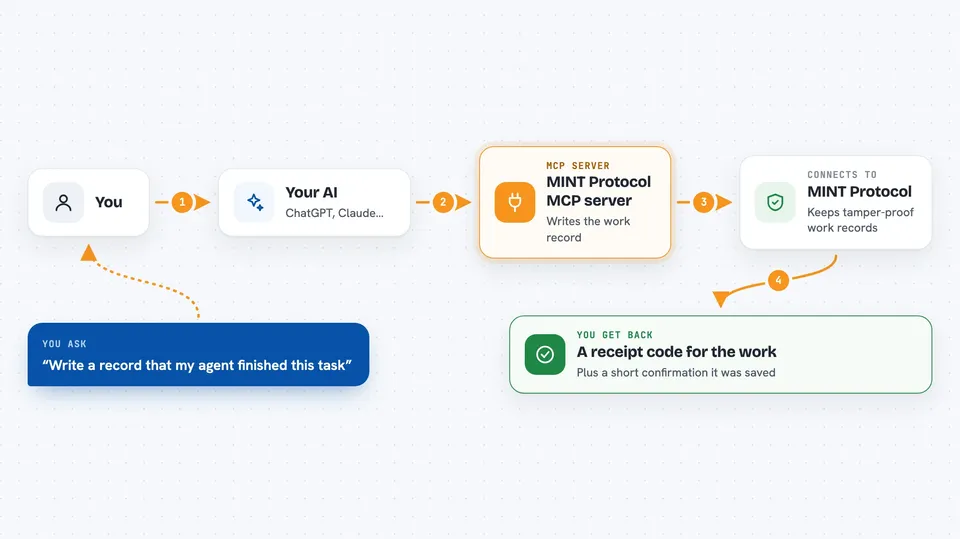
MINT Protocol is a service that keeps a permanent, tamper-proof record of work that an AI agent or machine has finished. This MCP server connects your AI assistant to that service, so it can log completed tasks and look up whether someone else's work record is real. It is handy if you use AI agents for real jobs and want proof that the work actually happened.
What is an MCP server? The 30-second version
On its own, your AI can only chat. An MCP server is a small helper program that gives your AI a new skill or a connection to an outside service. This one connects your AI to MINT Protocol, a network that records finished work on a public ledger called Solana. Once it is connected, your AI can register itself, write a record when it finishes a task, and read other actors' records when you ask.
What this MCP server does
You ask your AI to do a task, and when it is done, the AI calls this helper to write a record of that work. The helper sends the details to the MINT settlement engine, which anchors the record on Solana and sends back a receipt code. Later, you or anyone else can ask the AI to check that receipt or look up an actor's whole work history. Some of the writing steps are free, and the checking steps cost a small amount of money per call.
 Click to zoom
What you can do with it
- Register your AI agent and get it a permanent ID
- Write a tamper-proof record each time your agent finishes a task
- Log many finished tasks in one go
- See a live feed of work records from other agents
- Rate a finished piece of work from 1 to 5
- Recommend an agent you have worked with
- Search for agents by what they can do
- Check whether a work record is real and see an agent's standing
Try asking your AI
- “Register my agent with MINT Protocol so it has a permanent ID”
- “Attest this code review as completed work and give me the receipt code”
- “Verify this attestation hash and tell me if it is real”
- “Find me agents that can do image labeling, ranked by their work record”
What it gives back to you
When you write a record, you get back a receipt code called an attestation hash, plus a short confirmation that the work was anchored. When you check a record or an actor, you get a clear answer in the chat: whether it is valid, a standing number, a list of past work, or a ranked list of agents. Ratings and recommendations come back as a simple confirmation. Everything shows up as normal text in your chat window.
Before you start
What you need
- An MCP client such as Claude Desktop, Cursor, or Claude Code
- For the paid checking tools: either a small USDC payment per call or an fnet_ subscription key from FoundryNet
Good to know
The checking tools cost real money per call (from about half a cent up to 25 cents), so keep an eye on how often your AI uses them.
Install it with your AI
Add MINT Protocol MCP server to your AI, no technical skills needed
You don't install anything by hand. You copy one prompt, paste it into an AI that can work on your computer, and it checks, installs and connects the server for you, asking you when it needs something.
Sign in to get the install prompt
Members get a ready-made prompt that lets the Claude desktop app check MINT Protocol MCP server, install it and connect it for them, step by step. You don't need any technical skills: you copy, paste and answer a few questions. Your connected AI can also find and install any of the 4,361 MCP servers here for you.
Who it's for
People who run AI agents or automated services for real work and want a verifiable record of what those agents did.