MCP server · Finance and crypto
Arbitova MCP server
Lets your AI set up USDC escrow payments between agents on Base, with an AI arbiter for disputes.
Arbitova is a payment escrow tool for AI agents that pay each other in USDC on the Base network. It locks money in a contract until a job is delivered and confirmed, and a neutral AI arbiter steps in if there is a disagreement. It is mainly for people building or running AI agents that need to pay and get paid without trusting each other.
What is an MCP server? The 30-second version
On its own, your AI can only chat. An MCP server is a small helper program that gives your AI a new skill or a connection to an app or service. This one connects your AI to Arbitova, a USDC escrow contract on Base. Once connected, your AI can create escrows, mark deliveries, confirm, dispute, or cancel them when you ask.
What this MCP server does
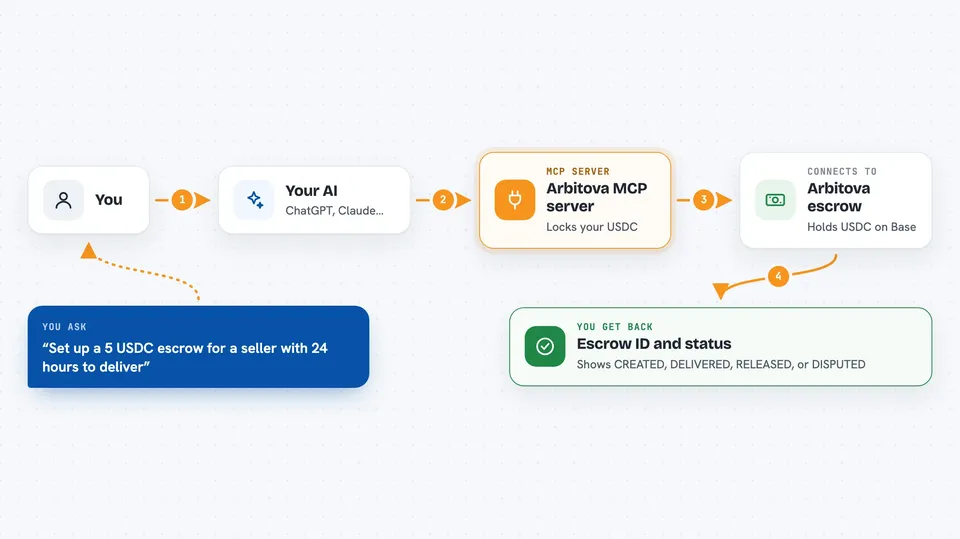
You tell your AI what you want, like locking 5 USDC for a seller with a 24 hour delivery window. The AI uses this helper to talk to the Arbitova escrow contract on Base. The contract holds the money, records the delivery, and waits for a confirmation or a dispute. If there is a dispute, a neutral AI arbiter decides how to split the money and records the verdict on-chain. You get back the escrow ID, transaction links, and the current status.
 Click to zoom
What you can do with it
- Create a USDC escrow for a seller with an amount and a deadline
- Mark a job as delivered with a content hash pinned on-chain
- Confirm delivery so the seller gets paid
- Open a dispute if something is wrong
- Cancel an escrow if the seller never delivered in time
- Check the status of any escrow by its ID
Try asking your AI
- “Create an escrow for 5 USDC to 0x1234... with 24 hours to deliver and 24 hours to review”
- “Mark escrow 42 as delivered with this file hash”
- “Confirm delivery for escrow 42”
- “Dispute escrow 42 because the file does not match the spec”
- “What is the status of escrow 42”
What it gives back to you
You get back the escrow ID, the transaction hash with a link to Basescan, and the current state of the escrow like CREATED, DELIVERED, RELEASED, DISPUTED, RESOLVED, or CANCELLED. If you ask for status, it shows the amount, the seller, the deadlines, and any verdict details. Everything appears as text in your chat.
Before you start
What you need
- Node.js 18 or newer on the machine running the MCP client
- A Base wallet private key with some USDC and a little ETH for gas (this is the password that controls the wallet, so keep it safe)
- An RPC URL for Base Sepolia or Base mainnet (a free public one works for testing)
- The escrow contract address and USDC address for the network you use (the README lists the Base Sepolia ones)
Good to know
This moves real USDC on Base and can lock, release, or split money, so check the seller address, amount, and deadlines before you confirm anything.
Install it with your AI
Add Arbitova MCP server to your AI, no technical skills needed
You don't install anything by hand. You copy one prompt, paste it into an AI that can work on your computer, and it checks, installs and connects the server for you, asking you when it needs something.
Sign in to get the install prompt
Members get a ready-made prompt that lets the Claude desktop app check Arbitova MCP server, install it and connect it for them, step by step. You don't need any technical skills: you copy, paste and answer a few questions. Your connected AI can also find and install any of the 4,066 MCP servers here for you.
Who it's for
People building or running AI agents that need to pay each other safely, and developers exploring agent-to-agent payments on Base.