2026: HR Moves From Admin To Strategic AI Ops
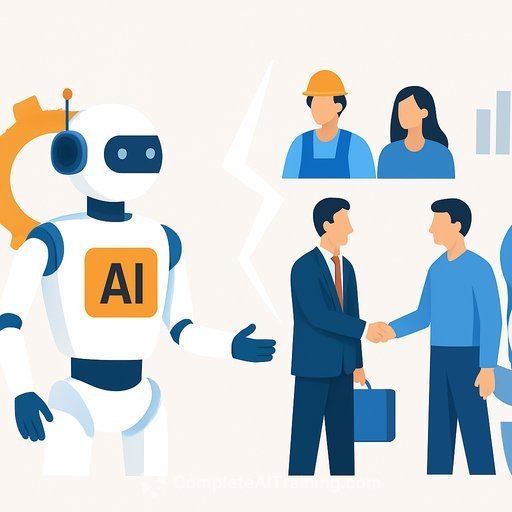
HR is entering its biggest shift in decades. Enterprise AI is moving from simple assistants to multi-functional "Superagents" that run end-to-end workflows like onboarding, talent acquisition, and HR support.
The outcome: less manual work, faster cycles, and a sharper focus on business impact. Early deployments show 30-40% of routine tasks can be automated with low effort when data and governance are in place.
What Superagents Change Immediately
- Global onboarding with policy-aware workflows that adapt to local rules and roles.
- Targeted sourcing and screening that prioritizes skills, not just credentials.
- Always-on HR helpdesks that resolve common requests and escalate exceptions.
- Learning paths and sales training built from real performance data.
- Scheduling, interview coordination, and ticket triage handled without human back-and-forth.
Real companies are already doing this. An insurance giant uses Superagents for precise hiring. An airline accelerates onboarding. A pharma firm shortens sales training. Chipotle speeds hiring and scheduling to drive revenue. Boeing applies AI to training and talent mobility to improve production.
Expect HR's employee-to-staff ratio to rise from ~100:1 to 300-400:1 as tactical load shifts to AI. This is evolution, not elimination. Headcount will skew toward roles that create value.
Two Kinds of HR Work
There's the administrative side: forms, scheduling, case management. And there's the value side: workforce strategy, culture, org design, skills, and change.
The first should be automated as much as possible. The second requires "full-stack" HR pros who blend strategy, analytics, and AI orchestration with strong people skills.
Skills-First Hiring With AI
2026 forecasts are clear: skills beat credentials. AI helps verify competencies, reduce mis-hires, and keep recruiting continuous, not seasonal.
Analysts expect HR to redesign jobs for human-AI collaboration and measure value created, not just activity. Entry-level roles are thinning, so build internal mobility, apprenticeship-style onboarding, and prescriptive performance plans to protect your pipeline.
Adoption is rising. Large firms are rolling out agentic AI while tightening governance, especially under new regulations like the EU AI Act. Cross-functional HR-IT partnerships are now a must.
Risk, Bias, and Data Trust
The legal heat is real. Lawsuits around biased hiring models show that explainability and data quality aren't "nice to have." They are your safety net.
Prioritize transparent models, audit trails, and documented human oversight. Put workers' rights, consent, and fairness at the center of your design.
- Inventory data sources and remove unfit or high-risk fields.
- Run pre-deployment and ongoing bias tests with clear remediation steps.
- Use explainable models where decisions affect people's pay or prospects.
- Keep a human-in-the-loop for high-impact calls.
- Bake in retention rules, access controls, and vendor SLAs for security and privacy.
- Align with regulations like the EU AI Act.
CHROs: From Sponsor To Architect
Many organizations use AI in HR, but few have a formal strategy. That gap slows value and raises risk.
CHROs should architect the whole selection system: problem framing, data standards, vendor choices, change enablement, and metrics. Partner with IT, Legal, and the business to move as one team.
A 90-Day Action Plan
- Identify three high-friction use cases: onboarding, TA screening, HR helpdesk.
- Set baselines: time-to-hire, time-to-productivity, case resolution time/CSAT, internal mobility rate.
- Form an AI council (HR, IT, Legal, Security, DEI) with a weekly cadence.
- Select safe pilots: one Superagent for service, one for talent, one for learning.
- Clean your job architecture and define a practical skills taxonomy tied to real outcomes.
- Establish data quality checks, PII controls, and model monitoring.
- Write an AI use policy: human oversight, accountability, and employee communication.
- Train HRBPs and recruiters to orchestrate AI workflows and validate outputs.
- Launch pilots to 1-2 business units; share quick wins and lessons learned.
- Plan scale-out with funding, playbooks, and a change network.
Metrics That Matter
- Time-to-hire, quality-of-hire, and candidate NPS.
- Onboarding time-to-productivity and first-90-day retention.
- HR case resolution time, first-contact resolution, and CSAT.
- Internal mobility rate and time-to-fill internal moves.
- Learning time-to-application and sales productivity lift from training.
- Manager span of control and employee-to-HR ratio.
- Voluntary attrition in critical roles and pay equity gap closure.
Tooling Snapshot
AI agents are mapping hundreds of HR roles and automating 30-40% of tasks like interview scheduling and helpdesk responses. Vendors are shipping skills engines, conversational experiences, and integrated policy controls.
Legacy systems still matter, but the workflow layer is getting smarter. Expect orchestration that adapts by country, job family, and compliance rules without endless manual tweaks.
Where To Upskill Fast
Level up in AI orchestration, prompt design, basic model risks, workforce analytics, and change enablement. Start with focused practice tied to one business outcome.
If you want structured options, explore curated training and certifications: Latest AI courses, courses by job, and the AI Learning Path for Training & Development Managers.
What This Means For Your Team
Automation will absorb the repetitive work. Your edge is judgment, empathy, and the ability to connect people, data, and strategy.
Use AI to handle the clicks. Use your time to build skills, mobility, fair pay, and manager effectiveness. That's where business value shows up.
The Bottom Line
Superagents give HR unusual leverage. Move early, measure hard, and keep humans in charge.
If you lead HR today, dig in. The teams that act now will set the operating model everyone else imitates next year.
Your membership also unlocks: