
AI news ·
Agentic AI connects customer support insights to product and sales teams
Only half of firms share support insights with product teams, missing a 67% improvement in development. Companies must build data paths instead of just deploying AI.
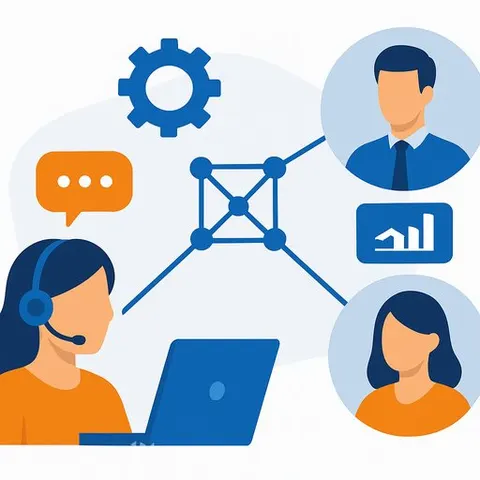
Customer support teams generate some of the richest intelligence in any organization - real-time signals about product failures, adoption friction, and early churn risk. But most companies have no structural mechanism to get that intelligence to the product managers, account executives, and customer success managers who need it. The gap is not a lack of data. It is a lack of reach.
The intelligence is already there
Support agents see product failures before engineering surfaces them. They hear early warning signs of a difficult renewal weeks before account executives. They catch adoption failures in customer feedback long before quarterly surveys register the problem. "The intelligence is there and always has been," the source material argues. What is missing is a designed path for that signal to travel from the case system to the decision-maker.
Capgemini Research Institute's latest Customer Service Transformation report confirms the scale of the disconnect. The report found:
"As per the latest Capgemini Research Institute (CRI) Customer Service Transformation report, customer service remains one of the most underleveraged intelligence engines in the enterprise: while it generates rich, real-time customer insights, only around half of organizations systematically integrate these signals into decision-making-despite clear evidence that doing so drives outcomes such as 67% improvement in product development and 63% higher customer retention. At the same time, the rapid scale-up of Gen AI marks a critical inflection point, with 86% of organizations already exploring or deploying it, yet fewer than half feel prepared to deliver AI-powered customer service at scale."
This means most companies are investing in AI for customer service without first solving the structural problem: intelligence that never reaches the people who can act on it limits AI to incremental efficiency gains rather than unlocking its potential as a strategic driver.
Where the signal breaks down
Today, when a support case closes, the insight - the specific reason a feature broke, the fact this customer called four times about the same issue - sits in a summary field inside a case system. On the rare occasion it moves, it gets compressed, aggregated, and averaged through quarterly business reviews and NPS summaries. By the time a product manager sees it three months later, the specificity is gone. The timeliness is gone. What arrives is a directional trend, not an actionable signal.
The product manager who could fix the issue that generated 200 support cases this quarter has probably never seen those cases. The account executive managing a critical renewal has not seen the eight escalations from that customer in the last 30 days. Support and sales data live in different systems, with different rhythms, and no one is accountable for the connection. "Nobody designed the path," the analysis states.
This is why framing the problem as an intelligence gap leads to the wrong investments. Better summaries, smarter classification, and faster resolution produce better-organized intelligence that still goes nowhere. The business impact remains fundamentally unchanged.
Building the path from insight to action
Approached as a reach and connection problem, the question shifts. How do you ensure what a support team knows on a Tuesday morning reaches the PM, the AE, and the CSM in a form they can use? AI Agents & Automation can synthesize support signals continuously and route them to the right person in near real time. The infrastructure exists. The capability is mature enough to move from proof of concept to production in weeks.
The hard part is organizational. Building this requires support, product, and sales to share data and take accountability in ways most large organizations are not set up to do. It requires someone at the executive level to own the outcome across all three functions and to redefine what success looks like for support - from tickets closed to intelligence delivered, from cost per case to reach and connection.
Data governance is a real constraint. Sharing customer case data across functions involves genuine privacy and compliance considerations. In some organizations, the legal and data architecture work is the longest part of the build. But complexity is not the same as intractability. The organizations building this are treating governance as a solvable design problem rather than a reason to wait.
Once the path is built, the logic of compounding takes over. Every case processed makes the organization smarter. The product improves based on real-world signals. The revenue team gets ahead of risk. Customer success becomes proactive rather than reactive. That institutional intelligence - the continuously improving, real-time understanding of customers - is hard to replicate quickly. Technology can be licensed. The intelligence that accumulates over time cannot.
Why this matters for customer support professionals
For support leaders, the opportunity is to redefine how the organization values their function. The metrics that matter shift from case volume and resolution speed to reach and connection - how far support intelligence travels and how many decisions it informs. This requires building alliances with product and revenue leaders, making the case for shared data infrastructure, and finding an executive sponsor who owns outcomes across functions. The technology to do this exists today through AI for Customer Support. What determines whether it happens is whether someone inside the organization decides the path is worth building.