
AI news ·
Agentic AI cuts customer support load by handling routine requests autonomously
Agentic AI can handle up to 70% of customer interactions without human involvement, per McKinsey. Unlike older chatbots, it reasons through problems and resolves issues end-to-end rather than transferring customers elsewhere.
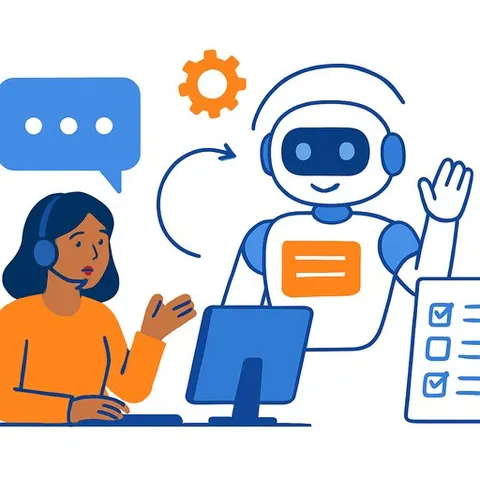
How agentic AI is reshaping customer support
Customer support teams face a familiar squeeze: volumes keep rising, costs keep climbing, and agent burnout is real. Agentic AI offers a practical answer by automating routine work and freeing agents to handle complex issues that require human judgment.
The technology has moved well beyond scripted chatbots. Modern agentic AI systems reason through problems, maintain context across multi-step conversations, and execute workflows autonomously. They can diagnose and resolve issues that previously required human expertise.
What separates agentic AI from older systems
Traditional chatbots match keywords to pre-written responses. They fail when customers ask something outside the script.
Basic automation follows decision trees to route customers or provide status updates. It transfers to a human agent the moment a request deviates from the expected path.
Agentic AI interprets what customers actually need, pulls data from multiple sources, and orchestrates complex workflows. A customer describing a technical problem gets troubleshooting. A customer with a billing question gets a resolution, not a transfer.
The numbers on efficiency
Research from McKinsey found that AI-powered automation can handle up to 70% of customer interactions without human involvement. Gartner predicts that by 2029, agentic AI will resolve 80% of common customer service issues without escalation.
IBM's research showed organizations using AI in customer service reported a 17% increase in customer satisfaction. The dual benefit reflects reality: faster resolution and 24/7 availability improve the customer experience while reducing operational strain.
The immediate gains come from automating high-volume, repetitive work. Password resets, order status checks, account balance inquiries, and subscription changes represent significant portions of support volume. An AI system handles these instantly, regardless of time zone or staffing levels.
What matters beyond cost-per-contact
The business case extends beyond simple math. The strategic value lies in how support teams redeploy freed-up time and capacity.
When AI handles routine requests, human agents focus on customers with complex needs or situations requiring empathy and judgment. Emotional customers, novel scenarios, or decisions with significant business impact still need human involvement. Agentic AI recognizes these moments and escalates appropriately.
This shift reduces agent burnout while improving overall service quality. Support teams transition from processing high-volume repetitive work to solving complex problems and building customer relationships.
Measuring what actually works
To ensure AI improves service rather than just hiding problems, leading enterprises track specific metrics:
- Containment and satisfaction: Percentage of issues resolved entirely by AI, alongside customer satisfaction scores
- Operational health: Cost-per-contact and first-contact resolution rates
- Agent empowerment: Agent satisfaction and average handle time for escalated cases
A key question: when AI handles routine work, are the remaining complex cases easier for human staff to manage? If agents are spending less time on simple requests but still drowning in difficult ones, the system isn't delivering value.
Global coverage and pattern detection
Agentic AI configured with proper language support and governance can serve customers in dozens of languages. A customer reaching out in French, Japanese, or English receives valuable assistance without requiring separate support teams.
Beyond individual interactions, AI-powered systems surface recurring issues, sentiment patterns, and problem clusters. Support teams can identify patterns before they become widespread issues, turning customer service data into business intelligence for product and operations teams.
The human-AI partnership
Successful implementations treat agentic AI as an extension of human teams, not a replacement. AI handles high-volume and routine interactions. Humans handle situations requiring nuance, creativity, or judgment calls.
When a customer needs escalation, agentic AI captures the full conversational context-original questions, expressed preferences, content shared, steps already taken. Human teams start with complete information rather than asking customers to repeat themselves. This context-rich handoff reduces handle times and ensures consistent service.
Support teams that work effectively with agentic AI build skills in oversight, complex problem resolution, and customer relationship management. The result is more consistent, higher-quality customer service while reducing the burnout that comes from endless repetitive requests.
For customer support professionals, the question isn't whether to adopt this technology. It's how to implement it in ways that actually improve your work-reducing the frustrating repetitive tasks while giving you time to solve harder problems and build better customer relationships.