
AI news ·
How businesses are deploying AI in customer support in 2026 and what the data shows
91% of customer service leaders face pressure to deploy AI, and the global market has hit $15.12 billion. ServiceNow now resolves 80% of inquiries autonomously, cutting complex case time by 52%.
How AI Is Reshaping Customer Support Operations in 2026
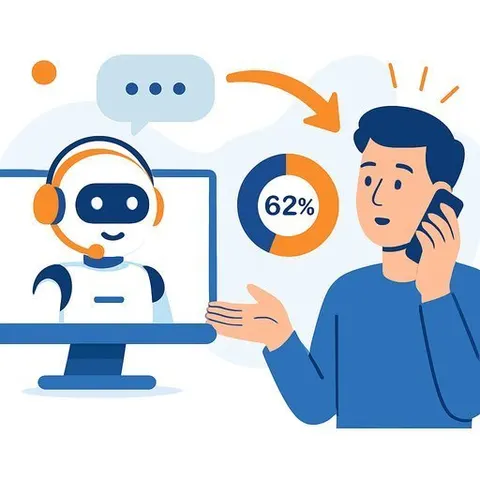
Ninety-one percent of customer service leaders face executive pressure to implement AI. The global AI customer service market has reached $15.12 billion, with 65% of organizations planning to expand their AI use over the next 12 months. The shift is happening. What separates successful deployments from stalled pilots is precision in how companies apply the technology.
Autonomous resolution for high-volume tickets
The most mature AI application in customer support is autonomous ticket resolution. AI systems trained on a company's knowledge base, ticket history, and internal documentation can handle defined ticket categories without human involvement.
The categories are consistent across industries: order status inquiries, password resets, account access issues, billing questions, subscription management, and basic product troubleshooting. These are not edge cases-they represent the majority of incoming volume for most businesses.
ServiceNow reported that its AI agents handle 80% of customer support inquiries autonomously, resulting in a 52% reduction in time spent on complex case resolution. The company estimated $325 million in annualized productivity value from this single deployment.
Data quality determines whether a deployment reaches that performance level. AI systems trained on outdated documentation or inconsistent historical data produce inconsistent responses. Organizations that invest in knowledge base maintenance before deployment see faster improvement curves and higher sustained resolution rates.
Agent assistance as a productivity tool
Not every interaction is suitable for full automation. Complex troubleshooting, escalated accounts, emotionally sensitive conversations, and compliance-adjacent requests require human judgment. These interactions also generate the most cognitive load for agents switching between documentation, context, and response drafting under time pressure.
AI assistance addresses this directly. Rather than replacing the agent, the system sits inside the helpdesk and surfaces relevant information before the agent starts composing a response. A well-implemented AI assistant drafts suggested replies based on conversation context, summarizes long ticket threads, surfaces knowledge base content, and translates multilingual conversations-all without requiring a separate tool.
The agent reviews, adjusts, and sends. The work remains human. The preparation is automated.
Gartner projects that customer service teams implementing this technology will improve contact center efficiency by up to 30% by the end of 2026. Agents spend less time on mechanical tasks and more time on judgment and communication. That reallocation reduces fatigue and improves quality on complex cases.
Multilingual support without proportional cost
Global businesses have historically faced a cost challenge in support: serving customers in multiple languages requires either multilingual agents or separate localized teams. Both options are expensive and introduce consistency challenges as the organization grows into new markets.
AI handles multilingual support through translation and generation capabilities built into the existing workflow. A customer message in French, Spanish, or Japanese is translated, the AI retrieves the relevant response from the knowledge base, and the reply is generated in the customer's language. The agent reviewing the interaction does not need to speak the language to verify the response against the approved content it was generated from.
This means a business entering a new market does not need to build a localized support team before providing consistent service quality. The same AI infrastructure handles the new market's tickets through the same training data and governance controls.
Conversation analytics as business intelligence
The least discussed but increasingly valuable AI application is analyzing conversation data for business insights. Support conversations contain structured information about where products generate confusion, where customers are most likely to churn, what features are most frequently requested, and where operational failures upstream are creating preventable contact volume.
Most businesses treat resolved tickets as closed records. AI analytics treats them as a continuous signal feed. Patterns invisible in individual ticket reviews become visible at scale: a feature generating confusion spikes after an update, a pricing objection appearing more frequently in cancellation conversations, a competitor mentioned repeatedly in specific contexts.
Teams connecting that signal to product, marketing, and operations decisions shorten the feedback loop from quarters to weeks. That is a competitive advantage that does not appear in cost-per-ticket calculations but compounds over time.
Where implementations fail
The most common implementation failure is deploying AI across too many ticket categories before any of them perform well. Organizations that start with three to five high-volume, clearly defined categories, measure resolution quality weekly, and expand based on performance data consistently outperform those attempting broad deployment from the start.
The second most common failure is treating knowledge base maintenance as a pre-launch task rather than an ongoing responsibility. Policies change. Products update. Procedures evolve. A knowledge base current at deployment but neglected six months later produces AI responses reflecting the old state of the business. Customers receive confident, fluent, incorrect information, which damages trust more than a slow response would.
These factors predict whether an AI support deployment sustains performance beyond initial months:
- Defined ownership of knowledge base quality, with a specific person or team responsible for updates on a regular cadence
- Confidence thresholds that escalate to human agents when the AI's certainty falls below a defined level, rather than generating a best-guess response
- Weekly measurement of resolution rate and follow-up rate, not just deflection rate, to distinguish genuine resolution from displaced contact volume
- A phased expansion plan tied to performance benchmarks rather than a calendar
The operational shift
The most accurate framing is not replacement. It is reallocation. Work that required human time because there was no alternative is increasingly handled by systems that do it faster, more consistently, and at a fraction of the cost. Work that requires human judgment because the situation is genuinely complex, emotionally sensitive, or strategically important gets more human attention than it did before.
Ninety-two percent of businesses report improved customer satisfaction after implementing AI in their support operations. The improvement is not uniform, and it is not automatic. It follows from matching the technology to tasks where it is reliable and preserving human involvement where it is necessary.
The businesses modernizing support effectively in 2026 are the ones that understand that distinction clearly enough to act on it. Learn more about AI for Customer Support and AI Agents & Automation to build that understanding for your organization.