
AI news ·
Agentic AI improves battery traceability in EV supply chains to meet regulatory requirements
U.S. Customs stopped 11,778 shipments in 2024 over forced-labor concerns. Battery makers now use agentic AI to trace materials and avoid border delays.
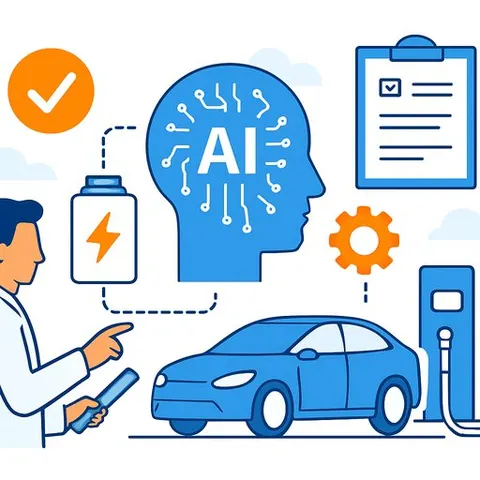
The electric vehicle supply chain faces a documentation crunch as regulators demand proof that battery materials are free of forced labor and meet domestic content rules. Agentic AI is emerging as a way to handle the mounting evidence workload without drowning in paperwork.
U.S. Customs and Border Protection stopped 11,778 shipments in fiscal year 2024 under the Uyghur Forced Labor Prevention Act, and the agency's enforcement task force added lithium to its high-priority list in 2025. When shipments are flagged, importers must provide evidence packages that link raw materials to finished products across multiple tiers of suppliers. Supplier declarations alone are no longer enough; batch-level documentation is increasingly required.
At the same time, Build America, Buy America provisions and domestic-content incentives for energy projects demand that companies know where materials are mined, processed, and assembled. The common thread is a single question: can you trace the material and defend its origin with evidence?
What credible traceability looks like
A defensible traceability model connects three streams of evidence: financial flow (purchase agreements, invoices, proof of payment), physical flow (delivery notes, customs declarations, bills of lading), and production flow (manufacturing, charge-in, and packaging records). The mechanism that ties them together is the batch handoff. At every tier, the finished-product batch number must reconcile to the raw-material batches consumed to create it. When this identifier chain remains intact, a company establishes a verifiable chain of custody from pack to mine.
The same framework also serves as a quality-management tool. If a battery pack fails in the field, batch-level traceability can narrow containment from broad production runs to specific modules, cells, and supplier lots, reducing investigation time and limiting exposure.
Where agentic AI changes the model
The visibility gap is structural. McKinsey's Supply Chain Risk Pulse found that 95% of respondents had visibility into Tier 1 supplier risks, but only 42% saw into Tier 2 or beyond. Supply disruptions often emerge below the first tier, where buyers have no direct commercial relationship. The challenge is not just collecting information; it is managing the volume, complexity, and frequency of updates. A single pack-to-mine traceability exercise can involve hundreds of documents across multiple tiers, and new production batches constantly create new evidence requirements.
An agentic AI can perform three functions at a scale that would be difficult to achieve manually:
- Extraction: The AI can pull supplier names, batch numbers, and origin information from unstructured, multilingual documents without requiring suppliers to adopt a common template.
- Reconciliation: It can compare purchase orders, invoices, delivery records, and production records to check whether they consistently reference the same material batches. Mismatches are flagged for human review.
- Continuous monitoring: The AI can maintain current supplier maps by component, supplier, location, and due diligence status, enabling organizations to assemble audit-ready evidence packages faster.
Gartner predicts that by 2030, 50% of cross-functional supply chain management solutions will use intelligent agents, and that software spending with agentic AI capabilities will grow from under $2 billion in 2025 to $53 billion by 2030. The 2021 semiconductor shortage, which cost more than 9.5 million units of lost light-vehicle production globally, shows what happens when sub-tier visibility fails. A living supplier map lets organizations see which programs and purchase orders could be hit by a disruption at a specific facility or logistics route.
What organizations should do now
Companies should treat material traceability as a capability-building initiative, not a software purchase. The first step is to risk-rank critical materials-cells, cathodes, anodes, lithium compounds, graphite, separators, electrolytes-against the current enforcement landscape. Then define a minimum evidence package for each category and embed traceability requirements, evidence-response expectations, and audit rights into supplier agreements. These terms are far easier to secure before the purchase order is signed than during a regulatory detention.
A practical starting point is to pilot AI-enabled traceability on a single material chain from end-to-end. Set clear baseline metrics at the outset, such as evidence assembly time and supplier exception rates, to measure progress and identify where visibility is weakest. The same data then supports recurring disruption assessments, sourcing decisions, and supplier-risk reviews.
Why this matters for management
Traceability is no longer just a compliance exercise. As regulatory expectations rise, the ability to establish a defensible chain of custody from pack to mine becomes a competitive differentiator. Companies that can prove their supply chain will hold up at the border and on the line will have an edge in contract negotiations, avoid costly shipment delays, and contain quality failures faster. Investing in the capability now is a risk management move that can pay off in both resilience and market access.