
AI news ·
Artificial intelligence security becomes a core risk management priority for investors and businesses
Businesses are moving AI security to the boardroom as a core risk priority. Investors now scrutinize AI data handling and model oversight alongside traditional cybersecurity.
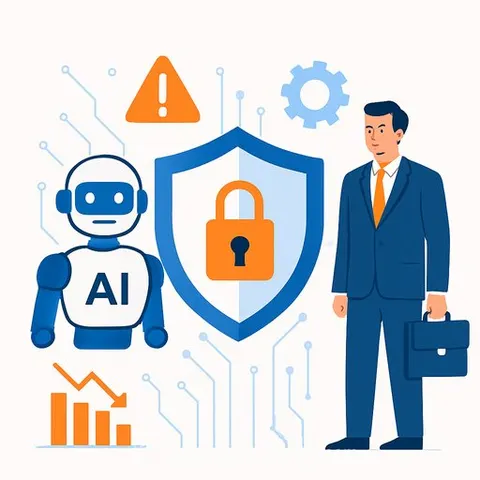
Businesses and investors are moving AI security from the IT department to the boardroom as a core risk management priority. The shift comes as artificial intelligence tools are now used daily in customer service, coding, data analysis, and even security operations, exposing new vulnerabilities that traditional cybersecurity controls were not designed to handle.
When AI security becomes a business decision
A financial services firm using AI to summarize client information can save employees hours of work. But the risks surface quickly: what if confidential data ends up in an unapproved tool, or inaccurate summaries slip into a report? These questions are pulling compliance officers, legal teams, and investors into conversations that used to stay within technology departments. A company that handles AI responsibly signals readiness for long-term growth, while one that adopts tools without safeguards draws scrutiny.
New risks that go beyond traditional cybersecurity
Some threats look familiar, like employees accidentally feeding sensitive data to external AI platforms. Others are specific to AI systems: prompt injection attacks, data poisoning, model manipulation, and insecure plugins. Recent coverage examining AI-powered cybersecurity agents underscores that AI itself is becoming part of security operations, which makes governance even more critical. The business consequences - bad decisions, eroded trust, operational disruptions - are the same regardless of whether the root cause is a classic breach or a flawed AI model.
Why data protection is the foundation
The Cybersecurity and Infrastructure Security Agency has pointed out that data security directly affects the integrity, trustworthiness, and accuracy of AI outcomes throughout the system's lifecycle. A healthcare technology company relying on incomplete or poorly protected patient data, for example, will get unreliable AI-generated insights. Across industries, strong access controls, encryption, and vendor oversight do double duty: they protect privacy and support more dependable results. Data protection often determines whether an AI initiative succeeds or fails.
Structure over speed in AI governance
Many organizations rushed to experiment with AI and are now building policies around approved uses, vendor vetting, access permissions, employee training, and incident response plans. The National Institute of Standards and Technology developed its AI Risk Management Framework to help embed trustworthiness into AI development and deployment. Even with AI coding assistants, engineers still review generated code for security issues before it reaches production. Human judgment remains part of the process.
Investors are watching governance signals
Investors have spent years scrutinizing cybersecurity practices, and AI governance is heading in the same direction. Policies on data handling, model oversight, vendor review, and incident response reveal a lot about a company's operational discipline. A hedge fund using AI to analyze earnings reports, for instance, may still require analysts to verify findings before acting on them. The goal is to ensure efficiency gains do not create avoidable vulnerabilities that could rattle markets or regulators.
Why this matters for management
AI security is no longer a specialized technical topic. It is a tangible indicator of whether a company can scale AI responsibly, maintain customer trust, and meet rising regulatory expectations. For managers, integrating AI governance into strategic planning - from data protection to human oversight of automated outputs - is becoming as fundamental as financial controls. The organizations that treat AI as both an opportunity and a responsibility will be better positioned to adapt as the technology matures.