
AI news ·
Agentic AI shifts customer journeys from static automation to adaptive decisioning across channels
Agentic AI in customer support doesn't just flag problems-it routes tickets, executes actions, and adapts based on outcomes without waiting for a human prompt. The shift from generative to agentic changes who decides what happens next.
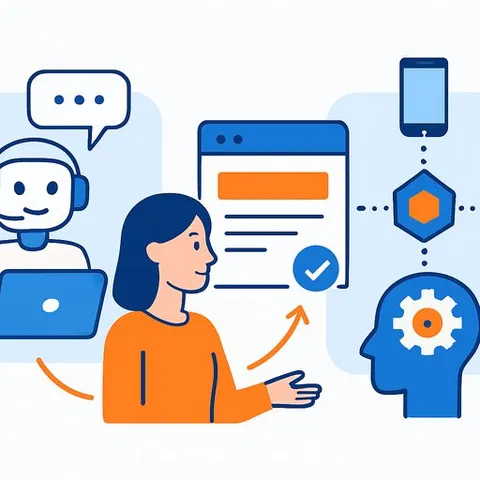
Agentic AI Is Already Managing Your Customer Support-Here's What That Means
Most support teams already use AI somewhere in their workflows. They use models to score incoming tickets, summarize cases, draft responses, and power chat interfaces. But most of that work still waits for a person to decide what happens next. A support rep escalates the ticket. A manager reviews the summary. An analyst interprets the signal.
Agentic AI changes that. Instead of generating a single answer, these systems evaluate context, select a goal, decide the next action, use connected tools, monitor outcomes, and adapt as conditions change. In support operations, that means AI does not simply describe a problem. It helps resolve it.
What Agentic AI Does Differently
Traditional automation follows fixed paths. If a customer reports issue type A, the system routes to team B. Generative AI creates or summarizes content but usually waits for a human prompt. Agentic AI can decide whether the original plan still makes sense, whether a different team is more appropriate, whether human involvement is required now, or whether the approach should change based on new information.
That distinction matters because support cases are rarely simple. A customer may report a billing problem but actually need technical help. An account may show no recent issues yet have unresolved complaints in the background. A high-priority ticket may be low-risk if the customer is already satisfied with the company otherwise. Real cases are full of overlapping signals, conflicting priorities, and changing context.
Agentic systems are useful when they help resolve that complexity in a controlled and measurable way.
Where Support Teams See Real Value
The strongest current use cases are not experimental projects. They address routine support needs: reduce first-contact resolution time, lower service cost, improve ticket routing, detect issues before customers report them, and reduce repeat contacts.
An agentic support system can identify which issues require immediate escalation and which can be resolved through guided self-service. It can combine ticket content, customer history, account status, and prior interactions to route cases to the right specialist. It can detect patterns that historically preceded complaints or churn and flag those accounts for proactive outreach. It can maintain continuity when a customer moves between channels-so a question asked in chat does not require repetition when the customer calls.
In practice, support work breaks into five decision layers.
Perception: The system ingests what is happening-support tickets, chat messages, customer history, product usage, account status, and sentiment signals.
Interpretation: The system evaluates what those signals likely mean-urgency level, root cause, customer frustration, account risk, or need for specialist help.
Planning: The system determines the best next action, the timing, the right team, and its confidence level.
Execution: The system routes the ticket, opens a specialist queue, sends a response, or escalates to a human.
Learning: The system observes whether the action improved the outcome and uses that feedback for later decisions.
Many current support AI programs stop at interpretation. They detect problems but do not act. Agentic AI becomes meaningful when the system can operate at planning and execution while staying inside business rules, legal constraints, and escalation boundaries.
Graduated Autonomy Matters More Than Full Automation
Support teams should not think of agentic AI as full autonomy everywhere. The better model is graduated autonomy based on risk and consequence.
Low autonomy: Use this for high-risk or high-emotion situations-complaints involving financial impact, privacy issues, regulated industries, or vulnerable customers. These should require human approval before action.
Medium autonomy: Use this for operational decisions such as routing, prioritization, knowledge retrieval, and standard follow-up. The system can act, but decisions should be logged and reviewable.
Higher autonomy: Use this for repetitive and low-risk actions such as ticket tagging, meeting scheduling, status updates, and routine acknowledgments. These can run with minimal oversight.
The point is not to automate everything. The point is to automate the right decisions at the right level of consequence.
How Agentic AI Improves Each Support Stage
Intake and Triage: Instead of routing by keyword alone, the system can evaluate urgency, complexity, account value, and required expertise. A billing question from a long-term customer with no prior issues may be routed differently than the same question from a new account with a history of complaints.
First Response: The system can provide immediate acknowledgment with relevant context. If the customer previously reported a similar issue, the system can reference that history. If the issue is known to require specialist help, the system can set expectations about wait time rather than starting with generic troubleshooting.
Resolution: The system can suggest knowledge articles, previous solutions, or escalation paths based on the specific case. It can recognize when a customer is repeating the same problem and flag that as a deeper issue rather than continuing with standard troubleshooting steps.
Escalation: The system can hand off to human agents with structured context-summary of prior interactions, attempted solutions, customer tone, account status, and recommended next steps. Context does not get lost between systems and teams.
Follow-up: The system can monitor whether the resolution actually solved the problem. If the customer contacts support again with the same issue, the system can flag that the prior solution failed and route differently.
The Data and Systems You Actually Need
To use agentic AI well in support, teams need a practical foundation, not a perfect one.
They need reliable customer identity so ticket history, account status, product usage, and prior support interactions can be connected. They need event quality-if timestamps, status changes, or ticket categorization cannot be trusted, routing logic will degrade quickly. They need accessible systems so AI agents can actually retrieve information and execute actions. They need decision logs so the business can review what the system decided, why it decided it, and what happened next.
No team needs all of this to begin. But every team needs enough to prevent the system from operating blindly.
Measuring What Actually Matters
A common mistake is measuring these programs only through speed. Speed matters, but support programs should be measured across four categories.
Business outcome: Cost per resolution, ticket volume handled, time to resolution, and cost to serve.
Customer experience: First-contact resolution rate, repeat contact rate, customer effort, and satisfaction.
Operational quality: Escalation accuracy, containment rate, decision latency, and exception frequency.
Risk and governance: Compliance pass rate, override rate, complaint volume linked to automation, and percentage of decisions with complete audit trails.
The strongest measurement compares agentic support against a controlled baseline. That means asking whether the system produced a better outcome than the prior workflow for the same type of ticket.
Common Failure Modes to Avoid
Over-automation: Teams automate emotionally complex or high-risk interactions too early and damage trust. A billing complaint that gets routed to a bot instead of a human feels like dismissal.
Shallow context: The system looks intelligent in a demo but fails when cross-channel history, prior complaints, or account nuance is missing. The customer repeats their issue because the system has no memory.
Unclear escalation: Customers get trapped in loops because the business did not define when the human handoff must occur. They cycle between automated responses and never reach a person.
Local optimization: Support cost drops while churn rises, or ticket volume decreases while satisfaction falls. The metric improves but the actual customer experience deteriorates.
No feedback discipline: Teams launch the system and monitor output volume, but they do not study failed paths closely enough to improve the underlying logic.
A Practical First Project
Most support teams should begin with one problem, one measurable pain point, and a clear baseline.
Examples: reducing ticket triage time, improving routing accuracy, automating acknowledgment responses, detecting high-risk accounts that need proactive outreach, or reducing repeat contacts for common issues.
Start by mapping the current workflow, identifying where delays happen, measuring human effort required, and assessing data quality at each step. Define which actions the AI can recommend, which it can execute, and which require approval. Set a small group of metrics that matter. Test against a baseline. Review failure cases weekly. Expand only after the handoffs, permissions, and decision quality are stable.
That may sound conservative. It is. Conservative is appropriate when a system is acting inside customer relationships.
Why Journey Mapping Still Matters
Some teams assume agentic AI reduces the need for support process documentation because the system can discover patterns on its own. In practice, the opposite is true. Process maps become more important when autonomy increases.
A good map documents goals, friction points, emotional states, handoff points, dependencies, and failure modes. That context helps define where agentic action is useful and where it may cause harm. If a billing complaint tends to escalate emotionally after the second failed explanation, the system needs rules for earlier human handoff. If technical questions often reflect confusion about a specific feature, the system needs to know which clarification helps and when.
Maps also reveal edge cases. Customer harm often comes from exceptions, not averages. A system trained on common tickets may perform poorly when customers cross channels unexpectedly, have unusual account constraints, or combine service and billing issues at the same time.
The Organizational Side Matters as Much as the Technology
Support journeys cut across teams. If no one owns the full support experience, the AI will optimize locally and fail globally. A ticket may get routed faster but with less relevant context. A customer may get a quick response but one that does not address their actual problem.
Governance is not only a policy document. It is a set of rules for permissions, escalation, auditability, human review, and outcome monitoring. Who can approve high-risk actions? What triggers mandatory human review? How are decisions logged? When can the system override a customer's preference? These questions need answers before deployment, not after.
Cost discipline also matters. Agentic AI can create real value, but only if teams choose use cases with measurable impact and avoid building expensive autonomy for low-value moments. Automating routine acknowledgments may save time. Automating complex technical troubleshooting may not.
Getting the Handoff Right
The difference between a good agentic system and a frustrating one is usually the quality of the human handoff. When escalation happens, the system should pass forward structured context-summary of prior interactions, attempted solutions, customer sentiment, account status, and recommended next steps.
A customer should not have to repeat their issue when they reach a person. A support agent should not have to hunt for prior ticket history. The system should make the human's job easier, not harder.
That requires careful design. The system needs to know what information matters for different types of escalations. A technical specialist needs different context than a billing specialist. A VIP account needs different routing than a new customer.
What Success Actually Looks Like
A strong agentic support program does not feel like automation. It feels like continuity. Customers do not notice that an AI routed their ticket correctly or summarized their history accurately. They notice that they did not have to repeat themselves. They notice that their issue got resolved faster. They notice that they reached the right person without friction.
The companies that gain the most from agentic AI in support will not be the ones with the most dramatic demos. They will be the ones that identify real friction, connect the right data, set clear guardrails, measure what matters, and keep humans focused on the moments where judgment, empathy, and accountability matter most.
In that model, AI does not replace support teams. It strengthens the systems that support them.
For support professionals looking to understand how these systems work and where they fit in modern support operations, resources on AI for Customer Support and AI Agents & Automation can provide deeper context on practical implementation.