
AI news ·
AI agents automate sales order entry at Nucor Steel and other enterprises
Nucor Steel and other firms are deploying AI agents to automate manual order entry, cutting hours of clerical work. Sales staff reclaim that time for customer engagement, with the agents interpreting casual language into ERP-ready data.
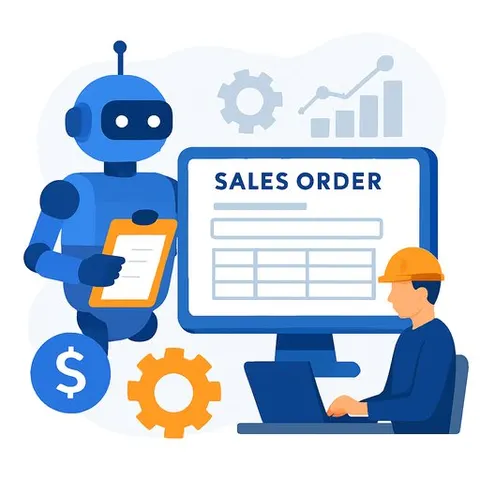
Sales teams at Nucor Steel and other enterprises are now deploying AI agents to handle manual order entry, a shift that cuts hours of administrative work and returns staff to direct customer engagement. The transition from small-scale experimentation to production-wide deployment is already underway at these organizations, with Microsoft's Power Platform and Azure AI tools providing the technical backbone.
In a recent Microsoft keynote, Sachin Gandhi, Principal R&D Solution Architect, alongside Nick Leamon, AI Consultant at Crowe, and Chad Dickerhoff, ERP Manager at Nucor Steel, detailed how their teams built and rolled out these agents. The discussion focused on practical implementation rather than theoretical potential.
From exploration to enterprise-wide deployment
What started as isolated tests quickly expanded into coordinated development across business divisions. Teams worked together to establish ethical guardrails, define implementation playbooks, and build reusable agents that could scale. The goal was not a single tool but an architecture that multiple departments could adopt without starting from scratch.
The speed of this shift caught attention. Organizations that were merely evaluating AI capabilities months ago are now running agents in live operational environments. The work at Nucor and Crowe demonstrates a pattern: internal collaboration between IT, operations, and business units accelerates deployment well beyond what siloed experimentation can achieve.
What the sales order agent actually does
The sales order agent tackles a specific bottleneck. Sales representatives spend significant time re-keying information from customer emails and attachments into ERP systems. The agent reads incoming orders, extracts relevant data, and populates the system without manual intervention. This means fewer errors from re-typing and more time for salespeople to build relationships and close deals.
Dickerhoff described the direct operational impact at Nucor Steel. Rather than processing orders late into the evening, staff can focus on customer conversations. The agent does not replace the sales function - it removes the clerical drag that pulls people away from selling. For teams looking to advance their broader automation strategy, resources on AI Agents & Automation cover how these systems integrate across CRM and ERP platforms.
Bridging human language and rigid systems
One technical challenge stands out: customers do not write orders in ERP terminology. A buyer might refer to a product by a nickname or use shorthand for a shipping location. The agent uses Azure Content Understanding to interpret that language and map it to clean data structures - correct customer records, product SKUs, and order quantities - before entry.
This translation layer is where the real value lies. The agent acts as an interpreter between casual human communication and the structured logic of enterprise systems. It handles the friction that normally requires a person to decode an email, cross-reference a spreadsheet, and manually enter line items. Professionals exploring similar sales-focused tools can find targeted courses under AI for Sales, which examine AI sales automation and CRM optimization.
Why this matters for sales professionals
The sales order agent removes administrative work that directly competes with selling time. For individual contributors, this means fewer hours on data entry and more on pipeline activity. Sales managers should track not just adoption rates but shifts in time allocation - if order processing drops from hours to minutes, the team's capacity for revenue-generating work increases without adding headcount.