AI anxiety is showing up at work. HR needs a plan.
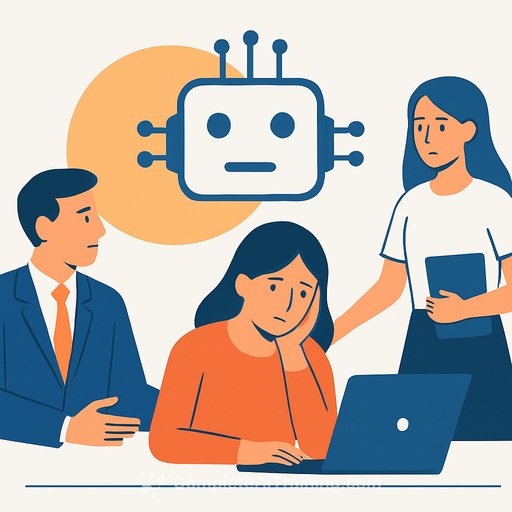
Walk into any meeting and you'll notice it: fewer voices, more silence, and an invisible third attendee feeding prompts under the table. People are letting AI take notes. Some are asking a chatbot what to say next. Underneath it all is a growing tension your HR team can't ignore.
A 2025 survey of 1,000+ full-time workers found a clear pattern: as AI use climbs, so does anxiety-and it's showing up in very human ways. Your policies, training, and culture either buffer that stress or magnify it.
What the data says
- Skill loss fear is real: nearly 1 in 4 worry they're losing abilities they used to have; 21% already feel slower at tasks they once handled easily.
- Reliance is split: 1 in 10 say they rely on AI to do their job, yet 37% admit they judge coworkers who lean on AI (even while doing the same).
- Confidence is mixed: 28% say AI makes them feel smarter; nearly the same say it makes them feel less capable.
- Trust isn't universal: over a third think AI is a bubble that could burst and hurt the economy. Nearly 1 in 5 doubt their employer's AI strategy will last; 19% fear job loss.
- Upskilling is underway: about a third are skilling up; 17% are considering going back to school.
- Shadow AI is spreading: nearly 1 in 5 hide their AI use; some name their tools or talk to them more than coworkers. One in five prefer talking to AI over colleagues.
- Emotional dependence is emerging: 24% use AI for stress management; 1 in 6 report friendships or romantic ties with AI.
- Gen Z stands out: nearly half say they're more reliant on AI across life; 14% fully depend on it for work, yet 28% believe it's making them "more stupid." Still, 29% plan to pursue a higher degree.
Why HR should care
Unchecked AI use chips away at skills, trust, and connection-the core drivers of performance. If people feel judged for using AI, they hide it. If they outsource thinking to tools, skills drift. If your strategy feels shaky, morale drops.
That's not a tech problem. It's a culture, policy, and management problem. HR is in the best position to set guardrails, build confidence, and protect what makes teams effective: human judgment, creativity, and healthy relationships.
Risk signals to watch
- Quiet meetings, shallow debate, heavy reliance on summaries over original thought.
- Shadow AI: unapproved tools, hidden prompts, or copy-paste outputs no one reviews.
- Skills drift: once-routine tasks feel harder without a model's assist.
- Judgment culture: employees shame AI use in public, copy it in private.
- Tool attachment: employees prefer chatting with AI over teammates.
- Manager confusion: inconsistent rules, unclear review standards, and policy whiplash.
Your practical playbook
- Publish a simple AI policy that covers approved uses, data privacy, review standards, and disclosure. Keep it to one page; update quarterly.
- Require disclosure of material AI assistance in docs, code, and client deliverables. Add a brief "AI assistance" note with version and what was checked by a human.
- Create an approved tools list with security review and clear use cases. Offer safe defaults to reduce shadow AI.
- Set quality bars: "AI can draft; humans decide." Define when original thinking is required, and when automation is allowed.
- Train on digital literacy: prompt basics, verification, bias checks, and legal risks. Make it role-specific, short, and hands-on.
- Protect core skills: run "AI-off" reps for key tasks (presenting, writing, analysis) to keep muscles strong.
- Refresh job architecture so roles reflect AI-assisted workflows, not just old responsibilities plus "use AI."
- Coach managers to spot over-reliance, ask better questions, and give feedback on thinking, not just outputs.
- Red team high-risk tasks (legal, finance, safety). Practice failure modes; document what "good" looks like.
- Build human connection on purpose: live workshops, pairing, and office hours where people talk through work-not just share outputs.
- Clarify ethics and privacy: no sensitive data in public models; store prompts and outputs securely.
- Offer growth paths: fund micro-credentials and role-based courses; recognize people who improve team workflows, not just model tricks.
Manager prompts that help
- "Where did AI help here, and where did you make the call?"
- "What did you verify with a source or dataset?"
- "If the model wasn't available, how would you approach this?"
- "What trade-offs did you consider, and why this path?"
Support for mental health
Some employees are leaning on AI for stress relief and even companionship. Treat that as a signal, not a headline. Strengthen access to counseling, EAPs, and manager training for tough conversations.
If you need a reference point for workplace mental health policies, see guidance from the World Health Organization on mental health at work (WHO). For risk controls in AI use, the NIST AI Risk Management Framework offers helpful structure (NIST).
Gen Z: design the runway
- Onboard with "how we think here." Teach problem-solving steps before tool use. Pair new hires with mentors for live reps.
- Make practice visible. Short "AI-off" challenges, show-your-work reviews, and feedback on reasoning.
- Channel ambition. Offer clear skill ladders and certifications; fund courses that translate to project wins.
Metrics to track
- Use transparency rate: % of deliverables with AI-assist notes.
- Skills health: periodic "AI-off" assessments for core tasks.
- Manager confidence: pulse on clarity of standards and policies.
- Psychological safety: willingness to discuss AI use openly.
- Shadow AI incidents: tool exceptions, data leakage, rework.
- Quality outcomes: error rates, client satisfaction, review time.
Upskilling that actually sticks
Focus training on real workflows, not hype. Keep it short, role-based, and tied to measurable outcomes. If you need structured options by job family or certification paths, browse curated resources at Complete AI Training - Courses by Job or review Popular AI Certifications.
The bottom line
AI isn't leaving, and anxiety around it won't fade on its own. With clear rules, steady training, and a renewed focus on human connection, HR can lower the temperature-and raise the quality of work.
Your edge isn't the tool. It's how your people think together.
Your membership also unlocks: