
AI news ·
AI-assisted writing demands more thought from students, study finds
AI-assisted writing increases cognitive demands, not simplifies, a study of 38 students finds. The writer still bears the weight of idea formation, judgment, and revision.
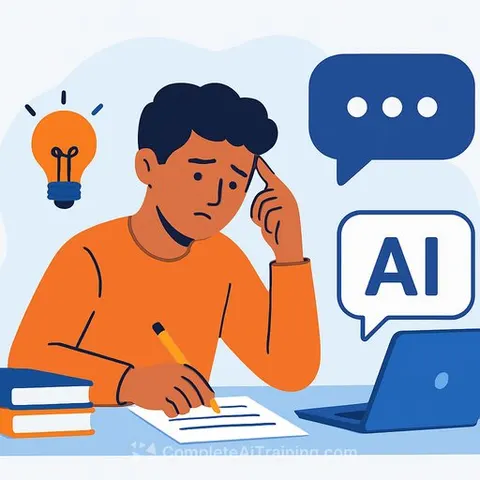
A new study finds that AI-assisted writing does not make the process simpler for students-it actually increases the cognitive demands they face. Researchers at Iowa State University tracked 38 undergraduates through a two-semester course that taught them to collaborate with generative AI, and the results challenge the widespread belief that these tools offer a shortcut to polished prose.
The study, published in Computers and Composition, reveals that while AI can handle surface-level sentence construction, the heavier work of forming ideas, exercising judgment, and directing revision stays firmly with the human writer. "Writing with AI doesn't take the work out of writing," said Abram Anders, associate professor of English at Iowa State and coauthor of the research. "It changes it."
Anders and coauthor Emily Dux Speltz designed an "AI and Writing" course that drew students from 22 majors. At the start, many participants believed that better tools should require less effort and that the AI would carry the cognitive load. That illusion faded quickly. One student reflected, "I had to learn how to think about my thinking."
What emerged, the researchers say, are three threshold concepts that any writer must grasp to use AI productively-principles that matter as much for professionals as for undergraduates.
Writing with AI is experimental
Students who treated the AI like a search engine-typing a vague prompt and accepting whatever text appeared-soon learned that effective collaboration demands trial, error, and constant tinkering. "AI isn't going to provide a 'perfect' answer or automatically spit out what you need," Anders said. "It requires trial and error-trying, testing, revising, and trying again." The process mirrors the planning, clarity, and rhetorical awareness that skilled writers already bring to their work.
Human expertise still carries the weight
Because AI writes in confident, polished sentences, it can easily slip into what Anders calls the fluency trap. "That polish can trick students into trusting it, even when it's wrong, shallow, or missing the point entirely," he said. The course taught participants to interrogate AI output rather than merely edit it-checking claims, refining logic, and aligning the text with the demands of a specific discipline. Fluency, the students discovered, is not the same as understanding.
AI must augment human agency, not replace it
The third threshold moves the writer from outsourcing work to orchestrating it. "Students must recognize that while AI can generate text, it can't generate purpose-only the writer can do that," Anders said. Generative AI cannot decide what an argument is, what matters, or why the writing exists. It requires human direction, judgment, and boundaries. Students who crossed this threshold began using AI to explore possibilities and test ideas instead of avoiding the cognitive weight of writing.
Why this matters for writers
For anyone who earns a living through words, the study's findings reinforce a hard truth: writing remains an act of thinking, not mere composition. The tools can handle surface fluency, but the decisions about what to say, how to structure an argument, and what to leave out still belong to the writer. The fluency trap is not just a student problem-polished but hollow AI text can mislead professionals just as easily. Many writers are now turning to resources like AI for Writers to build the critical skills needed to direct these systems rather than react to their output.
"AI changes the workflow, but it doesn't change the fact that writing is thinking," Anders said. "Students still have to make decisions, set direction, and shape meaning." Writers who learn to steer AI with that mindset will retain their authority while making the tools useful-an ability that will outlast any particular model or interface.