
AI news ·
AI backlash grows as tokenmaxxing costs spiral and public opposition to data centers mounts
Corporate enthusiasm for AI is cracking under the weight of runaway costs. Uber's CTO blew his 2026 budget by April; Amazon and Meta killed internal AI leaderboards; one company burned $500 million in tokens in a single month.
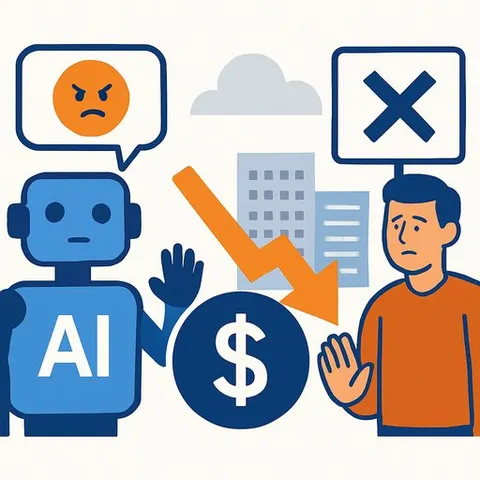
Silicon Valley's AI Backlash Is Real-and It's Driven by Token Costs
The tech industry's enthusiasm for artificial intelligence is cracking. Companies that spent 2025 racing to maximize AI token consumption are now shutting down internal leaderboards, scaling back agent plans, and asking executives to justify the spending.
Uber's chief technology officer told investors in April that his 2026 budget was already blown through-less than four months into the year. Uber's chief operating officer later called it a "head-exploding moment," acknowledging that AI costs are becoming impossible to justify when the technology hasn't delivered measurable business value.
The shift extends beyond Uber. Amazon and Meta have disabled their internal AI leaderboards. Walmart and Starbucks have reduced AI agent deployments. One Amazon executive sent a leaked email telling staff to "stop using AI just for the sake of using AI."
The token economy is breaking
OpenAI and Anthropic built their business models on selling tokens-the units that measure AI prompt and response length. Companies adopted "tokenmaxxing" in 2025: encouraging maximum AI usage through leaderboards and competitions.
That strategy is collapsing. An unnamed company burned through half a billion dollars in tokens in a single month after failing to set usage limits. A Claude user blew 50 percent of his monthly credits on a single prompt.
Both companies have quietly shifted pricing models. Anthropic changed how it charges many customers, switching to per-token pricing. OpenAI is eliminating its "unlimited" ChatGPT plans-a reversal from Sam Altman's 2024 promise that AI would be "intelligence too cheap to meter."
Altman acknowledged the problem in interviews this week. Companies now ask: "How long do I have to wait for AI benefits to show up in revenue?" He called it a "fair issue" but offered no timeline for resolution beyond "another year or two."
Public opposition is mounting
The backlash extends beyond corporate budgets. A Pew poll found just 10 percent of Americans say they're excited about AI's future. Eighty percent of registered voters told NBC pollsters that neither Democrats nor Republicans are handling AI policy well.
Worker resistance is widespread. Eighty percent of white-collar workers refuse to use AI even when employers mandate it. In the past month, 54 percent of workers bypassed company AI tools to complete jobs themselves.
Data center protests are producing results. At least 48 data center projects were blocked or delayed in 2025. In Utah, local opposition forced venture capitalist Kevin O'Leary to reduce his planned Stratos data center's land usage by 75 percent. "We screwed up," O'Leary told local television. "We pissed off a lot of people."
New York State legislators sent a one-year data center moratorium to the governor's desk this week. Senator Bernie Sanders proposed that the U.S. government take a 50 percent stake in AI companies. President Trump signed an AI regulation executive order-a move his AI czar had long opposed.
The hiring shift tells the story
Companies are now hiring humans instead of relying on AI. Cognizant, an AI services firm, hired 20,000 graduates last year and plans to hire more this year. The reason is simple: human workers are becoming cheaper than AI, and they're needed to fix AI errors.
Even Nvidia, which has profited enormously by selling computing infrastructure to AI companies, faces pressure. One Nvidia executive told Axios that "the cost of compute is far beyond the costs of the employees." That's why human hiring has become the hottest trend in AI.
The hallucination problem remains
One vibe hasn't shifted: AI hallucinations. Users still aren't aware how often AI models produce false information. A December Google study found that Gemini may only be accurate between 68.8 and 83.8 percent of the time-but Google won't disclose how often it hallucinates.
The larger hallucination, according to critics, is the premise itself. OpenAI, Anthropic, and SpaceX claim to be trillion-dollar companies worthy of index funds, yet none are profitable. The S&P 500 officially rejected that idea this week. Nvidia's dominance appears invulnerable until you notice that companies representing most of its business are developing their own AI chips.
The final hallucination: that customers want AI in everything. Survey after survey shows the opposite. The generation that will define AI's future points and laughs at low-quality AI-generated content.
If these illusions fade from Silicon Valley and Wall Street, the AI vibe shift of 2026 will be complete. For writers evaluating whether to adopt AI tools, understanding these cost and quality realities matters. Consider exploring AI for Writers Courses that teach practical, cost-effective approaches to AI integration rather than maximum token consumption.