
AI news ·
AI companies pour millions into lobbying push on both sides of the Atlantic
AI companies deployed more than 3,500 federal lobbyists on AI issues last year, a 170% jump in three years. A pro-AI group has raised $100M to back friendly candidates in the 2026 midterms.
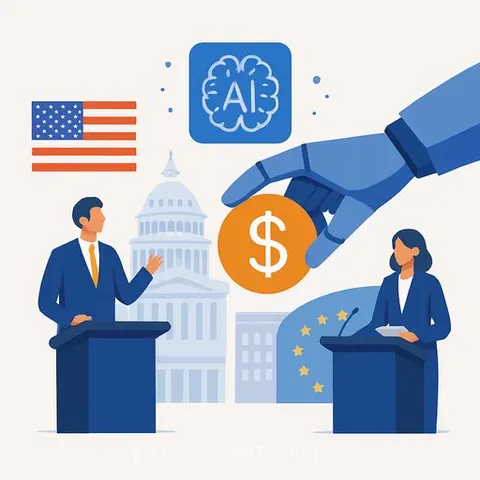
AI Companies Intensify Lobbying Push in US and Europe
Major artificial intelligence companies are spending heavily to influence regulatory decisions on both sides of the Atlantic, deploying lobbyists, funding political campaigns, and reshaping public narratives about the technology.
The scale of this effort has grown dramatically. More than 3,500 federal lobbyists - roughly one-fourth of all lobbyists in Washington - worked on AI issues last year, a 170 percent increase over three years, according to Public Citizen, a consumer advocacy group.
OpenAI, the ChatGPT maker, published a 13-page "Industrial Policy for the Intelligence Age" this month that calls for new taxation and expanded safety nets. The company also acquired TBPN, a technology-focused talk show, to help shape public conversation about AI's future.
OpenAI has faced complications in its public relations efforts. The company halted plans for a sexually explicit chatbot after public backlash and introduced age-verification following legal challenges from families who said ChatGPT contributed to harm and suicide among teenagers.
Established tech giants like Meta, Google, and Microsoft still lead in lobbying spending, but AI startups including OpenAI and Anthropic have rapidly expanded their Washington operations. Anthropic has focused its message on AI safety and tighter regulation, while OpenAI is actively pushing the industry's top legislative priority: preventing individual US states from passing their own AI laws.
The influence campaign has entered electoral politics. A pro-AI group called Leading the Future assembled a $100 million war chest to back AI-friendly candidates in the 2026 midterms. OpenAI cofounder Sam Altman and president Greg Brockman are among President Donald Trump's largest donors.
European regulators face similar pressure. French startup Mistral presented a 22-point plan in Brussels to accelerate AI development on the continent. Tech industry lobbying spending in Europe surged 55 percent since 2021 to reach 151 million euros ($177 million) last year, according to research by the Corporate Europe Observatory and LobbyControl.
A Democratic Concern
Margarida Silva, a researcher at the Centre for Research on Multinational Corporations, said AI firms are following the playbook of oil and tobacco industries, but with greater financial resources. "When you have such intense corporate lobbying that is based on having such a concentration of wealth, and that is standing in the way of public interest regulations, we are really talking about a democratic threat," Silva said.
Political leaders cultivate relationships with AI executives to secure development spending for their regions and states, said Charles Thibout, a political science professor at Sciences Po Strasbourg. The concentration of tech moguls at Trump's inauguration and the close ties between Mistral cofounder Arthur Mensch and French President Emmanuel Macron illustrate these dynamics.
Public skepticism about AI remains high despite the industry's spending. Opinion polls regularly show Americans remain wary of the technology's benefits and worry it will eliminate millions of jobs.
Alexandra Iteanu, a Paris-based lawyer specializing in digital law, said this is a pivotal moment. "Companies are spending a fortune to try to get favourable measures passed in their patch," she said. But lawmakers are not easily swayed, she added - public concern about AI's consequences has not disappeared.
For PR and communications professionals: Understanding how AI companies are positioning themselves and managing stakeholder relationships offers valuable lessons. AI for PR & Communications resources can help you navigate these industry dynamics and develop effective strategies for your own organization.