
AI news ·
AI customer service improves CX only when governance and human fallback are built in
AI chatbots are improving customer experience at some companies and driving customers away at others. The difference comes down to whether leaders treat automation as a service tool or a cost-cutting shortcut.
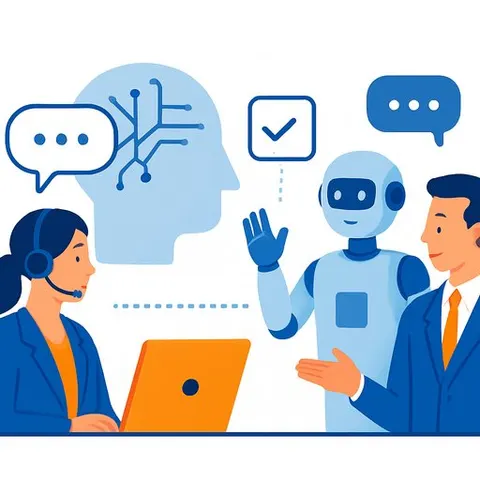
AI Customer Service Is Improving CX in Some Companies and Driving Customers Away in Others
The difference between success and failure is not which AI tools your organization owns. It's whether you treat AI chatbots as a service strategy or a cost-cutting measure.
Conversational AI can reduce friction, speed up resolutions, and make support feel effortless. The same automation can also trap customers in repetitive loops that make them feel dismissed. Contact center automation is now powerful enough to reshape trust, which means it needs rules, oversight, and a clear path to human agents.
The stakes are rising fast. Gartner predicts that by 2028, at least 70% of customers will start their support journey with a conversational AI interface. If AI is becoming the front door, CX leaders cannot treat it like a side project.
What AI-Powered Customer Service Actually Does
AI-powered customer service uses AI to handle support conversations, assist agents, or automate steps behind the scenes. In practice, it's not a single tool. It's an operating model that decides how quickly customers get help, how many times they repeat themselves, and whether the experience feels human.
Salesforce's latest research shows AI is rising fast on service leaders' priority lists. The stated goal is still customer experience, not automation for its own sake. The dangerous move is chasing efficiency metrics while ignoring the emotional math customers apply in the moment.
Do AI Chatbots Actually Improve Satisfaction?
They do, but only in the same way self-checkout improves a grocery store. It works when it is fast, predictable, and optional. It fails when it replaces help rather than speeding it up.
Many enterprise deployments automate too aggressively, too early, and too stubbornly. When customers cannot escape automation, they stop believing you want to solve the issue. They start believing you want to avoid it.
A useful test: would a customer recommend your AI experience to an already annoyed friend? If the answer is no, the automation is not a CX win. It's a complaint deferral system.
When to Use AI Instead of Human Agents
AI should go first when the customer's intent is clear and the stakes are low. Humans should lead when ambiguity, emotion, or risk are high. This is not a moral argument. It's a trust argument.
Customers do not hate automation. They hate wasted time. When AI saves time, it earns loyalty. When it wastes time, it becomes a brand tax.
Here is the practical line: automate the predictable and protect the fragile. AI can handle volume, but humans must own moments that can break relationships.
Which Metrics Actually Prove ROI
Many programs get exposed here. Leaders celebrate containment while churn quietly rises. They praise lower handle time while repeat contacts climb. Then they wonder why sentiment collapses.
A serious measurement model tracks efficiency and trust at the same time. If you only measure efficiency, your AI will optimize for making customers go away. You will then celebrate the numbers while losing the relationship.
Use these three metrics as your baseline:
- Cost-to-serve paired with repeat contact rate. This prevents confusing deflection with resolution.
- Escalation rate and escalation quality. Measure whether customers reach humans with context intact.
- Customer sentiment and effort signals. Customers tell you when automation is harming trust.
If two points improve while one collapses, you don't have an AI success story. You have a risk that is simply not visible in finance dashboards.
How AI Should Integrate With Your Platform
Integration decides whether your AI feels like a concierge or a maze. Customers should not feel the seams between your conversational AI platform, CCaaS routing, CRM, and knowledge base. They should feel a single service brain that remembers what they said and acts on it.
From a platform standpoint, enterprise-grade integration means your automation can escalate cleanly and hand context to agents. That kind of deliberate handoff is not a nice-to-have. It's the difference between helpful automation and rage-inducing loops.
Buyer conversations are shifting from "which bot is smartest" to "which operating model is safest." Leaders are trying to find the right mix of humans and AI rather than chasing full automation.
The Biggest Risks of Over-Automating
Over-automation fails in patterns, not randomly. That's good news - you can design against it.
No escape hatch. Customers cannot reach a human fast enough, even when the situation clearly needs one.
Repetition traps. Customers repeat account details and their issue after escalation, signaling that your stack is not connected.
Confidence theater. The bot sounds certain but offers vague outcomes, eroding trust faster than a simple "I don't know."
Many brands are training customers to avoid digital channels entirely. That increases call volume, raises cost, and forces the organization to hire more humans to fix what automation broke.
The Real Difference Between Success and Failure
AI customer service can absolutely improve CX. It can also drive customers away. Both outcomes are common because the determinant is not the technology. It's the discipline.
CX leaders who win treat AI like a governed service channel. They define escalation rules, monitor sentiment, and force automation to earn trust. They don't over-automate because it looks efficient in a spreadsheet. They automate because it reduces effort without stripping empathy.
AI should make customers feel helped, not handled.
For hands-on guidance on deploying these principles, consider exploring resources on AI for Customer Support and AI Agents & Automation.