
AI news ·
AI data center rush inflates UK land prices and clogs grid connection queue
Old factories and chemical plants across Britain are being snapped up for AI data centers, with 119 projects recently submitted to planners. Land with grid connections now sells for up to £15m per acre-more than double standard industrial rates.
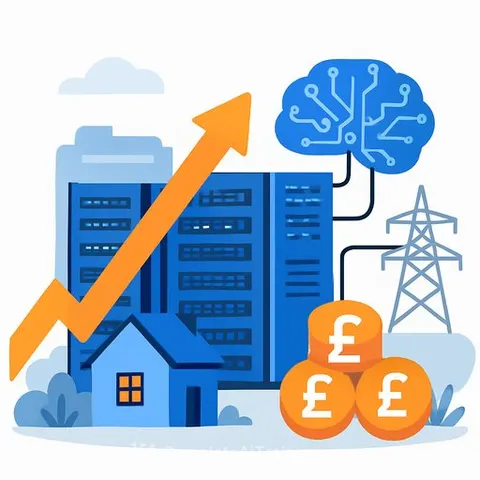
Britain's industrial sites become premium real estate in data center rush
Disused chemical plants, old car factories and defunct hotels across Britain are being repositioned as prime locations for AI data centers. Owners are cashing in on tech giants' plans to spend billions on infrastructure, with 119 data center projects submitted to planning authorities in recent months.
The shift accelerated after King Charles hosted Donald Trump and technology executives last year. Google, Microsoft and Nvidia all pledged major investments in Britain's digital infrastructure.
The 'powered land' premium
What matters most for AI data centers is processing power, not proximity to financial hubs. That opens cheaper industrial sites far from London to development.
Wilton International near Middlesbrough exemplifies the trend. The site, once serving the petrochemical industry, has what developers call "powered land" - existing power generation or high-voltage grid connections. Sembcorp UK, the majority owner, is working with developer Digital Reef to attract a major tech tenant.
"We're trying to develop something quite quickly, and bring jobs and industry and investment back," said Mike Patrick, CEO of Sembcorp UK.
The power premium is substantial. London industrial land sells for 4.5 to 6 million pounds per acre. Land suitable for data centers commands 8 to 15 million pounds per acre, according to real estate firm Savills. In the United States, powered land sells for up to three times more than standard industrial property.
Grid congestion creates bottlenecks
The surge in data center demand has clogged Britain's electrical grid application queue. Connection wait times have stretched to 12 to 15 years.
Demand for grid connections jumped 460% in the first six months of 2025. Requests for high-voltage capacity reached 96 gigawatts - more than the nation's total generation capacity of roughly 72 gigawatts. The National Energy System Operator identified 140 data centers in the main queue alone, representing about 50 GW of capacity.
Speculative applications are the culprit. The operator said many requests come from land owners with no power, planning permission or identified end users. These "zombie projects" clog the system and delay viable developments.
In March, the operator announced plans to tighten its application process and prioritize strategic sectors. A similar cleanup of renewable energy requests cut applications by half.
Creative solutions and high costs
Some developers are working around grid constraints. Equinix, a U.S. data center operator, bought a site north of London that required an unconventional approach: acquiring an allocated grid connection meant for battery storage and converting it to a data center connection.
Equinix plans to invest 3.9 billion pounds in the development - its largest project outside the United States. The company expects to break ground in early 2027 and open the facility in 2031.
Britain's high industrial electricity costs present another hurdle. OpenAI paused plans this month for a major data center in northeastern England, citing energy costs and regulatory concerns.
Britain falling behind competitors
Progress on data center construction lags other markets. Only 7% of 61 British projects tracked since late 2022 are under construction or completed. Germany has 46% of projects at those stages, France 40% and the United States 24%.
That gap matters. The government and tech industry view major data centers as essential to modernizing the economy and establishing Britain as an AI hub.
Wilton's prospects remain positive. The site has a 240 MW grid connection and on-site generation including gas, biomass and waste-to-energy plants. Sembcorp and Digital Reef expect to integrate solar and wind capacity and reach 1 GW eventually, requiring roughly 15 billion pounds investment over eight to 10 years.
Discussions with potential operators are progressing, according to the partners. Despite skepticism about whether demand is genuine or speculative, the consensus holds that AI adoption is real and sites offering power, planning permission and land will remain valuable.
AI for Real Estate & Construction professionals should monitor how grid policy changes and power availability reshape land valuations across Britain.