
AI news ·
AI-driven HR decisions make employees feel objectified and more likely to quit, study finds
A study of nearly 700 people found AI decisions on pay or promotions raised turnover intentions. HR leaders should keep humans in final decisions to prevent disengagement.
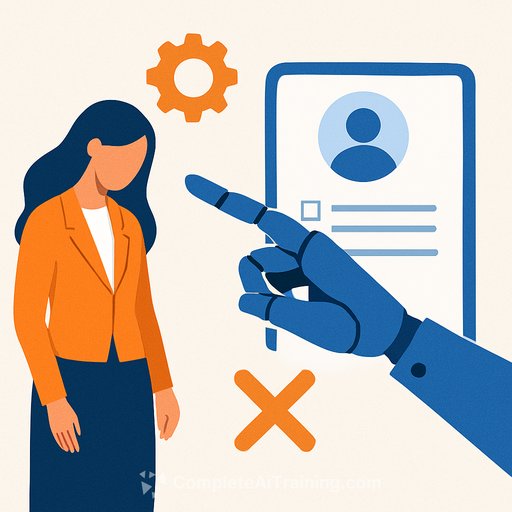
Employees are more likely to feel objectified, disengaged, and ready to quit when artificial intelligence makes decisions about their promotions or pay, according to new research from the Chinese University of Hong Kong (CUHK) Business School. The findings, published June 19, 2026, draw on three online experiments involving nearly 700 participants and arrive as AI adoption in HR functions accelerates across industries globally.
Researchers found that AI-driven HR decisions trigger what they call "organisational dehumanisation" - a sense of being reduced to data points rather than treated as individuals with distinct qualities and emotions. Across all three experiments, participants reported lower organisational commitment, stronger intentions to leave, and greater retaliatory feelings when AI was responsible for career-affecting decisions.
The empathy gap and transparency problem
The research team, led by Choi Sungwoo, an assistant professor at CUHK's School of Hotel and Tourism Management, worked with collaborators from the Hong Kong Polytechnic University and the University of Macau. They attributed the negative effect to employees perceiving AI systems as lacking empathy and unable to account for the social and ethical nuances of individual circumstances.
Compounding this, the lack of transparency surrounding algorithmic decision-making left workers feeling excluded from processes that directly affected their careers. "Putting it all together, loss of empathy, transparency, and control can leave people feeling objectified," Choi said. "When AI performs human resources operations, employee characteristics are seen as numbers. Therefore, employees would feel like they are not treated as humans."
A cultural paradox emerges
The study also identified what researchers described as a cultural paradox. Organisations with collaborative and people-oriented cultures may face stronger employee resistance to AI in HR functions. In these workplaces, algorithmic decision-making clashes more sharply with the interpersonal values they project, making the dehumanisation effect more pronounced.
This finding complicates the common assumption that organisations with strong human-centric values would adapt more easily to technology-driven change. Instead, the gap between a company's stated culture and the mechanical nature of AI decisions can widen the sense of betrayal among employees.
What HR leaders should do
Rather than a full retreat from AI in HR, the researchers recommended a hybrid model in which AI informs decisions without making them. "This hybrid approach helps preserve the sense that consequential decisions about people are ultimately made by people," Choi said. "If AI serves only in an assistive capacity with limited input into the final decision, the dehumanisation effect should be substantially mitigated."
This recommendation lands at a moment when tools for screening job applicants, managing performance, and modeling compensation are becoming increasingly common. The challenge for HR leaders is not whether to use AI, but how to design decision workflows that keep human judgment at the center. For teams exploring how to integrate AI responsibly, structured AI Learning Path for HR Managers can help build the skills needed to evaluate where automation adds value and where it risks undermining trust.
Why this matters for HR professionals
The research draws a clear line between who makes a decision and how employees respond to it. When AI owns the final call on promotions or compensation, the risk of disengagement and turnover rises measurably. HR leaders who design hybrid systems - where AI provides analysis but a person delivers the decision - can preserve the relational trust that keeps teams intact. The practical takeaway is not to avoid AI entirely but to audit every HR workflow for the point where a human handoff matters most.