
AI news ·
German companies largely unprepared for EU AI Act human resources deadline
German companies are largely unprepared for the EU AI Act's August 2 deadline, risking steep fines. Only 7% have advanced controls despite 81% of execs fearing AI failure.
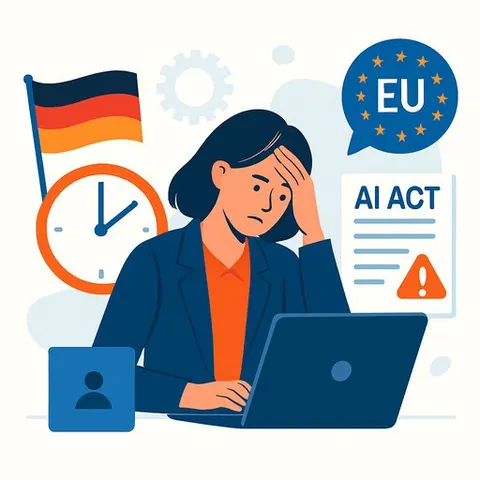
German companies are largely unprepared for the EU AI Act's August 2 deadline, which will impose strict obligations on high-risk AI systems used in human resources. Systems handling recruitment screening, performance analytics, and other HR functions must comply or face heavy penalties.
Industry experts are urging HR departments to act now. The new rules demand stringent data-protection measures, anonymization of personal data, and a clear legal review before any AI tool is approved for use.
AI adoption in HR: high demand, low readiness
Sixty percent of HR professionals now rank artificial intelligence as their top priority, according to a survey of more than 1,800 specialists. Efficiency gains are cited by 60 percent, cost reduction by 20 percent. Already, 42 percent of respondents report notable productivity improvements.
But the governance needed to manage AI risk has not kept pace. A recent KPMG study found that while AI strategies exist broadly in German companies, only a minority steer their AI strategy actively from the top. For HR managers seeking to build internal expertise on compliant AI use, an AI Learning Path for HR Managers provides structured guidance. A report from Publicis Sapient shows that 42 percent of organizations cannot unlock the full value of AI; in Germany, barely 10 percent have fully embedded AI into workflows.
Rapid automation and its hidden frictions
Some innovations are pushing ahead. Remote People unveiled its "Command Center" on June 19, a system that handles nine core HR actions - from onboarding to contract changes - using voice commands and automatically ensures compliance across more than 180 countries. Adecco reports roughly 1.2 million AI-powered interactions and has cut time-to-hire by half.
Yet automation doesn't always deliver the promised time savings. A survey found that 40 percent of employees see no reduction in their workload from AI tools. Reviewing AI-generated outputs can create extra work, as shown by Waydev's data on declining code-acceptance rates when corrections mount.
Dependency risks and the legal enforcement
The growing reliance on AI deepens the stakes. An IBM study from early 2026 found that 81 percent of executives fear serious damage if their AI systems fail for just seven days. Yet only 7 percent of companies have advanced control mechanisms in place.
Starting August 2, the EU AI Act will force the issue. Any high-risk AI system - a category that covers many HR applications - must meet strict obligations. Penalties for violations will be steep, and regulators are expected to scrutinize compliance closely.
New roles and a shifting HR mandate
The shift is also reshaping the job market. PwC's "KI-Jobbarometer 2026" shows that postings requiring AI skills are growing eight times faster than the overall market, with a wage premium that has jumped to 62 percent. New roles like AI managers are emerging to coordinate rollouts, develop strategies, and analyze cost savings.
For HR departments, this means a transition from administrative gatekeepers to strategic architects of a learning organization. Building future skills has become a core mandate - and the August 2 deadline makes it an urgent one.
Why this matters for HR professionals
For HR professionals, the August 2 deadline is a prompt to act. High-risk AI systems in recruitment, performance, and workforce management need immediate legal review and data protection safeguards. Those who build governance structures now will avoid fines and position HR as a strategic driver of responsible AI adoption.