
AI news ·
AI-enabled irregular warfare targets military morale and public trust, researchers warn
China, Russia, and Iran are using AI to wage influence campaigns that erode military morale and alliance trust without firing a shot. The Pentagon has no dedicated doctrine or intelligence center to counter it.
Pentagon Must Treat AI-Enabled Influence Operations as Operational Threat
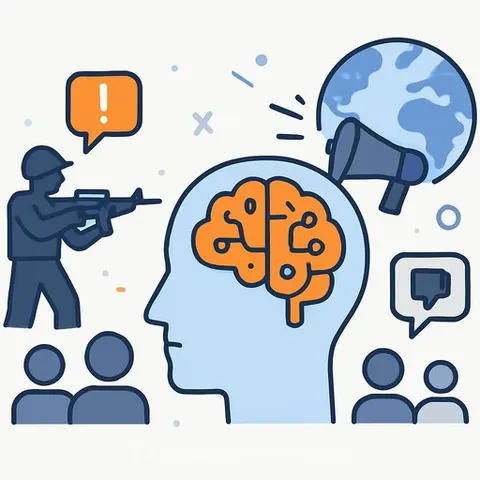
Adversaries are using artificial intelligence to conduct cognitive warfare at scale, targeting military morale, alliance cohesion, and public trust without firing a shot. The Department of Defense needs to treat this threat with the same urgency it reserves for kinetic warfare.
China, Russia, and Iran have already integrated AI into non-kinetic campaigns designed to achieve strategic objectives below the threshold that triggers military response. These operations move beyond traditional propaganda. They use algorithms to create personalized, contextually plausible distortions tailored to specific audiences-making them far harder to detect and counter than conventional disinformation.
How AI Changes the Threat
AI compresses the time between narrative creation and mass dissemination to near-zero. Official fact-checking and bureaucratic response cannot keep pace. By the time a correction arrives, the false narrative has already shaped perceptions across networks.
The goal often isn't to convince people a lie is true. It's to make them believe truth itself is uncertain, that authority cannot be trusted, and that cooperation is risky. This approach fractures alliance architectures from within.
Influence campaigns can directly target military readiness by eroding confidence in leadership, amplifying perceptions of institutional corruption, or suggesting that military service is pointless. They can simultaneously exploit divisions within allied nations-ethnic, economic, political-to delay collective action and complicate coordinated response.
What Operations Teams Need to Know
The battlespace now includes cognition and social confidence. Adversaries continuously probe for vulnerabilities and apply calibrated pressure that stays below legal and political thresholds for kinetic response. Cyber defense and public affairs statements alone cannot address this challenge.
Military effectiveness depends on factors that AI-enabled operations directly target: morale, organizational cohesion, confidence in leadership, institutional legitimacy, and social trust. When these erode, operational capability erodes with them.
Recommended Actions
The Pentagon should establish a dedicated intelligence center to assess adversarial AI-enabled influence operations in real time across all non-kinetic domains. This center would integrate signals intelligence, open-source intelligence, behavioral science, and AI technical expertise to support combatant commanders and the National Command Authority.
Develop cognitive resistance training as a core readiness function. Personnel and units need evidence-based programs-grounded in neurocognitive science and social systems research-to recognize and resist AI-based information manipulation. These programs should extend to allied and partner defense establishments.
Update joint doctrine to treat AI-enabled influence operations as a discrete operational challenge. Current planning processes, from theater campaigns to crisis contingencies, should integrate detection, disruption, attribution, and response to AI-based threats.
Fund a national research program focused on AI-enabled influence operations. This should include dedicated resources for AI detection and attribution technologies, synthetic media forensics, and analysis methods applicable to adversarial AI. Partnerships with academic institutions, national laboratories, and private sector entities will be essential.
The Strategic Imperative
AI has not changed the core logic of irregular warfare-exploiting asymmetries and vulnerabilities. But it has radically expanded reach, precision, and persistence. Peer competitors understand this and are already harnessing it.
The adversary most effective at manipulating perception, trust, and collective resolve could achieve strategic gains without conventional military engagement. The Pentagon must recognize AI-enabled, non-kinetic influence operations as a clear operational reality demanding the same resource commitment and strategic attention reserved for kinetic threats.
For operations personnel, understanding how AI integrates into operational planning and threat assessment is now essential to readiness. The cognitive domain is contested. Defense requires integration across intelligence, doctrine, training, and research-not in sequence, but simultaneously.