
AI news ·
AI-generated phrase "it's not X, it's Y" surges fivefold in U.S. corporate documents
The phrase "It's not X, it's Y" has flooded SEC filings and earnings calls, appearing five times more often in 2025 than two years ago. Communications experts now flag it as one of the clearest signs of AI-drafted corporate text.
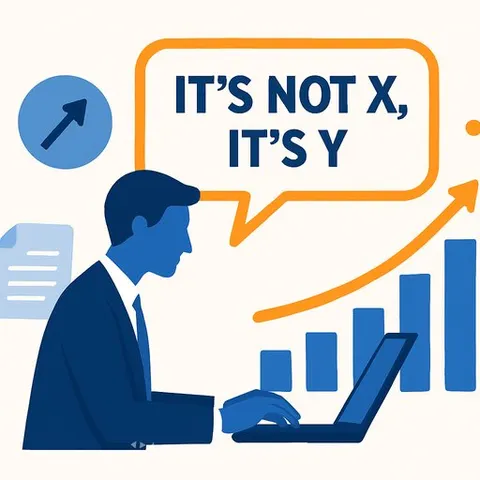
Corporate America's AI Tells Are Getting Harder to Miss
A specific sentence structure has flooded American corporate documents over the past two years: "It's not X, it's Y." The phrase appears in SEC filings, earnings transcripts, press releases, and investor presentations with striking frequency.
Data from AlphaSense, which scans millions of official company documents, shows the pattern barely existed through the 2000s and 2010s. In 2024, usage surged. By 2025, it had doubled again - reaching five times the level from just two years earlier. In the final quarter of 2025 alone, 73 major U.S. companies used the construction in official documents.
Communications professionals now recognize it as one of the clearest signals of AI-generated text, grouped alongside overuse of em-dashes and "rule of three" lists.
Why Large Language Models Love This Phrase
ChatGPT and similar models default to contrastive framing because it sounds authoritative and persuasive without requiring original analysis. When companies ask AI to "make this more professional" or rewrite an announcement, the model reaches for this exact rhetorical device.
The result is what some call "neuro-slop" - polished-sounding but increasingly generic corporate language that obscures rather than clarifies.
Jeff Gaunt, a crisis communications expert, said: "The sentence construction 'it's not X, it's Y' is one of the biggest tells in AI."
The Real Problem: Accuracy Takes a Back Seat
The stylistic issue masks a deeper risk. When companies rely on AI to draft official communications, subtle inaccuracies and hallucinations slip through more easily. Vague claims and exaggerated benefits can hide behind confident-sounding language.
Some communications teams have already started actively avoiding the phrase - along with em-dashes and repetitive three-part lists - precisely because they signal AI authorship.
What This Means for Your Work
This isn't a linguistic quirk. It's evidence of how thoroughly generative AI has embedded itself in corporate content pipelines. Work that once required human editing, institutional knowledge, and careful review now frequently bypasses those steps.
As an AI for PR & Communications professional, you're likely fielding requests to use AI for drafting. Understanding these patterns - and their risks - matters. Investors, regulators, and employees will develop sharper eyes for AI-generated text. Documents that sound confident but use these recognizable patterns may damage credibility rather than build it.
The question for 2026 isn't whether AI can write corporate documents. It's whether your organization can use it responsibly without leaving obvious fingerprints.
Learn more about AI for PR & Communications and how prompt engineering shapes AI output in professional settings.