AI-Generated Podcasts Transform Science Communication
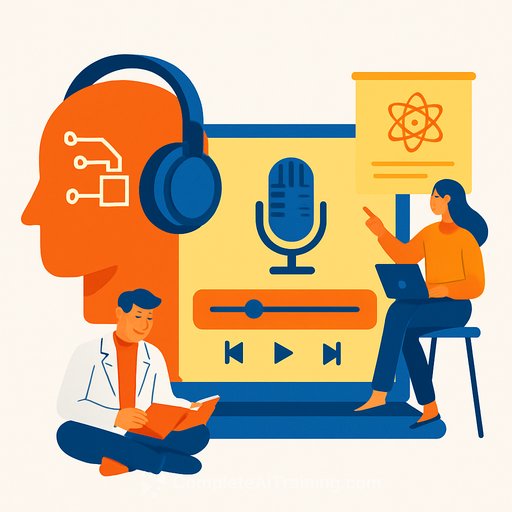
The discussion around artificial intelligence (AI) and creativity has touched many professions, including acting, design, programming, and more recently, podcasting. A recent study from the University of Leuven in Belgium marks the first attempt to use AI to produce podcasts summarizing research papers from the academic community.
Professor Philip Moons, who led the research, highlighted the potential of AI-generated podcasts to simplify the dissemination of scientific knowledge. “Podcasts could be created with minimal effort—just upload the article and add some prompts,” he explained. This approach could help reach audiences who typically avoid reading scientific journals.
Testing AI for Podcasting
Moons and his team used Google NotebookLM, an AI research assistant developed by Google Labs, which introduced a podcast generation feature in September 2024. After testing it on one of his own articles, Moons was impressed by the natural sound and quality. This led to a broader study assessing its potential for science communication.
The researchers selected ten different article types and produced AI-generated podcasts without informing the authors. These authors were then asked to review the podcasts for engagement, trustworthiness, and to guess whether the content was AI-made. Feedback was collected via AI-created questionnaires and follow-up interviews.
Results and Feedback
Half of the authors believed the AI-generated podcasts were human-made, expressing surprise upon learning otherwise. The podcasts effectively captured key points, maintained good structure, and balanced length with depth. Some hosts sounded convincingly knowledgeable in medicine or nursing, and the interaction between hosts felt natural.
However, the authors noted some issues, including occasional misused medical terms, mispronunciations, and an overly enthusiastic tone. They emphasized the importance of thorough fact-checking before releasing AI-generated podcasts publicly. Additionally, all agreed that such content should be clearly labeled as AI-produced.
Looking Ahead
Dr. Chance M. Glenn, President of Morningbird Space Corporation, envisions AI-generated podcasts becoming part of university curricula to enhance learning accessibility. He also suggests that science journals could integrate these podcasts but stresses the need for transparency about their AI origins.
Glenn pointed out that while human input remains valuable, AI’s growing influence on scientific research and communication is undeniable. Its ability to synthesize vast amounts of data quickly offers a resource too beneficial to overlook.
Professor Moons and his team plan to explore how AI-generated podcasts can further support public and patient engagement in science. They are also considering using this technology to summarize sessions from scientific conferences.
The study’s findings were shared at the Association of Cardiovascular Nursing and Allied Professions (ACNAP) conference in Sophia Antipolis, France, and published in the European Journal of Cardiovascular Nursing.
- AI-generated podcasts could reduce the time and effort required to communicate scientific findings.
- Clear labeling and fact-checking are essential to maintain trust and accuracy.
- These podcasts may be especially useful for reaching non-technical audiences, such as patients and the general public.
For communications professionals interested in learning how AI tools like this can enhance their work, exploring relevant training resources can be valuable. Check out Complete AI Training for courses on AI applications in communication and research.
Your membership also unlocks: