
AI news ·
AI hallucinations and probabilistic reasoning create structural risks for tax practice
AI-generated tax analysis has led to court sanctions and disciplinary referrals after attorneys submitted briefs citing fabricated cases. Every AI-produced citation must be verified against primary sources before filing.
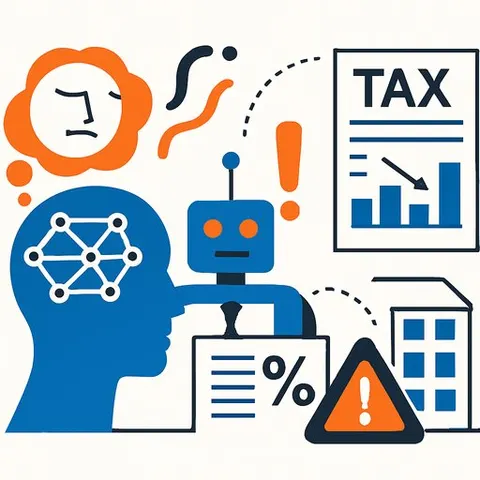
AI's Hallucinations Create Real Legal Risk in Tax Practice
Large language models now generate legal analysis through probabilistic text prediction rather than authoritative reasoning. In tax law, where even a comma can alter meaning, that distinction is consequential. Hallucinated citations aren't drafting defects-they are substantive legal failures that can trigger penalties and disciplinary action.
Tax professionals deploy these systems to streamline work, especially time-intensive tasks like parsing statutes and drafting preliminary memoranda. The efficiencies come with serious professional and legal risks. Because LLMs rely on statistical prediction rather than legal reasoning, they can't assess precedent reliably, don't distinguish dicta from holdings, and ignore the hierarchical nature of tax authorities.
When AI Fabricates Authority
When prompted about complex provisions such as IRC §351 or §199A, an LLM answers via token probabilities rather than by retrieving and verifying authoritative legal sources. It can fabricate safe harbors, misquote Treasury Regulations, or invent precedent. The output looks polished and professionally formatted-that is precisely the risk.
In Mata v. Avianca, a federal court sanctioned counsel under Rule 11 for submitting a brief relying on fictitious ChatGPT-generated cases. The US Tax Court struck a pretrial memorandum in Thomas v. Commissioner that relied on fabricated cases. A Minnesota tax court referred counsel to disciplinary authorities for submitting an AI-generated brief in Delano Crossing v. Wright.
These aren't citation mistakes. They are breaches of the non-delegable duty to verify legal content before filing.
The Post-Loper Bright Problem
The Supreme Court's rejection of administrative deference in Loper Light Enterprises v. Raimondo removes the interpretive buffer. Agency interpretations no longer receive deference, and courts must independently construe ambiguous statutes.
Without Chevron deference, there is no agency cushion. The court must rely on text, structure, and verifiable history. Practitioners who rely on AI-generated legislative summaries do more than commit negligence-they facilitate corruption of the judicial function through submission of unverified secondary sources.
If an LLM hallucinates a Senate report or Treasury explanation to support a statutory reading, the error is irreparable. Probabilistic outputs that can't be traced to official records destabilize interpretive legitimacy.
AI Can't Understand Purpose
Tax law isn't a codebook of mechanical steps. It is grounded in statutory text and judicial interpretation. Generative AI misreads this structure. The model prioritizes surface fluency while disregarding substantive legal requirements.
Consider the economic substance doctrine under IRC §7701(o). It imposes a conjunctive test requiring meaningful economic change and substantial non-tax purpose. AI can't meet this standard. The system simulates economic gain through projected minimal profits and fabricates business justifications using statistically common rationales. But these aren't factual representations-they are probabilistic fabrications.
An LLM can prepare an IRC §351 exchange that appears valid on its face: property transferred, stock received, 80 percent control achieved. But it can't evaluate whether the transaction was orchestrated solely for tax deferral without economic substance. The form is satisfied; the doctrine isn't.
The step transaction doctrine presents a similar problem. This doctrine collapses formal steps into a single transaction where they are interdependent or prearranged. AI sequences operations independently: structure A, then structure B, then outcome C. But courts look through this sequence and ask whether the taxpayer had a fixed plan. An AI unaware of the integration risk may inadvertently script a series of transactions that courts treat as one abusive whole.
Jurisdictional Flattening
LLMs are trained on corpora that overrepresent certain jurisdictions and doctrines. In tax law, federal authorities dominate the training corpus, while state and international regimes remain underrepresented.
This imbalance forces the model to internalize a distorted representation of legal doctrine. The result is "jurisdictional flattening," where algorithmic models sometimes misapply Ninth Circuit precedent to Fifth Circuit taxpayers in violation of Golsen v. Commissioner. These systems also conflate OECD guidelines with US transfer pricing rules and incorrectly equate EU VAT frameworks with US sales tax structures.
Tax law operates on specificity, not averages. The proper answer usually depends on a precise jurisdiction, taxpayer profile, or factual exception. AI doesn't recognize these constraints-it smooths them out, degrading the accuracy of legal advice.
The Liability Gap
Practitioners who rely on AI to structure transactions risk penalties under IRC §6662 and potential promoter sanctions under IRC §6700 if the AI-generated plan is later deemed abusive. When the human element is absent, the legal standard isn't met.
One case illustrates the operational risk: counsel relied on a non-existent safe harbor for deductions in a pretrial brief. The IRS correctly found the position unsupported. An IRC §6662 penalty, which otherwise would have been avoidable, was imposed because of the hallucinated authority.
Tax compliance turns on voluntary observance of an intricate statutory scheme. Hallucinated authorities distort that scheme, eroding the reliability of precedent and injecting false reference points into a regime already burdened by complexity.
What Comes Next
AI's efficiencies are undeniable. The risks are equally real. The profession must move from passive reliance to active verification. The duty of competence now includes the technological capacity to distinguish statistical probability from legal authority.
For tax professionals using AI for legal work, verification is non-delegable. Every citation must be independently checked against primary sources. Every transaction structure must be evaluated for economic substance and step transaction risk before filing. AI can assist in drafting and research, but it cannot discharge the verification obligation that tax law requires.