
AI news ·
AI helps scientist decode 11 zebra finch calls and win animal communication prize
Dr. Julie Elie won a $100,000 prize for identifying 11 distinct zebra finch calls. Her 15-year study proves the birds process vocal meanings, not just acoustic patterns.
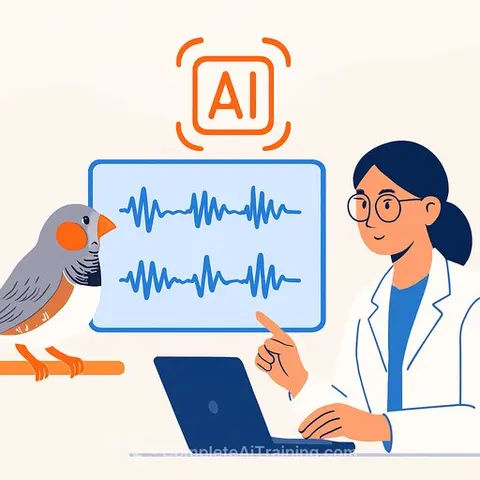
Dr. Julie Elie of the University of California, Berkeley, has won the 2026 Coller-Dolittle Prize for Two-Way Interspecies Communication. Her research identified 11 distinct call types in zebra finches, showing the birds respond to meaning rather than just acoustic patterns - a finding that gives researchers a clearer map of how structured animal vocalizations can be.
The prize awards $100,000 annually for breakthroughs in the field. A separate $10 million prize remains unclaimed, waiting for the first verified two-way exchange between humans and another species. Elie's work, built on 15 years of field recordings and behavioural experiments, brought that goal a small step closer by proving zebra finches process calls as messages, not just sounds.
Fifteen years of listening
The project was not a quick machine-learning win. Elie's team spent more than a decade recording thousands of vocalizations in specific contexts before using AI to organise and analyse the data. The technology accelerated the sorting process, but only after years of manual observation had established what each call likely meant.
Behavioural playback tests produced the strongest evidence. When the team played different calls to the birds, the finches confused calls that carried similar meanings more often than calls that merely sounded alike. The birds were responding to information, not simply matching acoustic patterns.
AI is changing the field
The intersection of machine learning and biology is expanding quickly. Organisations such as the Earth Species Project are training large models on animal sounds instead of human language, searching for recurring structures across species. At SXSW earlier this year, co-founder Aza Raskin said AI gives scientists "an opportunity to analyse nature at a scale that simply wasn't possible before." The immediate goal remains understanding, not conversation.
Other recent findings add momentum. Researchers have reported that bonobos combine calls in ways that resemble simple linguistic rules, while separate studies have documented sophisticated vocal systems in chimpanzees and ultrasonic communication among African striped mice. Each discovery chips away at a puzzle that scientists are only beginning to assemble.
This work is part of a broader trend where AI for Science & Research is being applied to process biological data that once defied analysis. The zebra finch study shows how machine learning can surface patterns hidden inside years of raw observations.
Why this matters for science and research professionals
Animal communication research increasingly depends on computational methods that were rare in biology a decade ago. For researchers, building basic machine learning skills is no longer a fringe option. The tools that identified 11 call types in zebra finches are the same class of algorithms used in drug discovery, climate modelling, and genomics. Understanding how they extract signal from noise - and how to pair them with careful experimental design - will define which research teams move fastest.
Context remains the hard problem. Even powerful AI models cannot yet distinguish a call that carries a fixed meaning from one that signals an emotional state or an instinctive response. Solving that will require cross-disciplinary teams fluent in both field biology and data science. The prize money signals that funders are betting on those collaborations to break new ground.