
AI news ·
AI impersonation and fake accounts exploit social customer service channels
Scammers use AI to impersonate brand support on social media and intercept customer complaints. The FTC reported $2.1 billion in social fraud losses in 2025.
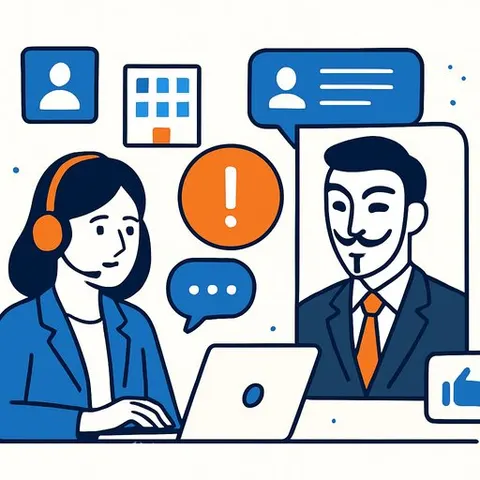
Cybercriminals are intercepting customer complaints on social platforms using AI-generated fake support accounts that mirror a brand's tone, visuals, and executive identities. A white paper by the Payments Association found that 66% of authorized push payment fraud cases in the first half of 2025 originated on online platforms, including social media and messaging services, well before any money changed hands.
The fraud lifecycle often begins when a customer posts a public complaint and a scammer posing as the brand replies with an offer to help. By the time a payment or credential is requested, the victim already trusts the impersonator. "Fraud frequently begins well before a payment is initiated," the Payments Association report said, noting that reimbursement rules and banking controls only address the final stage. The initial compromise happens on digital platforms where brands are expected to provide support.
AI is industrializing impersonation
Generative AI has cut the time needed to create a convincing phishing campaign from more than 16 hours to under five minutes, according to Vyntra's 2026 Anatomy of Modern Banking Fraud report. Global scam losses reached an estimated $442 billion over the past year, while 70% of adults experienced at least one scam attempt. Criminals now generate personalized messages, cloned identities, and deepfake videos that reproduce a company's customer service language with high accuracy.
"If a user's data is breached elsewhere, scammers can easily triangulate it with what that person shares on social media and use it to spearhead more convincing AI-powered attacks," said Darius Belejevas, CEO of Incogni. He pointed to U.S. Federal Trade Commission data showing consumers reported $2.1 billion in losses from social media scams in 2025 alone. "Social media has become a honey pot for scammers."
Customer trust becomes the attack surface
Last week, NatWest warned customers after AI-generated images falsely showed CEO Paul Thwaite in a BBC interview promoting fraudulent investments. The manipulated content spread on X before being removed. While that campaign focused on investment fraud, the same techniques appear in customer service environments: fake support accounts monitor public complaints, reply with offers to assist, and move conversations to direct messages where identity verification is nearly impossible.
Belejevas said technology platforms themselves are eroding trust by defaulting users into AI features that treat public data as available. He cited Instagram's Muse Image feature, which automatically enrolls public accounts into AI image remixing unless users opt out through a buried setting. "Big Tech often favors opt-in-by-default models, which cannot really translate as consent," he said. More than half of consumers in Incogni's research said they would consider abandoning Social Media platforms if their personal information isn't adequately protected.
Customer care becomes a security function
Social media teams historically measured success by response times and sentiment. Now they must identify fraudulent interactions before customers suffer financial harm. That requires closer collaboration between customer service, cybersecurity, fraud operations, legal, and digital brand protection teams. CRM systems need to capture impersonation reports alongside legitimate service cases so organizations can detect coordinated campaigns earlier and warn affected customers.
Treating impersonation as an isolated social media incident leaves gaps. When a fake account, cloned website, or suspicious direct message becomes a searchable signal in the customer record, the organization gains fraud intelligence that connects what appears to be separate events. This shift turns customer relationship management into a defensive capability, not just a service tool.
What to ask technology vendors
As social engagement platforms blur with fraud prevention, customer experience leaders should evaluate suppliers against a broader set of requirements:
- Can the platform identify suspicious or duplicate brand accounts across major social networks?
- How are impersonation reports captured within CRM and linked to customer records?
- Can customer service agents escalate suspected scams directly into fraud investigation workflows?
- Does the platform integrate with digital risk protection and brand monitoring tools?
- How quickly can suspected impersonation campaigns be shared across customer service, security, legal, and communications teams?
- Can AI help distinguish genuine customer conversations from coordinated impersonation attempts?
Why this matters for customer support
Every public customer complaint is now an opening for either a service recovery or a scam. Customer support teams can no longer focus solely on speed and empathy; they must also verify that the interaction is genuine. This means building workflows that connect social listening, fraud detection, and case management in real time. It also means training agents to recognize impersonation tactics and giving them a direct path to escalate suspicious activity.
Organizations that treat social customer care as a standalone function will leave their customers exposed. Those that merge customer experience with security operations will protect trust where it's most vulnerable-at the moment a customer reaches out for help.