
AI news ·
AI in higher education poses a deeper threat than cheating, researchers argue
AI's real threat to universities isn't student cheating - it's eroding the training pipelines and productive struggle that turn novices into experts. When machines absorb the work, the learning mechanism disappears with it.
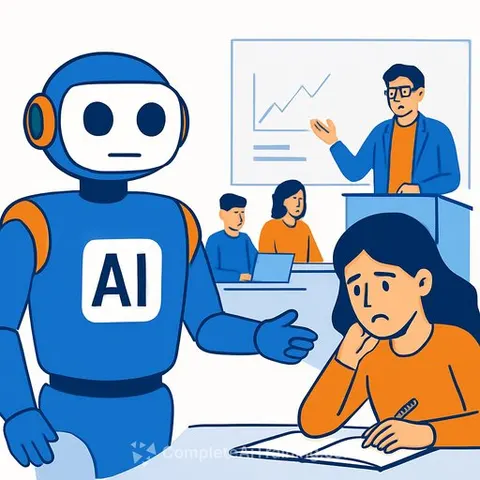
The Real Threat From AI in Higher Education Isn't Cheating
Universities are adopting artificial intelligence across admissions, scheduling, resource allocation and research. But the focus on whether students cheat with chatbots obscures a deeper problem: AI threatens to hollow out the educational ecosystem itself.
Researchers at UMass Boston have spent eight years studying how AI changes the moral stakes of higher education. Their conclusion: as machines become better at knowledge work, universities face a choice about what they actually are.
Three levels of AI risk
Not all AI systems pose the same threat. Understanding the differences matters for how institutions should respond.
Nonautonomous systems automate tasks but keep humans in control. These handle admissions reviews, purchasing decisions and student risk assessments. The risks are real-bias, privacy breaches, lack of transparency-but familiar. Universities have compliance offices and institutional review boards designed to address them.
Hybrid systems combine human goals with machine-generated steps. Students use AI chatbots as tutors and writing partners. Faculty use them to design syllabuses and generate rubrics. Researchers use them to summarize papers and write code.
This is where learning actually breaks down. When students can offload the struggle-drafting, revising, failing, trying again-they skip the cognitive work that builds understanding. Cognitive psychology shows that intellectual growth comes through that struggle, not around it.
Transparency matters too. A student should know whether feedback came from their instructor or a machine. When that line blurs, research from the University of Pittsburgh shows students report uncertainty, anxiety and distrust.
Autonomous agents represent the trajectory ahead. These systems could run experiments, conduct literature reviews and teach courses with minimal human intervention. Robotic laboratories already automate large portions of experimentation.
The pipeline problem
Universities aren't knowledge factories. They're systems where graduate students and early-career academics learn by doing the work.
If autonomous agents absorb the "routine" tasks that historically trained the next generation, universities keep producing courses and publications while quietly thinning the opportunity structures that sustain expertise. The same applies to undergraduates. When machines supply explanations and solutions on demand, students miss the on-ramp into academic thinking.
The industry pushing AI into universities may see this struggle as inefficient. But that inefficiency is the mechanism of learning itself.
What is the university for?
Universities face a choice about their purpose. One view treats them as engines for producing credentials and knowledge. If machines can do that more efficiently, adopt them.
Another view treats universities as ecosystems with intrinsic value. The pipeline through which novices become experts. The mentorship structures that cultivate judgment. The educational design that encourages productive struggle. In this model, how knowledge is produced matters as much as what is produced.
As knowledge work itself becomes automated, institutions must decide what higher education owes students, early-career scholars and society. The answers will determine not only how AI is adopted, but what the modern university becomes.
Educators working through these questions may find value in exploring AI for Education and AI Research Courses to understand both the tools and their implications.