
AI news ·
Universities use AI to cut costs, predict student dropouts and align programs with labor market demand
Universities are using AI to cut costs, predict student dropouts, and optimize financial aid offers-with 94% of higher ed staff now using the tools. The market is growing fast, but so are concerns about algorithmic bias in admissions.
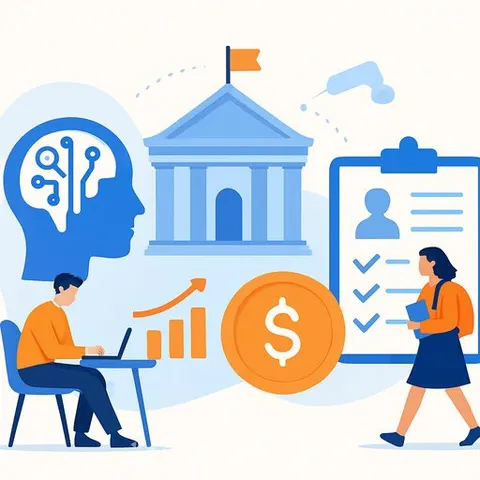
AI is reshaping how universities manage money, admit students, and retain them
Universities are deploying artificial intelligence across their administrative operations to address a financial and enrollment crisis. The global AI in education market, valued at $5.88 billion in 2024, is projected to reach $32.27 billion by 2030, growing at 31.2% annually.
This shift reflects genuine institutional pressure. Public trust in higher education has eroded. State funding remains flat or declining. Inflation has driven up costs. Universities that don't adapt face long-term viability questions.
Ninety-four percent of higher education staff now use AI tools for work-related tasks. The technology is moving beyond chatbots into core administrative functions: financial planning, enrollment management, student retention, and faculty scheduling.
Cost savings and smarter spending
Universities spend over $108 billion annually on research and development alone. Traditional accounting systems track these expenses but cannot identify inefficiencies or flag suspicious spending patterns.
AI-powered spend analytics platforms analyze complex contract data and vendor histories to flag billing errors and identify optimal times for renegotiations. Institutions using these tools have achieved an average 30% reduction in fixed costs without cutting staff or disrupting operations. These savings get reinvested in academic programs.
Tuition pricing presents a different challenge. Institutions must balance accessibility with revenue needs. AI algorithms analyze economic indicators, market demand, historical retention rates, and student demographics to model optimal pricing adjustments.
One university used price elasticity modeling to reset tuition and increased new student enrollment by 54% while boosting net tuition revenue by 55%.
Enrollment algorithms and ethical concerns
Admissions offices now use predictive algorithms to forecast which admitted students will enroll and which interventions will persuade them. These Financial Aid Optimization (FAO) tools analyze thousands of data points including academic performance, demographic background, and digital engagement.
Indiana University of Pennsylvania used this approach to increase fall-to-spring retention to 90% and improved first-year retention from 71% to 75% in a single academic year. Oklahoma State University surpassed its enrollment goals two years ahead of schedule.
But this creates an ethical problem. Two prospective students with identical financial need and grades may receive different scholarship offers based solely on their predicted likelihood to enroll. A student showing high engagement through campus visits and email opens might receive a smaller scholarship because the algorithm predicts they'll enroll anyway. A less-engaged student gets a larger offer to sway them.
This approach optimizes revenue but raises fairness questions. Universities are being advised to establish governance frameworks that ensure algorithms optimize for diversity and academic quality, not just revenue.
Predicting student dropout before it happens
Early warning systems now identify at-risk students by monitoring hundreds of data points daily. Georgia State University tracks over 800 metrics per student including grades, attendance, financial holds, and learning management system activity.
When the system detects patterns linked to attrition-such as missing two consecutive classes while avoiding the learning platform-it alerts an academic advisor. This proactive approach increased four-year graduation rates by 7 percentage points.
The University of Arizona analyzes student ID card swipes across campus to track physical activity patterns. Students who suddenly stop visiting the library, dining hall, or recreation center are flagged with 90% accuracy within the first 12 weeks. This physical isolation often precedes academic withdrawal.
The University of Oregon identifies at-risk first-year students during the summer before they arrive on campus, giving advisors time to build support systems before classes begin.
A critical finding: algorithms don't solve problems. They illuminate them. Success depends entirely on human advisors following up. As one advisor reflected on an at-risk student: "The algorithm told us Sarah was at risk, but it was the conversation we had about her goals and challenges that made the difference."
Curriculum alignment with job market demand
Thirty percent of the average job's required skills have been replaced over the past decade. Universities face pressure to function as workforce development engines, aligning academic programs with industry needs.
Firms like Lightcast use natural language processing to parse billions of global job postings daily, extracting specific skill requirements. Following the release of advanced generative AI models, U.S. job postings citing generative AI skills jumped from 16,000 in 2023 to over 66,000 in 2024. Demand for "prompt engineering" rose from 1,400 to nearly 6,300 postings.
Boston University used labor market data to redesign its doctoral programs. The university created a "PhD Progression" initiative with 160 digital badges that translate academic research skills into employer-recognized competencies like project management and communication.
Texas A&M University-Central Texas used AI to review syllabi against labor market demand, translating academic jargon into "employer speak" so students and employers recognize the market value of courses.
The stakes are high. A Harvard study tracking 62 million workers found that junior positions are shrinking at companies adopting AI. Workers aged 22-25 in AI-exposed fields experienced a 13% relative decline in employment. However, graduates who use generative AI tools regularly report higher productivity and better professional alignment.
Sixty-six percent of education and business leaders say AI fluency is now a baseline requirement for hiring.
Automating hiring and faculty scheduling
Ninety-one percent of higher education HR professionals use AI tools, primarily as drafting assistants and thought partners. The University of Minnesota classifies tasks like drafting interview questions and summarizing regulatory changes as "Medium Risk" activities suitable for AI collaboration with human oversight.
Candidate screening represents a bigger opportunity. AI platforms automatically analyze academic CVs, teaching philosophies, and research portfolios, generating structured summaries that highlight met and missing job requirements. This helps search committees make faster, more consistent hiring decisions.
Academic scheduling is mathematically complex-balancing space constraints, instructor availability, pedagogical requirements, and student preferences. Manual scheduling often results in poor space utilization and faculty burnout. AI-powered scheduling software generates conflict-free schedules using evolutionary algorithms.
Platforms like Watermark Faculty Success automate annual activity reporting and tenure dossier preparation by extracting data from faculty CVs and institutional databases. This eliminates bottlenecks and ensures promotion reviews are consistent and based on real-time workload histories.
Smart buildings and predictive maintenance
Universities are deploying interconnected sensors and AI analytics to create "smart campuses" that anticipate mechanical failures and optimize energy consumption.
The foundation is the "Digital Twin"-a data-rich 3D virtual replica of physical buildings and utility systems. AI layers intelligence over legacy building infrastructure using standard communication protocols. This allows facilities managers to view real-time building performance and test operational changes before implementing them.
Machine learning algorithms monitor high-frequency data from equipment including vibration, temperature, pressure, and electrical current. By comparing real-time data against historical failure signatures, the AI can predict remaining useful life. Impending chiller failures can be detected three to six weeks in advance, allowing planned repairs during scheduled windows instead of emergency shutdowns.
Institutions typically follow a four-stage deployment: assessment (connecting building systems), pilot deployment (automated fault detection), expansion (adding weather and occupancy data), and campus-wide intelligence (full integration).
Space optimization platforms enforce rules-based scheduling to maximize room utilization based on actual attendance. When integrated with occupancy sensors, systems automatically adjust lighting and HVAC when spaces are empty. Institutions achieve 20-35% energy savings and 60% reductions in emergency work orders.
Donor identification and fundraising automation
AI platforms analyze vast external datasets to identify prospective donors. These algorithms ingest philanthropic histories, real estate holdings, corporate board affiliations, and socioeconomic indicators to surface alumni and community members with major gift potential who may have gone unnoticed by manual prospecting.
Once identified, generative AI enables personalized outreach at scale. Platforms integrate with institutional databases to automate emails, text messages, and digital chat. Live donor profiles update in real time, ensuring messaging aligns with current life events and philanthropic interests.
Penn State University saw a 110% return on investment from engagement automation. At Boise State University, advancement staff reported that AI prioritization freed them to focus on meaningful face-to-face interactions instead of routine communications and data entry.
Global adoption and governance
The Middle East is aggressively adopting AI in higher education as part of broader economic transformation. Saudi Arabia's Vision 2030 initiative positions universities as engines of a knowledge economy shift.
King Abdulaziz University designated 2026 as the "Year of Artificial Intelligence" and mandated a 60-hour AI fellowship for faculty. Enrollment in its AI courses grew from a few hundred students in 2023 to several thousand by 2026. The university is aligning programs with MIT and Stanford to make AI a core component across all curricula.
The King Abdullah University of Science and Technology partnered with Deloitte's AI Institute to bridge academic research and commercial application. AI research at Saudi universities now supports healthcare by automating genomic logistics and predicting patient outcomes.
Approximately 70% of universities in Dubai have adopted AI. The American University in Dubai saw a 20% increase in student participation and 15% improvement in math pass rates using intelligent adaptive learning. The University of Wollongong in Dubai eliminated 45% of administrative burdens with AI assistants.
Qatar University deployed "Murshidi," an AI-driven academic advising chatbot providing bilingual support. Researchers are using AI-powered digital twins to detect oil and gas pipeline leaks and improve in-vitro fertilization success rates.
Rapid deployment creates governance challenges. Algorithms trained on sensitive student financial records and behavioral data present ethical and legal risks if improperly managed or if systemic biases are introduced.
Qatar University recently established comprehensive policies on generative AI use, mandating transparency, accountability, and protection of intellectual property and privacy. King Abdulaziz University classified AI use levels to protect institutional data.
These governance structures reflect a fundamental principle: transparency builds trust. Providing students explicit opt-in control over their data and restricting algorithmic access on a need-to-know basis are essential practices for responsible AI integration.
The human factor remains essential
The ultimate goal is validating the return on investment in higher education for all stakeholders. AI is restructuring operational, financial, and strategic foundations across institutions.
But success depends on symbiosis between machine intelligence and human empathy. Algorithms can identify at-risk students with 90% accuracy, but a human advisor executes the intervention. AI can parse millions of job postings to identify skill gaps, but faculty must update curriculum. AI can screen alumni networks for wealth markers, but advancement officers must cultivate genuine relationships.
Universities viewing AI solely as a cost-reduction tool will likely underperform and alienate their communities. Those embedding AI responsibly-governed by strict ethics policies, integrated across silos, and aligned with labor market needs-will secure institutional sustainability and deliver validated economic and social value to students, faculty, and society.
Learn more about AI for Education and AI Data Analysis to understand how these technologies apply to your role.