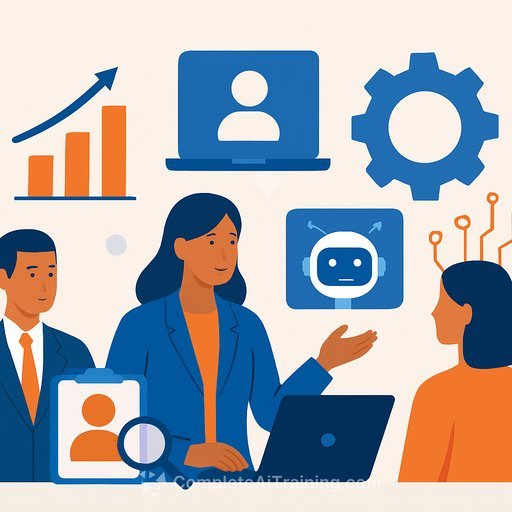
AI in HR: Trends to Watch in Resume Screening, Candidate Matching, and Skill Gap Analysis
AI is moving from buzz to budget line. The market sits at US$ 4.3B (2023) and is projected to hit US$ 25.0B by 2031, growing at a 24.8% CAGR. For HR teams, that growth is showing up in faster hiring cycles, more consistent decisions, and sharper visibility into skills.
If you run recruiting, L&D, or workforce planning, the message is simple: start with focused use cases, measure impact, and build responsible guardrails as you scale.
Where AI Is Creating Immediate Value
- Resume screening: Automates first-pass filtering, surfaces qualified profiles, and reduces manual review time.
- Candidate matching: Aligns skills and experience with role requirements to improve shortlist quality.
- Predictive analytics: Flags indicators of performance, retention risk, and ramp speed.
- Skill gap analysis: Maps current capabilities to business demand and informs L&D roadmaps.
- Personalized learning paths: Recommends courses and content based on role, performance, and goals.
- Feedback and sentiment: Monitors pulse data to spot engagement risks earlier.
- Succession planning: Identifies internal mobility paths and future leaders.
- Compensation optimization: Supports fair, market-aligned pay decisions.
Why Adoption Is Accelerating
- Automates repetitive tasks (screening, scheduling) so teams can focus on strategy.
- Improves decision consistency with data-backed insights.
- Supports retention with targeted development and internal mobility.
- Enables workforce planning using real-time analytics on skills, demand, and performance.
- Better affordability and clearer guidance from regulators are lowering barriers.
Real Constraints You Need to Manage
Upfront costs, data privacy, and the need for specialized expertise are the big ones. Bias, explainability, and cybersecurity sit close behind, especially for SMEs with limited resources.
- Run bias and validation tests on models before and after deployment.
- Apply data minimization and privacy-by-default practices; track evolving rules like the EU AI Act and EEOC guidance.
- Keep a human-in-the-loop for high-impact hiring decisions.
- Set vendor criteria for transparency, auditability, and security.
- Pilot with a narrow scope, define ROI targets, and commit to clear KPIs.
Useful resources: NIST AI Risk Management Framework and the EU AI Act overview.
Deployment Notes: Cloud vs On-Prem
Cloud-based tools offer speed, integrations, and frequent updates. On-premises can meet stricter data residency and security needs but demands more internal support.
Pick based on your industry's compliance requirements, sensitivity of recruiting and employee data, and your IT team's capacity to manage and secure the stack.
Who's Building the Tools
- IBM Corporation
- Oracle Corporation
- SAP SE
- ADP, LLC
- Workday, Inc.
- Ultimate Software Group, Inc.
- Cornerstone OnDemand, Inc.
- Kronos Incorporated
- Ceridian HCM, Inc.
- Talentsoft
- PeopleStrong HR Services Pvt. Ltd.
- Phenom People, Inc.
- Visier, Inc.
- Entelo
- HireVue Inc.
- Textio
- Brazen Technologies
- AllyO
- Pymetrics
- Eightfold AI
- ClearCompany
- Jobvite, Inc.
- Greenhouse Software, Inc.
- Talview
- Avature
Regional Outlook
North America leads, supported by strong tech ecosystems and data-driven HR practices. Europe is growing steadily with a focus on responsible AI and stricter regulatory guardrails. Asia-Pacific is scaling fast as enterprises modernize hiring and skills strategies, while Latin America and the Middle East & Africa show rising adoption as infrastructure improves.
Market Segmentation Snapshot
- Type: Recruitment & Selection; Employee Onboarding; Performance Management; Talent Management; Workforce Planning & Analytics; Employee Engagement; Learning & Development.
- Application: Resume Screening; Candidate Matching; Predictive Analytics for Employee Success; Skill Gap Analysis; Personalized Learning Paths; Feedback & Sentiment; Succession Planning; Compensation & Benefits Optimization.
- Deployment: Cloud-based; On-premises.
- Organization Size: SMEs; Large Enterprises.
Practical Rollout Plan
- Pick two high-impact use cases (e.g., resume screening and candidate matching) and define baseline metrics.
- Clean your job taxonomy and skills data; standardize titles and competencies.
- Shortlist vendors by explainability, integrations, audit logs, and security certifications.
- Run a 60-90 day pilot with clear success criteria and a small, diverse hiring cohort.
- Train recruiters and hiring managers on prompts, oversight, and escalation paths.
- Create an AI governance checklist: bias testing cadence, privacy controls, retention policies, and incident response.
- Publish a transparency note for candidates describing how AI is used in your hiring process.
KPIs That Prove It Works
- Time-to-apply review and time-to-interview scheduling.
- Qualified shortlist rate and offer acceptance rate.
- Quality of hire (performance at 6-12 months) and new-hire retention.
- Fairness metrics: pass-through parity across demographics.
- Internal mobility rate and skills coverage versus demand.
- Course engagement and completion for targeted learning paths.
Upskilling for HR Teams
AI literacy is now core HR capability. Give your team a clear path to build skills in prompts, analytics, and responsible deployment.
- AI Learning Path for Training & Development Managers to structure role-specific L&D and build practical competencies.
- AI courses by job function for recruiters, HRBPs, and L&D.
- Popular AI certifications for credibility and shared standards.
Bottom Line
The market is growing fast for a reason: resume screening, candidate matching, and skill gap analysis are delivering measurable results. Start small, measure hard, and build responsible guardrails as you scale across the HR lifecycle.
Your membership also unlocks: