
AI news ·
AI-integrated virtual reality shows early promise for mental health care but lacks clinical evidence, review finds
AI combined with VR can detect anxiety, stress, and depression, but a review of 18 studies finds the evidence too thin for clinical use. Small samples and weak validation mean technical accuracy hasn't translated into proven patient outcomes.
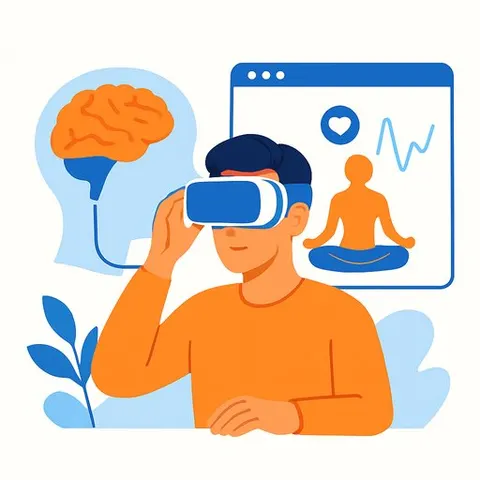
AI-integrated virtual reality shows promise for mental health but lacks clinical proof
A new review of research published in the Journal of Clinical Medicine finds that combining artificial intelligence with virtual reality can detect anxiety, monitor stress, assess trauma and screen for depression-but the field remains too early and fragmented for widespread clinical use.
The review examined 18 studies published between January 2020 and February 2026. Researchers found that while technical performance was often strong, clinical evidence lagged behind. Most studies tested whether AI could be connected to VR-based mental health workflows, not whether the combination actually outperforms standard VR or usual care.
What the research shows
Anxiety-related conditions dominated early applications. Studies used VR exposure scenarios paired with physiological sensors-heart rate monitors, electrodermal activity sensors, movement tracking-to classify anxiety responses. In one acrophobia study, researchers detected fear using these biosignals during height-simulation scenarios.
Social anxiety disorder featured prominently as well. Researchers placed patients in VR public speaking or social situations and used AI to predict which patients would experience severe symptoms or tolerate VR poorly.
Panic disorder, agoraphobia and PTSD formed another research focus. Studies used machine learning to distinguish patients from controls and predict early treatment response. Some work examined physiological habituation patterns in military personnel and veterans during immersive VR scenarios.
Depression screening appeared in newer research. One study combined behavioral and physiological signals in a VR framework to screen adolescents, though results remain preliminary.
Emerging work also tested adaptive VR systems that use AI to detect arousal levels and adjust feedback during exposure therapy. One recent study tested an AI-supported adaptive VR program for spider phobia and reported preliminary improvements.
The evidence gap
The review identifies a critical problem: small sample sizes, single-site designs and limited external validation make it difficult to translate technical accuracy into clinical value. High classification accuracy for stress or anxiety does not necessarily mean patients will improve.
Standard VR therapy already has a role in anxiety and exposure-based treatment. The unanswered question is whether AI improves outcomes by personalizing scenarios, detecting distress earlier, predicting response, reducing dropout or helping clinicians make better decisions.
Safety reporting is another weakness. VR can trigger cybersickness, emotional overload, dissociation or symptom worsening. AI systems introduce additional risks through bias, poor transparency or weak validation. Combined, these technologies process sensitive data including physiology, movement, behavior and emotional response.
The review emphasizes that clinician oversight remains essential. AI-integrated VR should function as a support tool for assessment, monitoring and treatment planning under human supervision-not as an autonomous intervention.
Implementation barriers
Even when studies report acceptability, real-world deployment faces obstacles. Hardware costs, sensor reliability, staff training, data privacy rules and workflow integration remain unresolved in most care settings.
The review calls for larger representative samples, standardized reporting on both AI and VR components, clearer safety monitoring and long-term follow-up. Future studies should test whether these tools work across different cultures, age groups, diagnoses and service settings.
Research should also measure whether AI adds clinical value beyond VR alone, alongside tracking adoption, fidelity, sustainability and cost.
What's next
The field shows that AI and VR can be technically connected. Proving they work better together in clinical practice requires a different level of evidence-large randomized trials, pragmatic multicenter studies and direct comparisons with standard care.
For healthcare professionals evaluating these tools, the takeaway is straightforward: promising does not mean proven. Current evidence supports further investigation, not routine implementation.