
AI news ·
AI layoffs show no correlation to return on investment, Gartner research finds
Cutting workers after an AI rollout doesn't improve returns, Gartner found in a late 2025 survey. Companies with the strongest ROI trained existing staff instead of replacing them.
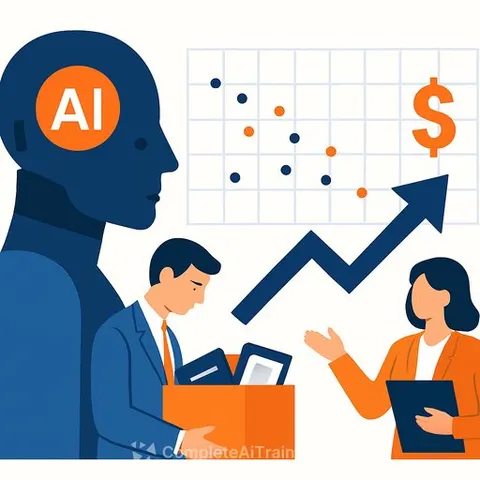
Layoffs After AI Rollout Don't Boost Returns, Gartner Research Shows
Eighty percent of large enterprises have cut workers after launching AI projects, but the companies achieving the strongest returns are not the ones cutting deepest. Gartner found no correlation between workforce reductions and AI return on investment.
Enterprises reporting significant ROI from automation laid off employees at the same rate as those reporting modest or negative returns, according to the research firm's late 2025 survey of business executives.
The finding contradicts a widespread assumption that AI-driven productivity gains translate directly into headcount cuts and profit. Layoffs may deliver short-term cost savings, but they don't predict whether an AI investment will pay off.
Training Drives Better Results
Companies achieving the strongest ROI are instead reinvesting in their workforce. They train existing employees to build and operate AI systems rather than replacing workers with automation.
The highest-performing companies create new roles for current staff-such as AI agent orchestrators-to manage and oversee automated workflows. They map career paths for workers whose jobs are being transformed by AI, rather than eliminating those positions.
"They're investing in upscaling people to be able to actually build their own agents or automations," said Helen Poitevin, digital workplace analyst at Gartner. "They're enabling people to do some innovation on their own."
Brian Behe, CTO of cybersecurity vendor RIIG Technology, said the pattern is clear: "The organizations getting real returns are the ones that took the people who understood their business deeply and gave them AI tools to do more with that knowledge."
Conversely, companies that cut staff first and automated second discovered they had eliminated the institutional knowledge their AI systems needed to function. Expertise cannot be automated once it's gone.
Measuring Progress the Wrong Way
Many organizations have used workforce reduction as a proxy for AI success, Behe said. Cutting headcount is easy to measure and announce. Building the operating model that makes AI actually deliver value is harder.
"Organizations treat workforce reduction as proof of AI progress, when it is actually a signal that they have skipped the hard part," he said. "Layoffs are being used as a proxy for progress. They're not."
Some recent AI-connected layoff announcements may reflect over-hiring from previous years rather than AI's actual displacement potential, said Andy Williamson, CEO and director of AI strategy for IT education vendor ONLC Training. Some companies are rehiring after cuts because they overestimated how much AI could replace workers.
The Automate-to-Augment Approach
A better strategy focuses on automating routine, low-risk tasks to free up employee time, then redirecting that capacity toward higher-value work. This might mean delivering better service to existing customers or expanding into markets the organization couldn't pursue before.
Gartner predicts that over the long term, AI will create more jobs than it replaces. In the near term, however, the technology will significantly transform 32 million jobs annually, creating what the firm calls "job chaos."
Smart companies will fill AI-related roles from their existing workforce rather than hiring externally, Poitevin said. This approach preserves institutional knowledge and reduces the risk of hiring people unfamiliar with how the business operates.
The human cost of large-scale layoffs often goes unexamined in boardrooms focused on financial projections. When Block announced 40% workforce cuts in February to refocus on AI, the decision received attention for severance terms but little scrutiny of whether the cuts were necessary or how they would affect the 4,000 employees losing their jobs.
"Talent and experience are among the largest assets an organization has," Williamson said. "Leadership that understands what AI can do today can find expansion opportunities that might have been too difficult without the aid of AI. Without this insight, there's a real risk of losing talent that could shape future product innovations."
For executives planning AI investments, the research points in one direction: training and reskilling your workforce will generate stronger returns than reducing it.