
AI news ·
AI makes entry-level candidates sound more prepared, but interviewers need to test for judgment, not polish
AI tools have made early-career candidates sound more polished than ever, making interviews a poor measure of actual judgment. Here's how hiring managers can test thinking under pressure instead.
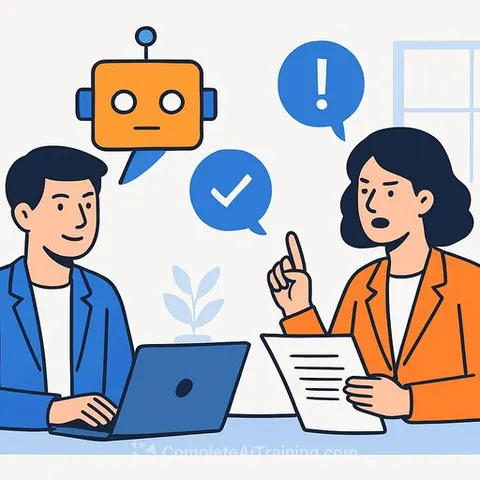
AI Has Raised the Hiring Bar. Interviews Haven't Caught Up.
Early-career candidates arrive at interviews more polished than ever. They have structured answers, clean language, and a fluency that once took years to develop. AI has raised what baseline competence looks like.
But fluency is not the same as judgment. What sounds like experience is often proximity to tools.
The problem is real for hiring managers in communications, marketing, and corporate affairs. You can no longer assume that capability - clear writing, composure, analytical thinking - will automatically develop into sound judgment. The interview itself needs to change.
The job of the interview has shifted
Hiring has moved from selecting for output to selecting for trajectory. You're no longer looking for the person who sounds most ready. You're looking for the person most likely to develop judgment under pressure.
That judgment rarely announces itself in a polished answer. It shows up when thinking has to evolve.
Traditional interviews reward candidates who sound prepared. Effective interviews surface how candidates think when they don't have a prepared answer.
Introduce ambiguity, not as a trick but as reality
Communications work doesn't operate on perfect information. Priorities collide. Facts are incomplete. Timing, accuracy, and stakeholder trust are constantly in tension.
A better interview question doesn't ask whether a candidate knows the answer. It asks what they do when there isn't one.
Try this: A regulator calls about an issue you don't fully understand yet. Media inquiries are starting. What do you do in the next two hours?
Then add pressure. Legal tells you that you can't disclose key facts yet. What changes?
The content of the answer matters less than how the thinking evolves. Candidates who move too quickly to closure often struggle when situations don't resolve cleanly - which is most of the time. The ones who become more thoughtful under pressure, who adapt rather than double down, are the ones who develop judgment.
Look for ownership and ethical awareness
Ownership shows up in how candidates describe past experiences. Most people can explain what happened. Fewer take responsibility for outcomes, especially when those outcomes weren't ideal.
Listen to whether candidates default to explanation or ownership. Do they acknowledge what they would do differently? Stronger candidates describe what they would change. Weaker candidates explain why the outcome wasn't their responsibility.
Blame halts development. Ownership accelerates it.
Ethical instinct matters just as much. Most organizational failures don't begin with clear ethical breaches. They begin with small rationalizations under pressure - because something was technically allowed, because speed felt necessary, or because no one expected immediate consequences.
Don't test obvious right-versus-wrong scenarios. Instead, introduce tension into an otherwise straightforward decision: We have incomplete information. Leadership wants to move quickly. There's no immediate legal constraint. What do you do?
Strong candidates will pause. They'll qualify their answer. They'll surface risks before being asked. They'll recognize the tradeoffs between speed, accuracy, and transparency. Weaker candidates move directly to action without acknowledging what's at stake.
Watch how thinking improves under complexity
Confidence is not a useful hiring signal. It can be manufactured. It can be borrowed.
What matters is judgment velocity - how quickly someone's thinking improves as complexity increases. You can see it happen in real time. Do their questions get better? Do they incorporate feedback? Do they refine how they frame the problem?
Early-career professionals haven't yet been close enough to sustained consequence to fully develop judgment. The role of the interviewer is not to confirm what they already know. It is to determine how they will learn.
In an environment where AI can replicate much of the visible work, the distinction between hiring for polish and hiring for judgment is no longer philosophical. It is operational.
For communications leaders managing hiring, this shift has direct implications. Learn more about how AI for PR & Communications is changing the skills your team needs, or explore the AI Learning Path for Public Relations Specialists to understand what judgment looks like in an AI-enabled environment.