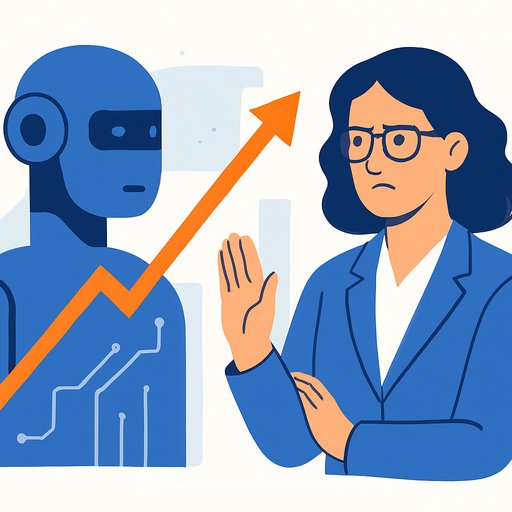
AI Is Outpacing Leadership Readiness. HR Can't Sit This One Out
AI has moved from a helpful tool to a quiet decision engine inside organizations. Productivity is up. So is risk when leaders hand over judgment without noticing.
As Dr. Andrea Adams-Miller, CEO of The RED Carpet Connection, LLC and an Executive Advisor & Applied Neuroscientist on AI, puts it: "Artificial intelligence dramatically increases speed, but speed without discernment increases organizational risk." She adds, "AI should amplify human intelligence. The moment artificial intelligence replaces critical thinking, performance becomes fragile."
What HR is seeing on the ground
Real benefits are showing up. Professional-services firms are reporting double-digit reductions in internal reporting time with generative tools. Financial teams are flagging risks faster and spending fewer hours on manual review.
Hiring teams have cut screening times with automated systems. Then some brought back human review after early models amplified bias. That's the lesson: efficiency without oversight creates downstream problems HR has to fix later.
The research is clear
Studies note that machine-learning systems reflect the assumptions and values in their training data and design. And when governance is weak, algorithmic decisions can scale errors and bias faster than humans can catch them. Speed multiplies both wins and mistakes.
What HR must do now
- Define decision rights: List what AI may draft, recommend, or decide-and where human sign-off is mandatory (hiring, compensation, promotion, termination).
- Human-in-the-loop by default: Force a pause and approval step for high-stakes actions. No "auto-accept" for people decisions.
- Create an AI use registry: Track every tool, model, use case, data source, owner, and risk level.
- Standardize prompts and inputs: Provide approved prompts, required context, and disallowed data. Include disclaimers for internal drafts.
- Bias and quality checks: Test outputs for disparate impact and accuracy. Re-test after model or data updates.
- Audit trails: Log prompts, outputs, overrides, and final decision owners. If it's not logged, it didn't happen.
- Manager training: Teach how to interpret model confidence, identify weak signals, and challenge AI suggestions. For managers building practical skills, consider the AI Learning Path for Business Unit Managers.
- Transparent notices: Inform applicants and employees when AI is used, how it's used, and their options.
- Vendor due diligence: Require documentation on data sources, bias testing, evaluation results, and update cadence.
- Incident playbook: Define how to pause a system, investigate, communicate, and remediate when harm or bias is detected.
- Metrics that matter: Time saved, error rate, override rate, fairness measures, audit completion rate, and employee trust scores.
30/60/90-day rollout
- Days 1-30: Inventory AI use, set decision rights, put human review on high-stakes workflows, start logging.
- Days 31-60: Launch bias testing, standardize prompts and data inputs, train managers, finalize vendor requirements.
- Days 61-90: Publish transparency notices, implement the incident playbook, report metrics to the executive team, and adjust.
Hiring and performance: keep the pen in human hands
Let AI draft job descriptions, screen for minimum qualifications, and suggest interview questions. Keep humans accountable for final decisions and candidate feedback.
For performance management, AI can summarize notes and spot trends. Managers still own the ratings, the pay decisions, and the conversation.
Governance that scales
Use a simple framework: clarity of decision rights, documented oversight, measurable outcomes. If you need a reference model, the NIST AI Risk Management Framework is a solid starting point for controls and language your legal team will recognize. NIST AI RMF
Bottom line
AI can make your team faster. Without human judgment, it makes your organization fragile. HR's job is to protect decision ownership while improving throughput.
As pressure rises, the quality of decisions matters more than the speed of them. Put governance in place before the next high-stakes moment exposes a gap.
If you're building HR capability around AI skills and governance, see role-based training options such as the AI Learning Path for Project Managers and the AI Learning Path for CIOs.
Your membership also unlocks: