AI-driven pricing and operations are delivering measurable hotel gains
Hotels are moving past experiments and getting real results from AI. Early adopters are seeing revenue lift, tighter labor efficiency, and better resource management. The message for operations leaders is simple: test focused use cases, integrate them into day-to-day workflows, and measure everything.
What early adopters are seeing
- Revenue: AI pricing engines are delivering up to 15% RevPAR gains by adjusting rates in real time based on booking pace, competitor pricing, and local events.
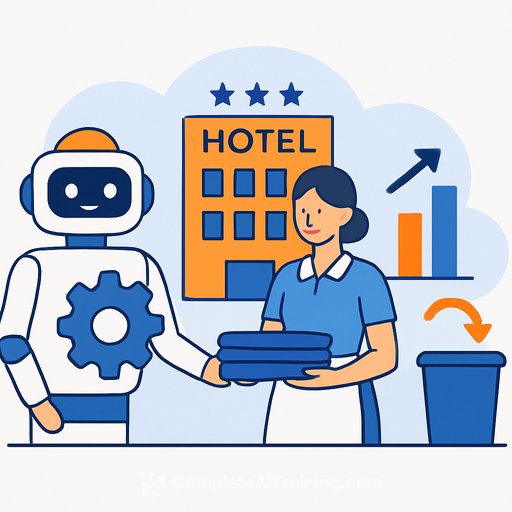
- Housekeeping: The Ritz-Carlton San Francisco reported a 20% increase in room-cleaning speed using predictive scheduling tuned to checkouts, guest preferences, and staffing levels.
- F&B waste: Four Seasons Peninsula Papagayo cut food waste by 50% in eight months with AI-driven tracking and feedback loops.
While fewer than one in 10 hospitality companies are using advanced AI at scale, about 25% are in the "AI-scaling" phase-turning strategy into repeatable results across marketing, revenue, guest engagement, and property operations. Practical applications now include hyper-targeted offers, dynamic pricing, service chatbots, and tools that optimize staffing, inventory, and maintenance.
What's next
The next wave will extend into risk and safety, construction planning, and capital allocation. Expect more predictive systems that reduce variance in costs, timelines, and outcomes-and make portfolio decisions less guesswork and more math.
Barriers you need to clear
Data fundamentals: Many properties run on fragmented stacks-separate PMS, POS, CRM, and loyalty systems. To scale AI, you need clean data, consistent definitions, and integrations that create a single source of truth.
Talent and adoption: Only 2.9% of full-time travel and tourism employees currently have AI skills (vs. 21% in tech and media), though hospitality is catching up at ~5% YoY growth. Your edge comes from targeted upskilling and process changes that make AI outputs actionable at the shift level.
Playbook for operations leaders
- Anchor on measurable use cases: Start with one revenue and one cost initiative. Examples: RevPAR lift from dynamic pricing; labor hours per occupied room via predictive housekeeping; food waste per cover; unplanned maintenance downtime.
- Pilot fast, then scale: Pick 1-2 properties with solid data hygiene. Run A/B tests for 8-12 weeks. Set guardrails (rate floors/ceilings, service SLAs). If the numbers hold, roll out with a standard playbook.
- Build the data spine: Map where booking, rate, guest, and ops data live. Standardize definitions (rooms sold, OOO, OOS, stayover vs. checkout). Integrate PMS/POS/CRM/loyalty into a central layer. Event streams beat batch when you need real-time pricing or staffing.
- Put AI inside workflows: Surface recommendations where work happens-housekeeping apps, maintenance tickets, rate dashboards, kitchen stations. Default to "AI suggests, humans confirm" until trust and accuracy are proven.
- Update SOPs and training: Turn model outputs into clear actions: who does what, by when, with what threshold. Train supervisors first, then line staff. Appoint on-property AI champions.
- Pick vendors like an operator: Open APIs; PMS/POS compatibility; explainability and audit logs; OTA and rate-parity compliance; privacy and data ownership spelled out; SOC 2/ISO 27001; total cost over 24-36 months. Insist on transparent lift reporting.
- Governance and risk: Set pricing fences by segment. Cap swings per day. Monitor fairness and bias in offers. Require human override for anomalies. Log every change for audit.
- Budget smart: Compare subscription vs. revenue-share vs. hybrid. Model impact on GOPPAR, not just RevPAR. Include integration and change-management costs. Tie payment to realized lift where possible.
- Build the bench: Upskill analysts and assistant managers on prompt use, data basics, and QA. Pair a data-savvy lead with an ops lead at each pilot property. Create an "AI ops" responsibility in your org chart.
Metrics that prove ROI
- RevPAR and net ADR growth vs. control
- Labor hours per occupied room (and variance by daypart)
- Food waste per cover and food cost percentage
- Predictive-to-reactive maintenance ratio and downtime
- Guest response time and case resolution rate for chat/service tools
- Forecast accuracy (demand, staffing, and inventory)
Keep the math simple. ROI = (Incremental profit - Total cost) / Total cost. Lock your baseline before launch, then measure weekly and cumulatively.
First moves to make this quarter
- Days 1-30: Establish baselines. Audit PMS/POS/CRM data quality. Shortlist vendors for pricing, housekeeping, or waste tracking. Define guardrails and KPIs.
- Days 31-60: Integrate data feeds. Update SOPs. Train supervisors and pilots teams. Launch controlled pilots with A/B structure.
- Days 61-90: Review lift vs. targets. Scale winners to 3-5 more properties. Sunset low-ROI experiments. Publish a playbook and dashboard for leadership.
If you want structured upskilling for your team, explore the AI Learning Path for Operations Managers. For hospitality-specific case studies and tools, see AI for Hospitality & Events.
Your membership also unlocks: