
AI news ·
AI reshapes how India delivers healthcare from diagnostics to remote care
India is rebuilding its healthcare system around AI from the ground up, not adding it onto existing workflows. Over 671 million health records are now linked, and AI has supported 12 million telemedicine consultations since 2023.
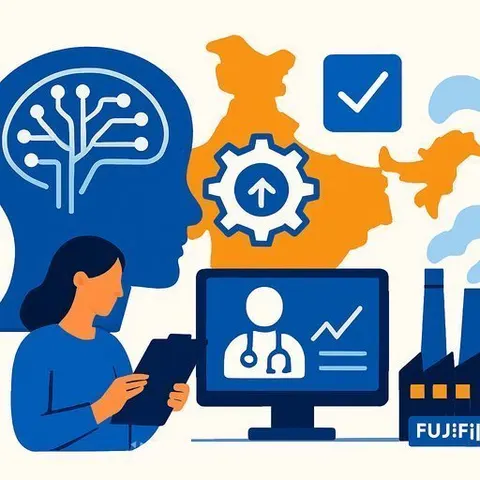
India redesigns healthcare around AI, not the other way around
India's healthcare system is restructuring itself with artificial intelligence at its core, rather than bolting AI onto existing workflows. The shift moves diagnostic power out of specialist offices and into communities, earlier detection into screening programs, and specialist-level advice into remote clinics where specialists don't exist.
The difference matters. Most organizations automate what they already do. India is redesigning what healthcare looks like from the ground up.
Diagnostics spread beyond hospital walls
MadhuNetrAI, India's first AI-assisted community screening program for diabetic retinopathy, has screened more than 7,100 people across 38 healthcare centers since 2025. These aren't digitized versions of old processes. They're new clinical encounters built with AI in mind from day one.
Small language models trained on locally relevant medical knowledge now operate in regional languages, helping patients in low-literacy areas understand their conditions and when to seek care. Health literacy, long one of India's most difficult healthcare challenges, has become an AI problem as much as an education one.
National infrastructure enables coordination
The Ayushman Bharat Digital Mission has linked 671 million health records across 410,000 health facilities and 670,000 health professionals into a single digital ecosystem. This is not a collection of hospital records systems. It's data architecture designed to give AI systems the information needed to personalize care and coordinate it across regions.
Of the 282 million telemedicine consultations via eSanjeevani between April 2023 and November 2025, around 12 million were facilitated by AI-powered clinical decision support systems. Doctors in remote locations offered specialist-quality advice without specialists physically present.
Government sets standards, not just adopts them
In March 2025, AIIMS Delhi, PGI Chandigarh, and AIIMS Rishikesh were designated Centers of Excellence for AI in healthcare to develop indigenous solutions. A memorandum of understanding between the National Health Authority and IIT Kanpur created an open benchmarking platform for validating AI models in health.
The Ministry of Health formalized this approach through its Strategy for AI in Healthcare (SAHI), developed with public institutions, academia, and industry. It's a co-created vision for healthcare, not a technology implementation roadmap.
The structural shift
The old architecture was built within constraints: scarce specialists, limited diagnostic technology, geography that separated patients from hospitals, linear patient journeys from symptoms to appointment to test to results to treatment. Each constraint shaped workflows that became accepted as normal.
AI doesn't speed up that sequence. At its most significant, it dismantles it. Non-specialist health workers now triage, screen, and refer with accuracy previously limited to trained specialists. Diagnostic power spreads beyond tertiary care hospital walls. Detection happens earlier.
Expert knowledge hasn't been replaced. It's been encoded, packaged, and sent to where patients are.
Learn more about AI for Healthcare and how Data Analysis powers these systems.