
AI news ·
AI, robotics and connectivity reshape surgical care as data governance emerges as key challenge
Modern operating rooms are evolving into connected systems where robotics, AI, and high-speed networks share data in real time. The biggest barrier to scaling isn't the technology-it's integrating it.
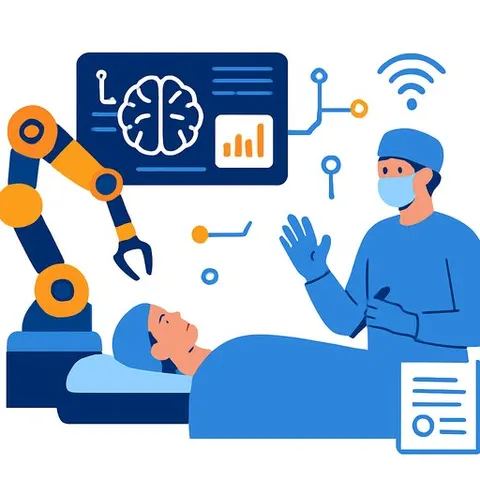
Operating Rooms Are Becoming Connected Systems-Not Just Rooms With Better Tools
Surgery is shifting from isolated procedures in operating rooms to connected ecosystems where robotics, artificial intelligence, and high-speed networks work together. For operations leaders, this means the next competitive advantage in healthcare won't come from buying individual technologies-it will come from integrating them into systems that actually work together.
The challenge isn't technical anymore. It's operational.
What's Actually Changing in the Operating Room
Robotic platforms now deliver sub-millimeter accuracy. Surgeons control instruments that scale their hand movements down to precise actions, reduce tremor, and move in ways human wrists cannot. This reduces tissue damage and speeds recovery.
Connectivity is enabling remote surgery. New 6G capabilities, specifically ultra-reliable low-latency communication (URLLC), create near real-time responsiveness. Haptic feedback lets surgeons feel tissue resistance from a distance.
AI is moving beyond support role to active participant. Computer vision identifies surgical instruments and detects anomalies in real time. AI also stabilizes motion and enhances precision in microscale work. Before surgery even starts, AI analyzes imaging data to identify anatomical structures and potential risks. Digital twin technology lets clinicians simulate procedures on patient-specific 3D models.
All of this data flows through what's called the Intelligent Internet of Medical Things (IIoMT)-devices continuously sharing information to support real-time decision-making.
Surgical Video Is Becoming Your Most Valuable Data
High-definition, stereoscopic video captures clinical detail other data sources miss, including subtle indicators like tissue tension. When structured properly, it enables real-time awareness, faster post-procedure review, and stronger clinical oversight.
Video is also critical for training AI. Multimodal models trained on video data consistently outperform those trained on motion data alone. This improves both surgical evaluation and robotic precision.
Searchable video libraries let clinicians benchmark against expert procedures and share knowledge globally. When paired with standardized medical data formats and integrated into clinical systems, these datasets become the foundation for analytics and continuous improvement.
But here's the operational risk: data quality matters enormously. As organizations generate and store AI-assisted content, maintaining clean, well-labeled, high-fidelity datasets is essential. Without strong data governance-including clear separation of original clinical data from AI-generated outputs-there's a real risk of degrading future AI model performance over time.
Where Scaling Actually Breaks Down
Healthcare organizations need more than new equipment. Success requires interoperable data systems, high-quality video infrastructure, secure low-latency connectivity, and integrated simulation capabilities. Governance, cybersecurity, and workforce readiness matter just as much.
As surgical environments become more connected and data-intensive, the biggest barriers to scale will be operational, not technical. The challenge is aligning technology, clinical workflows, and institutional oversight into a unified model that delivers consistent, safe outcomes.
Organizations that prioritize high-quality data, interoperability, and system-level integration will be positioned to lead the next phase. Those that treat robotics and AI as standalone purchases will struggle to scale.
For operations leaders, this means thinking about surgical innovation as a systems problem, not a procurement problem. The platforms, standards, and governance structures you build now will determine whether new capabilities can be adopted safely and at scale.
Learn more about AI for Operations or explore an AI Learning Path for Operations Managers to understand how system-level integration applies across your organization.