
AI news ·
AI saves Korean workers 1.5 hours a week but organizational productivity stays flat, Bank of Korea finds
AI saves Korean workers 1.5 hours weekly, but a Bank of Korea study of 5,512 workers found that time vanishes into idle hours rather than added output. Self-employed workers converted gains into real productivity; wage earners did not.
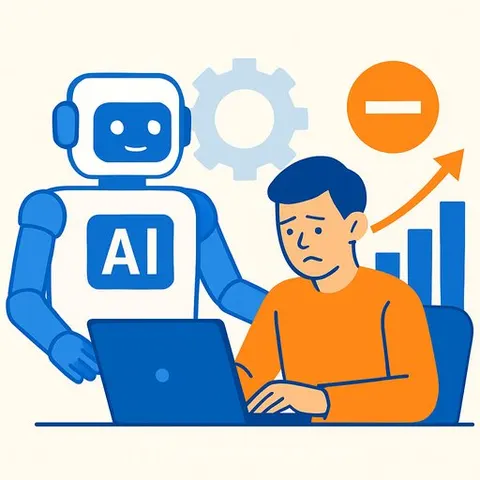
AI Cuts Worker Hours, But Organizations Aren't Capturing the Gains
Generative AI is saving employees about 1.5 hours per week, but the time savings are disappearing into idle hours rather than boosting organizational output, according to a Bank of Korea analysis released Monday.
The central bank surveyed 5,512 workers in May and June of last year and found that 51.8% of Korean workers now use generative AI on the job. That adoption rate is eight times faster than the internet spread through workplaces.
The efficiency gains are real at the individual level. Workers using AI reduced their average working hours by 3.8%-roughly 1.5 hours per week. Professionals saw the largest time savings at 2.8%, followed by office workers at 1.9% and managers at 1.5%.
But here's the problem: workload did not increase proportionally. When researchers compared the rate of time savings to the rate of workload growth, the correlation was zero. Workers completed tasks faster, but organizations didn't assign them more work.
Where the Time Actually Goes
The saved time scattered into waiting periods and idle hours instead of higher-value work. The Bank of Korea called this the "AI productivity disconnect"-a gap between individual efficiency and organizational output.
The disconnect wasn't uniform. Self-employed workers converted time savings into extra output at a 1-to-1 rate. Young workers showed productivity gains 0.6 percentage points higher than older workers. Professionals gained 0.7 percentage points more than office workers. Heavy AI users outperformed light users.
Wage earners, by contrast, saw minimal productivity gains. Researchers attributed this to unclear performance incentives and low work autonomy. When employees can't control their own output targets, they have little reason to channel saved time into additional work.
The Organizational Lag
The real bottleneck sits at the organizational level. While 51.8% of workers use AI, only 9.6% of corporate-level AI utilization has been implemented. Companies have not redesigned workflows or organizational structures to match individual tool adoption.
Individual workers are using AI to speed up specific tasks. Managers and operations teams have not redesigned entire processes around these efficiency gains. Work processes remain unchanged. Reward systems stay the same. Automation hasn't triggered the operational rethinking needed to multiply the effect.
The Bank of Korea does not view this as a technology limitation. When electricity and the internet spread, productivity gains appeared delayed but then accelerated sharply-a pattern called the "J-curve." The same trajectory could apply to AI once companies align their operations with the tools their workers are already using.
For operations professionals, the implication is direct: AI for Operations requires more than tool rollout. It requires process redesign. Organizations capturing productivity gains will be those that rethink workflows, restructure incentives, and build AI adoption into operational strategy-not those that simply let workers experiment with tools.