
AI news ·
AI search reshapes how patients find health information, and healthcare marketers need to keep up
40 million people ask ChatGPT health questions daily, yet 68% of doctors report patients refusing treatment based on inaccurate AI answers. Healthcare organizations that aren't cited by AI models are losing the conversation.
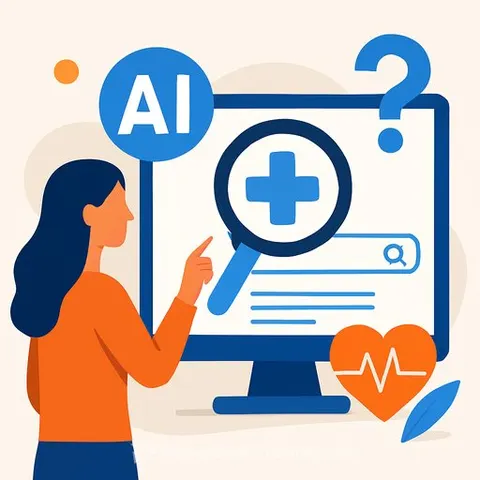
Patients are asking AI health questions. Healthcare companies need to answer.
Forty million people ask ChatGPT health-related questions daily. That's a staggering shift in where patients get medical information - and healthcare organizations are unprepared to meet them there.
A recent survey of 150 physicians found that 90% report patients now arrive at appointments having researched their condition using AI search. Yet 68% of those doctors say inaccurate AI information causes patients to question or refuse treatment.
The problem isn't that AI is giving health advice. It's that healthcare companies aren't part of the conversation.
The citation game has changed
Google searches used to be the battleground for healthcare marketers. Now, generative engine optimization (GEO) - getting your content cited by AI language models - matters more.
One year after Google launched AI Overviews, searches without a single click jumped 23%, according to Similarweb. People are getting answers directly from AI instead of clicking through to websites.
Different AI models cite different sources. ChatGPT cites sources in 96% of responses and favors Mayo Clinic and Healthline. Google's Gemini cites in 82% of responses and prefers the National Institutes of Health and Cleveland Clinic. Claude cites selectively but deeply - averaging 13 citations per response, heavily weighted toward PubMed and academic journals.
For healthcare marketers, this means one thing: your clinical data must align with these high-authority platforms.
Where the patient questions come from
A study of over 500,000 health-related conversations on Microsoft Copilot revealed the timing and nature of these queries. Nearly 41% focus on health information and education. One in seven involves someone other than the user - a parent asking about their child, a caregiver researching for a relative.
Personal health queries spike in the evening, when traditional healthcare is unavailable. A large share focuses on navigating the healthcare system itself - finding providers, understanding insurance, accessing care.
These are the moments when patients turn to AI because their doctor's office is closed.
Three steps to show up in AI search
Identify where you're missing. Check where your organization, therapeutic area, or product appears across ChatGPT and Google AI Overviews. Find the gaps.
Diversify your content sources. Create content across multiple channels - YouTube, Reddit, peer-reviewed journals, consumer health platforms. The more places your information appears, the more likely AI will cite it.
Make content AI-readable. Write for clarity, not complexity. Use complete abstracts, clear primary outcomes, and accessible language. Publish in open-access journals when possible so AI systems can find and index your work.
The trust question
AI isn't a cure for healthcare's problems. But it can close information gaps in rural areas, among uninsured populations, and for people without regular access to doctors.
The catch: the information has to be credible. When AI systems prioritize peer-reviewed data and authoritative sources, patients get better answers. When they don't, 68% of doctors see patients refusing treatment based on false information.
Healthcare organizations that establish themselves as trusted sources in AI search now will shape the conversations patients have with AI for years to come. Those that wait will watch competitors define the narrative.
Learn more about AI for Healthcare and how ChatGPT is reshaping patient education.