AI Tools Are Boosting Smart Job Matching in China: What HR Leaders Can Learn
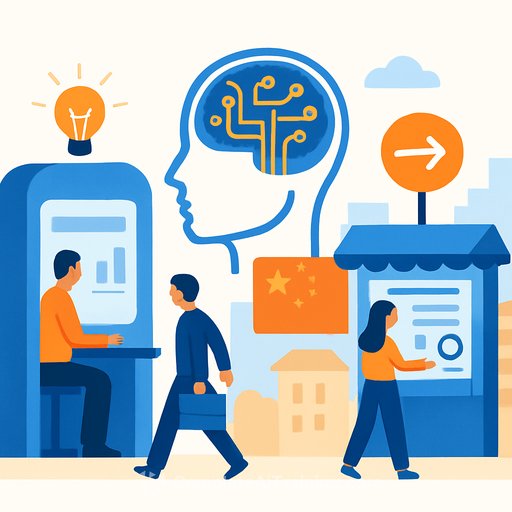
In Wuhan, a postgraduate stepped into an AI interview booth, answered on-screen questions, and walked out with instant feedback plus a shortlist of roles that matched her profile. She then booked an in-person interview with one of the suggested employers. That closed loop - practice, match, action - is becoming normal in China's hiring market.
For HR teams, this is a preview of a faster, more precise recruiting workflow. The lesson is simple: automate the grunt work, focus your people on decisions and relationships.
What's Happening on the Ground
At the Third National Conference on the Development of Human Resources Services in Wuhan, job seekers could scan a QR code, upload a resume, and get five targeted recommendations in under 30 seconds - with a short rationale for each match. One candidate left the booth with feedback to improve her delivery and a scheduled interview for the next week. The journey from interest to action took minutes, not days.
Efficiency Gains HR Leaders Care About
Guangdong Chitone Human Resource Chain Co., Ltd. showcased a resume screening tool that processes a profile in three to four seconds. The company reports at least an 80 percent boost to recruitment efficiency. The message from their CTO, Wang Wei: the aim is to upgrade each link in the HR process, not to replace recruiters.
For in-house teams, that looks like higher throughput, more consistent screening, and more time spent on candidate conversations and hiring manager alignment.
Beyond Campuses: Community-Level Job Matching
Jiangsu Leader Human Resources Group is deploying "employment-at-your-doorstep" service stations in Nanjing. Residents can browse local roles, learn policies, and send resumes from their phones. Interest is strong; more than 200 enterprises and HR departments made inquiries in half a day at the conference.
This model closes distance for frontline talent and helps local employers surface candidates who prefer nearby work.
Policy Context and Market Scale
China's upcoming 15th Five-Year Plan (2026-2030) highlights AI use across industry, culture, public services, and social governance, with a push to lead in AI application. In HR, officials report that AI is already embedded in real-time job matching, AI-led interviews, labor market monitoring, and personalized career guidance.
From 2021 to 2025, HR service providers delivered more than 300 million employment services each year and supported over 50 million companies with hiring. Online platforms publish hundreds of millions of postings annually, and AI matching has become a primary channel. Challenges persist: fragmented data standards, limited data sharing, and adoption hurdles for small and mid-sized employers. An "AI Plus HR Services" initiative is set to address these gaps.
What This Means for HR Teams
- Start with high-volume tasks: resume parsing, screening Q&A, job matching, candidate FAQs.
- Require explainable matches: show the "why" behind recommendations to aid recruiter trust and candidate transparency.
- Integrate with your ATS/HRIS so feedback, notes, and status updates flow in both directions.
- Pilot AI interview practice for candidates; keep it opt-in and share feedback instantly.
- Set fairness checks: audit for disparate impact across gender, age, education, and region on a regular schedule.
- Align on data standards: map your fields now to reduce cleanup later and enable cross-platform sharing.
- Define governance: usage policies, human-in-the-loop review points, and incident handling.
- Measure what matters: time-to-shortlist, interview-to-offer rate, recruiter workload, candidate satisfaction.
- Support SMEs: offer simplified workflows, prebuilt templates, and clear ROI calculators.
KPIs to Track
- Time-to-fill and time-to-first-interview
- Cost-per-hire and recruiter requisition load
- Quality-of-hire proxies (e.g., 90-day retention, manager satisfaction)
- Candidate NPS and feedback on fairness
- Data standard conformance rate and data-sharing uptime
- Model performance drift and false positive/negative rates
Tooling Notes
Look for resume parsing accuracy, clear match rationales, multilingual support, strong APIs, and enterprise security. Ask vendors for validation data, bias testing methods, and audit logs. For risk controls, frameworks like the NIST AI Risk Management Framework can help teams set practical guardrails.
NIST AI Risk Management Framework
Upskilling Your HR Team
New workflows require new skills: prompt writing for screening and outreach, interpreting AI explanations, and bias auditing. If your team needs a structured path, explore focused AI training mapped to roles.
AI courses by job role - Complete AI Training
A Practical Takeaway
The value is clear: faster matching, better feedback loops, and more informed decisions. As one candidate put it after reviewing her AI feedback, if the tech helps people know themselves and find the right fit sooner, that's progress. HR's move now is to build the guardrails, pick the right use cases, and scale what works.
Your membership also unlocks: