
AI news ·
AI speeds up cyber attacks on government, but also gives defenders new tools
AI-powered attacks can compromise government systems in under 30 minutes, down from weeks. Agencies are fighting back with AI-driven threat detection, but CISO confidence in data protection has dropped from 48% to 22% since 2022.
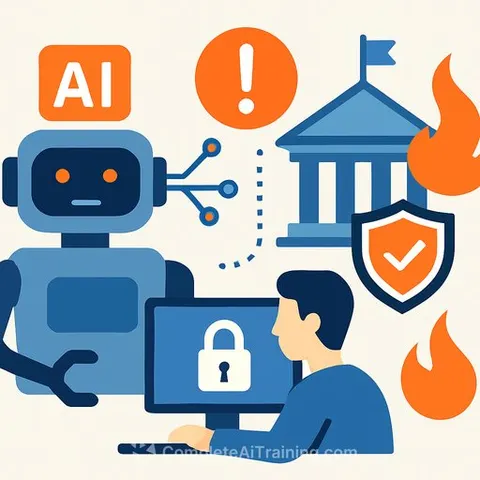
AI Is Accelerating Cyber Attacks on Government. Defenders Are Fighting Back With the Same Technology.
Cyber criminals are using artificial intelligence to find vulnerabilities and launch attacks in minutes instead of weeks. Government agencies are responding by deploying AI to detect threats in real time, but the acceleration has left many public-sector security leaders stretched thin.
The speed of exploitation has fundamentally changed. Missouri CISO Shawn Ivy, who has spent more than 30 years in public-sector cybersecurity, said his state received 22 billion perimeter requests in a recent month-the highest volume on record. "We're seeing the reports of how fast a vulnerability can be exploited, and it has gone from weeks, days, months - now we're down to minutes," Ivy said.
How Criminals Deploy AI
Cyber gangs are using AI agents to scan the internet for exposed services, unsupported software, and configuration weaknesses. They build dossiers on potential targets and automate the creation of convincing phishing emails and spoof websites at scale.
A report from Booz Allen Hamilton found that cyber criminals can move from initial system access to broader compromise in fewer than 30 minutes with AI assistance. Frontier AI models enable small groups to carry out campaigns that previously required larger, coordinated efforts.
The attack surface has grown beyond traditional perimeter threats. Hybrid work, cloud adoption, distributed devices, and unauthorized AI tools have created more entry points. New Jersey CISO Michael Geraghty described the scope: "Everything's connected to the Internet - your doorbell, your Alexa, your TV, so we've got an expanding attack surface that can be targeted by people anywhere in the world at any time of day or night."
The pressure is showing. A biennial report from the National Association of Chief Information Officers found that CISOs expressing "very" or "extremely" high confidence in their ability to protect data dropped from 48 percent in 2022 to 22 percent in 2026. Budget constraints, reduced federal support, and heavier workloads are cited as reasons.
AI Becomes a Defense Tool
Government agencies are using AI to monitor systems continuously rather than on fixed schedules. Kansas Chief IT Officer Jeff Maxon said his state moved to real-time scanning of devices: "If we just focused on once-a-month scanning, we would be exposed to a lot more vulnerabilities."
Missouri's cybersecurity office ingests roughly 3.5 terabytes of security logs daily across 17 agencies. Humans cannot manually review this volume. Ivy said the difference is clear: "Humans see events, but AI sees patterns in real time."
The Cloud Security Alliance recommends agencies combine traditional security with AI-enhanced tools. This includes using large language models for vulnerability discovery and adopting coding agents to accelerate security operations.
Fundamentals Still Matter Most
AI has not changed the basics of cybersecurity defense. Patch management, identity and access controls, network segmentation, and strong password practices remain essential. What has changed is the urgency.
Compromised credentials remain one of the primary attack vectors, just as they did decades ago. Phishing emails trick employees into sharing login information. The solution-training staff to spot and report suspicious emails-dates back to 1987.
Geraghty said the reality is simple: "Everything old is new again." Patching systems, enforcing multifactor authentication, locking down cloud configurations, and maintaining strong cyber hygiene are not new concepts. But AI has compressed the window between when a vulnerability exists and when it gets exploited, making these practices more urgent than ever.
For government technology professionals managing these risks, understanding both the threat and the defensive capabilities of AI is now essential. AI Learning Path for Cybersecurity Analysts covers threat detection and security analytics relevant to defending against AI-accelerated attacks. AI for Government resources address how public-sector organizations are applying these tools to their operations.