
AI news ·
AI stands to fix insurance underwriting's decades-old paperwork backlog, investor says
Insurance underwriters review only 40% of submitted files-the rest expire unread. AI tools now process the backlog, letting insurers price risk they previously ignored.
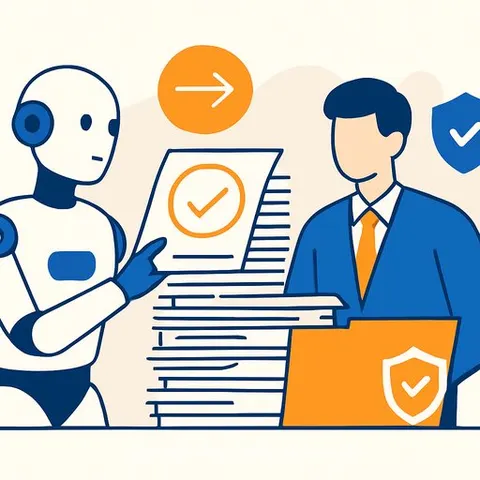
Insurance Underwriting's Unread Pile and the AI Fix Coming
The modern insurance industry was born in Edward Lloyd's coffeehouse on Tower Street in London in the late 1680s. Sailors, merchants, and ship owners gathered to price risk on cargo and vessels. Three hundred and forty years later, the work remains fundamentally the same. The coffee improved. The paperwork got worse.
Jonathan Crystal, who runs Crystal Venture Partners and spent two decades in insurance brokerage, recently identified a specific problem that explains why the industry has struggled to modernize: the average underwriter only reviews about 40% of the submissions that land on their desk. The other 60% sits in a queue, eventually expiring or getting declined by default.
The industry digitized its processes without solving its actual bottleneck. Paper became PDFs. Faxes became email attachments. Filing cabinets became servers. The assembly line simply moved inside a computer.
Where AI Reads What Humans Can't Reach
This is where artificial intelligence enters the picture. AI can process large volumes of documents quickly. Hand it a thousand-page litigation file or two decades of medical history, and it extracts the relevant details in minutes. It finds the signal inside the noise-the detail an underwriter would flag on page 847 if they ever got there.
Crystal calls what comes next "right pricing," not faster pricing. The risk has always been in the files. Most of it simply wasn't being priced correctly because nobody had time to read it.
He envisions a more aggressive shift: continuous pricing that updates every time new information arrives. A customer adds a warehouse. Their rate adjusts. Wildfire data updates for a region. Their rate adjusts. The pricing model runs constantly.
Insurance That Explains Itself
This reorganizes how customers relate to their insurers. Instead of a letter drafted by committee in 1978, customers could ask in plain English: "Why is my coverage priced this way?" and "What could I do to pay less?" and receive an answer that makes sense immediately.
Crystal doesn't oversell the technology's reach. Certain risks live in thin data, anecdotal history, and genuine uncertainty. Earthquakes in regions without seismic history. Novel cyberattacks. New drug classes. The rare and unprecedented events still require human judgment.
The coffeehouse stays open. It just gets an AI assistant.
The Portfolio Behind the Thesis
Crystal Venture Partners' investments trace this logic. Sixfold AI helps commercial underwriters process their submission queues. With Coverage operates a brokerage platform. Roe works on the customer-facing side of insurance. Charter Space addresses financial infrastructure in emerging industries like space.
When customers complain about insurance, they rarely start with price. They cite slowness, poor service, and lack of explanation. Three hundred and forty years of practice, and the industry still struggles with clarity and speed.
That gap-more than any actuarial model-is what AI has a real shot at closing.
The Leapfrog Effect
Countries that never built landline networks jumped straight to mobile phones. Nations without branch banking moved directly to digital payments. They didn't have to dismantle legacy systems first.
Insurance may follow the same pattern. The industry that failed to fully digitize might skip ahead to intelligence instead. The companies that lagged on email might end up ahead on AI.
An industry born pricing catastrophe-fires, shipwrecks, plagues-spent two decades struggling with its own paperwork. Now, just as it was finally getting organized, something larger arrived. And the companies behind on email might end up ahead on intelligence.
Learn more about AI for Insurance and how AI Agents & Automation are reshaping underwriting workflows.