
AI news ·
AI systems struggle with Korean communication beyond grammar as hierarchy and social context shape meaning
AI systems produce grammatically correct Korean that often sounds tone-deaf or socially inappropriate in workplace settings. Hierarchy, indirectness, and relational context shape meaning in ways current models consistently miss.
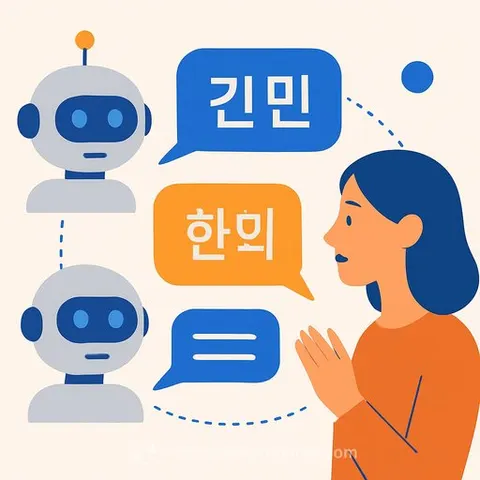
Korean Workplace Communication Is Exposing a Gap in AI Systems
AI translation quality has improved dramatically. Google processes around one trillion translated words monthly across its translation products. Models like OpenAI's GPT-5 and Naver's HyperCLOVA X now handle Korean with impressive grammatical accuracy.
Yet inside Korean workplaces, a different problem is becoming visible: AI produces technically correct Korean that sounds socially inappropriate, emotionally distant, or contextually wrong in ways that damage real relationships.
The issue goes beyond vocabulary or sentence structure. Researchers increasingly identify Korean communication as difficult for AI because meaning is shaped by hierarchy, indirectness, emotional calibration, and relationship dynamics rather than explicit wording alone.
Why Grammatically Correct Korean Still Fails Socially
Jinseong Kim, founder of communication platform Noonchi.ai, has studied how hierarchy and tone shape real outcomes inside Korean professional environments. She identifies a pattern she calls "Textbook Syndrome."
"ChatGPT will give you perfect 존댓말," Kim said, referring to the formal speech style used in Korean professional settings. "And it'll sound like you're reading from a customer service script to your coworker."
In Korean workplaces, speaking too formally creates distance. Speaking too casually appears disrespectful. AI systems optimizing for grammatical correctness often miss this balance entirely.
A 2024 study presented at LREC-COLING introduced "politeness" as a critical error category in English-Korean machine translation. Korean honorific systems encode hierarchy and social status directly into language usage. Another 2024 study published in Cognition found that violations involving Korean honorific hierarchy reduced perceived naturalness for native speakers, suggesting hierarchy is deeply integrated into Korean linguistic structure itself.
Indirect Communication Creates a Major AI Weakness
In Korean conversation, the literal meaning of a sentence often differs from its practical social meaning. This creates difficulty for AI systems trained primarily on surface-level interpretation.
When a Korean speaker says "그건 좀 어려울 것 같은데요…," the literal translation is "it might be difficult." The actual meaning is no.
Human speakers interpret this naturally through context, tone, hierarchy, and situational awareness. AI systems process the sentence literally.
A recent study evaluating large language models on Korean indirect speech acts found that AI systems consistently struggled more with indirect communication than direct communication. The research evaluated GPT-4o, Claude, HyperCLOVA, and Llama variants across Korean dialogue scenarios involving hierarchy, intimacy, and situational relationships.
The results highlighted an important issue for enterprise AI systems operating in Korean environments: understanding the sentence itself may not be enough to understand the communicative intention behind it.
The Real-World Operational Risk
A user asked how to refuse a task outside their responsibilities in a Korean workplace. Standard AI systems often generate: "그건 제 업무가 아닙니다." ("That is not my job.")
The Korean is grammatically correct. Socially, the response may sound confrontational or relationship-damaging inside many Korean workplace environments.
Noonchi.ai instead attempts to redirect more indirectly: "팀장님, 지금 진행 중인 건이 있어서요… 내일까지 해도 괜찮을까요?" ("Team leader, I'm currently handling another task… would tomorrow be okay?")
"The request isn't rejected," Kim explained. "You're acknowledging, showing respect, and negotiating timing."
The linguistic distinction may appear subtle. Operationally, it can significantly affect workplace trust, hierarchy management, and long-term collaboration.
Why Relationship Modeling Matters More Than Translation
Kim explained that Noonchi.ai moved away from rigid speech-level switching systems after discovering that Korean communication operates more like continuous relational calibration.
"We initially thought we could map Korean communication to a clean set of discrete levels," she said. "Turns out real life doesn't work like that."
The company instead built what it calls "relational parameters," where outputs change depending on age difference, familiarity, hierarchy, workplace setting, and emotional closeness.
A Seoul National University-linked study on context-aware Korean honorific translation found that speaker relationships and surrounding conversational context significantly improved translation quality compared to sentence-level generation alone. This suggests future Korean AI systems may require relationship-aware generation rather than standalone sentence translation.
The challenge extends beyond language learning applications. Enterprise AI copilots, workplace assistants, customer-service bots, HR automation systems, and cross-border collaboration tools may all face similar limitations if models cannot correctly interpret social hierarchy and contextual intent.
Korean as an AI Stress Test
As AI companies race to expand multilingual communication capability, Korean is increasingly emerging as a difficult benchmark for contextual intelligence.
The challenge is not simply producing fluent Korean sentences. It is understanding how hierarchy, indirect meaning, emotional nuance, and relational expectations shape the function of those sentences inside real social environments.
For PR and communications professionals, this matters directly. If AI systems mishandle Korean communication in workplace settings, they create relationship damage that extends far beyond translation errors. AI for PR & Communications professionals should understand these limitations when deploying conversational AI in multilingual environments.
Organizations using AI for internal communications, customer-facing messaging, or cross-border collaboration need to account for these gaps. A grammatically correct message that sounds tone-deaf or socially inappropriate can undermine trust and credibility.
"Speaking too formally to someone you're supposed to be comfortable with is just as strange as being too casual with your boss," Kim said. That complexity may ultimately explain why Korean communication is becoming a harder problem for AI than translation benchmarks alone suggest.